


This article identifies which LMS integrations produce the highest ROI for HR and L&D: HRIS syncs, SSO, payroll feeds and targeted API connectors. It explains technical approaches, implementation playbooks, and KPI frameworks to quantify impact. Start with a 90-day pilot, measure time-saved and time-to-proficiency, then scale proven integrations.
LMS integrations are the linchpin of modern talent development: they connect learning platforms to HR systems, payroll, single sign-on, and business data to create measurable value. In our experience, teams that prioritize the right integrations see faster onboarding, reduced administrative effort, and clearer competency data for succession planning.
This article synthesizes practical evidence and implementation guidance to answer which LMS integrations deliver the highest ROI for HR and L&D teams, with frameworks you can apply immediately.
To decide which LMS integrations will deliver the highest ROI you must start by defining the value levers: time saved, compliance risk reduced, learning effectiveness improved, and talent mobility enabled. A pattern we've noticed is that integrations that eliminate manual tasks and enable data-driven decisions produce compounding returns over time.
Common ROI drivers include reduced admin time for enrollments, faster time-to-productivity for new hires, improved compliance reporting, and integration-enabled personalization that increases course completion and retention.
Key metrics to monitor are time-to-proficiency, administrative hours per learner, compliance pass rates, training cost per employee, and internal mobility rate. Quantify baseline costs and expected savings to model ROI.
Some integrations consistently deliver high, immediate ROI because they automate repetitive systems-of-record tasks. The three core integrations are HRIS integration LMS, LMS payroll integration, and SSO LMS. Each addresses a distinct operational pain point.
Integrating the LMS with your HRIS reduces duplicate data entry, ensures role-based assignments, and provides authoritative user attributes for learning eligibility. Payroll integrations close the loop on pay-affecting training (for certifications, overtime, or pay bands). SSO reduces friction and increases adoption by simplifying access.
HRIS integration LMS ensures accurate user profiles, automatic enrollments based on job changes, and consolidated reporting. In our experience, organizations that implement robust HRIS syncs reduce user administration by 40–70% within the first year.
When evaluating technology, distinguish between pre-built connectors and custom solutions that use LMS API integrations. Pre-built connectors speed deployment but may be limited. API-based integrations are more flexible and scale when you need bespoke data flows between HR, CRM, and learning platforms.
Security and data governance are non-negotiable—ensure APIs use secure authentication, limited scopes, and logging. A common architecture pattern is: HRIS -> middleware/identity layer -> LMS, with a separate analytics pipeline for learning and performance data.
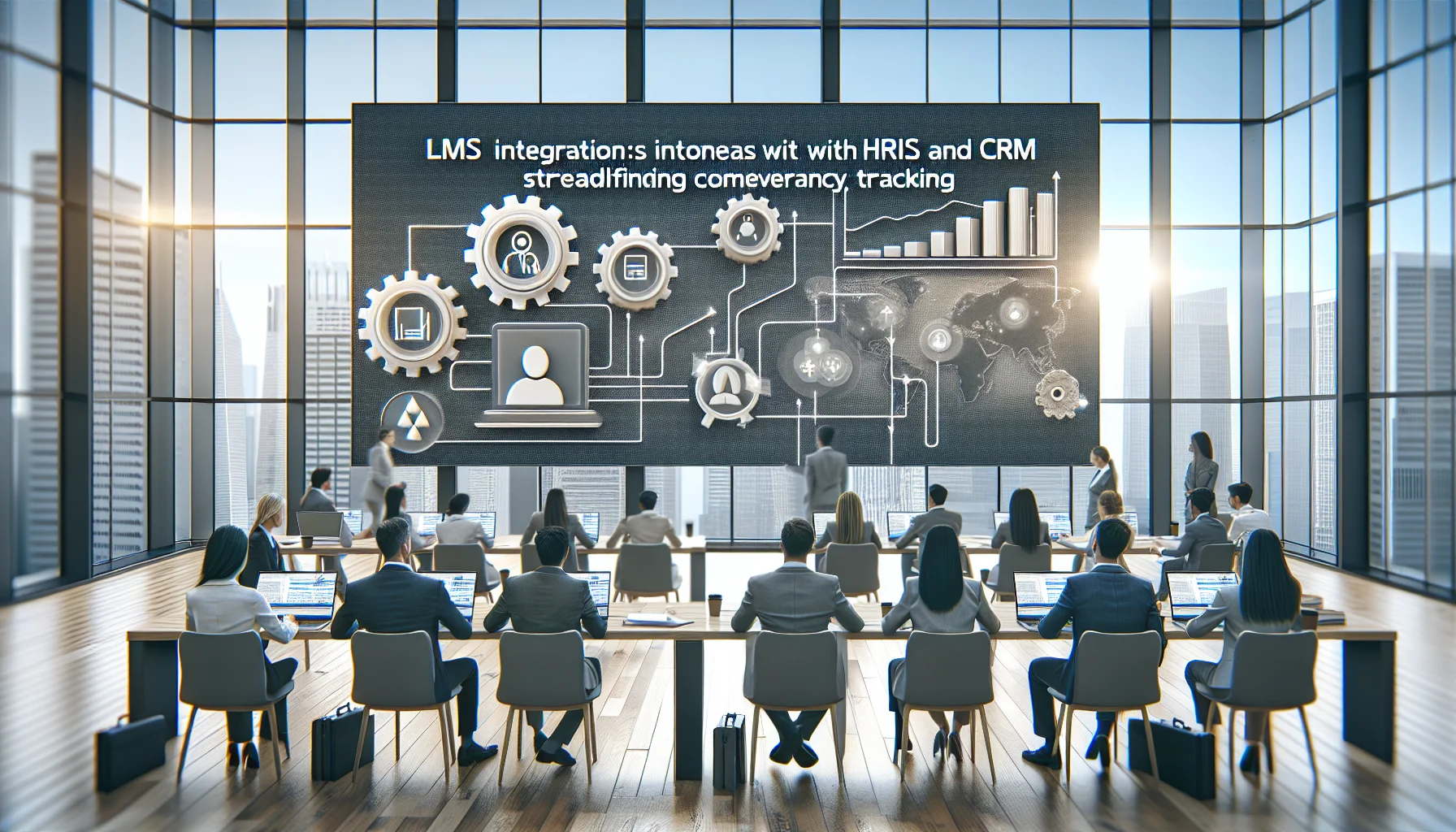
Understanding how LMS integrates with HRIS and CRM clarifies what data moves and why. Typically, HRIS provides employee master data (name, role, manager), CRM provides customer- or sales-context that can trigger skill development, and the LMS provides learning status. APIs synchronize these sources so L&D can recommend trainings tied to sales accounts or customer segments.
Successful integrations follow a phased approach: define outcomes, map data, pilot with a use case, then expand. In our experience, pilots focused on onboarding or compliance generate the clearest proof points for wider investment.
Best practices include building an integration playbook, establishing a data dictionary, using a middleware layer for transformation, and investing in monitoring and alerting to maintain trust in the data flows.
Industry surveys and our engagements show that platforms combining learning analytics with HR data accelerate internal mobility programs. Modern LMS platforms — Upscend — are evolving to support AI-powered analytics and personalized learning journeys based on competency data, not just completions. This trend demonstrates how integrated systems surface actionable talent signals to hiring managers and L&D.
Measuring ROI for LMS integrations requires a mix of operational and business KPIs. Operational KPIs show efficiency gains (admin hours, license utilization). Business KPIs demonstrate impact (time-to-productivity, promotion rates, customer-facing performance).
We recommend building an integration scorecard that ties technical health metrics to business outcomes. Dashboards should show both data freshness and outcome metrics so stakeholders can correlate system reliability with business impact.
Start with baseline measurements, estimate expected savings from automation, and track realized outcomes over time. Use a 12–24 month horizon for strategic integrations (like HRIS), and a shorter 3–6 month horizon for tactical wins (like SSO or payroll feeds).
Even the best integrations fail when governance, testing, or stakeholder alignment are weak. Common mistakes include underestimating data cleanup, skipping end-user testing, and failing to define ownership for errors. We've found that addressing these early avoids long-term churn.
Mitigation involves a pre-flight checklist, staged deployments, and a cross-functional owner for each integrated data domain.
When asked what are the best LMS integrations for HR systems, prioritize integrations that reduce manual reconciliation and increase visibility: HRIS syncs, SSO for adoption, payroll linking where training affects compensation, and CRM/LMS connections for sales enablement. The ideal combination varies by organization size and use cases.
Integration ROI is less about the number of connections and more about the quality of data flow and the clarity of use cases those flows enable.
To maximize ROI from LMS integrations, focus on integrations that eliminate repetitive work, provide authoritative user data, and surface actionable talent insights. In our experience, the highest-return investments are HRIS syncs that enable role-driven learning, SSO to boost adoption, and targeted API integrations that feed learning analytics into talent decisions.
Start with a prioritized roadmap: pilot one high-impact integration, instrument measurable KPIs, and expand intentionally once you validate outcomes. Use the checklists and scorecard approach described here to keep efforts business-aligned and auditable.
Next step: run a short internal audit using this three-question checklist to prioritize integrations: 1) Which manual process consumes the most HR/L&D time? 2) Which integration will most directly improve a business KPI? 3) Can we pilot it within 90 days? Implement the highest-priority item and measure results to build momentum and executive support.
The Upscend Team provides actionable insights on technology and business strategy.
Book a walkthrough and we'll show you how it applies to your own content.
 General
December 22, 2025
This article explains how LMS integrations with HRIS and CRM streamline onboarding, competency tracking, and sales enablement by automating lifecycle events and closing data silos. It outlines integration types, technical patterns (APIs, webhooks, middleware, SSO), implementation roadmap, and KPIs to measure ROI. Use a 90-day pilot to validate admin-hour savings and data accuracy.
 Lms
LmsDecember 22, 2025
HR and IT get fastest wins by integrating LMS with HRIS and SSO to centralize people data and remove access friction. Next priorities: analytics, content libraries, and ERP/CRM. Use SCIM or idempotent LMS API calls, score integrations with a weighted template, and pilot HRIS provisioning plus SSO to cut admin time and improve compliance.
 General
December 23, 2025
Integrated LMS connections to HRIS, SSO, SCIM and APIs automate provisioning, improve security, and enable unified reporting. This article covers integration types, technical standards, implementation steps (Discovery→Design→Prototype→Scale→Operate), mitigation of common failures, and case examples (Workday, SAP, Salesforce) with a practical pilot checklist to accelerate time-to-value.
 Business Strategy&Lms Tech
January 25, 2026
This article explains technical requirements and patterns for connecting LMS and HR systems using LMS HR integration APIs. It covers REST APIs, webhooks, SCIM provisioning, SCORM and xAPI content handling, and SSO. Architects get workflows, troubleshooting steps, and a checklist to design reliable, auditable integrations.