

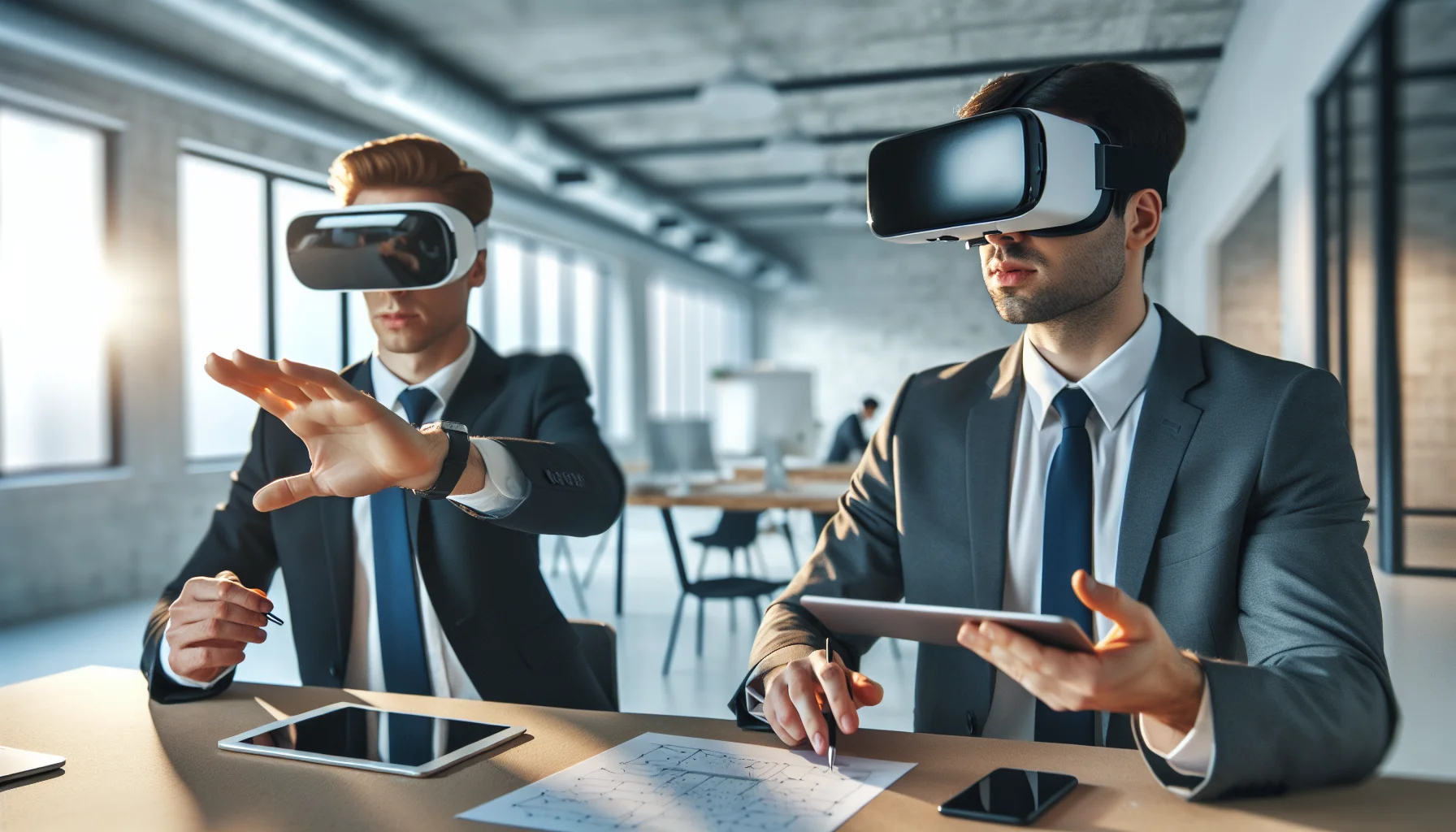
This article compares AR vs VR training for hands-on learning with digital twins, highlighting when each modality outperforms the other. AR preserves tactile fidelity for tool-use and on-the-job guidance; VR enables safe rehearsal of hazardous or rare events. It recommends hybrid pilots, measurable KPIs, and iterative content based on objective outcomes.
AR vs VR training is a common decision point for organizations scaling technical skill development with digital twins. In our experience, teams choose based on how closely the training must mirror real equipment, the risk profile of tasks, and the need for measurable skill transfer. This article compares the two approaches across hands-on learning, tool use training, environmental constraints, user fatigue, onboarding time, and measurable outcomes.
We’ll provide practical recommendations, implementation steps, common pitfalls, and a compact decision flowchart so practitioners can choose the right modality for specific use cases.
Augmented reality training overlays instructions on live equipment, supporting in-situ coaching and instant context awareness. Virtual reality training recreates entire environments so trainees can rehearse sequences, failures, and rare events without physical risk. Both use digital twins, but their hands-on effectiveness diverges based on fidelity needs.
For hands-on learning, the critical variables are sensory alignment, haptic realism, and task continuity. AR preserves proprioceptive cues because the trainee handles real tools and components; that boosts real-world transfer. VR can simulate complex sequences repeatedly, including emergent behaviors that would be dangerous or impractical with physical assets.
We’ve found that a hybrid approach often performs best: AR for day-to-day tool use training and immediate procedural guidance; VR for systems-level rehearsals and emergency response drills. Below we break these trade-offs into actionable criteria.
Sensory fidelity—visual alignment, tactile feedback, and spatial audio—drives how training transfers to the workplace. AR keeps tactile feedback intact because the trainee manipulates real objects, which makes motor learning more durable. VR requires simulated haptics or instrumented controllers; when haptics are insufficient, gains are often procedural rather than motor.
AR excels for incremental skill refinement, on-the-job assist, and situations where tool mass, torque, and feel matter. VR excels where scene control, repeatability, and exposure to rare events or hazards are priorities. Use the modality that aligns the training objective with the sensory component most important to performance.
This section answers the question: when to use AR instead of VR for technical training and provides criteria you can apply immediately. Use AR when the goal is to accelerate real-world transfer of manual skills, reduce errors in live maintenance, or provide stepwise guidance during complex assembly.
Key indicators for choosing AR include equipment accessibility, need for tactile accuracy, and regulatory requirements that mandate work on certified hardware. If trainees must feel torque, align components precisely, or manage cable routing, AR preserves those sensations.
Conversely, if tasks are hazardous, need scenario variability, or require full isolation from real environments, choose VR. Below are practical rules you can use during procurement and program design.
Short answer: not entirely. AR accelerates apprenticeship by scaffolding learning and reducing error rates, but it complements—not replaces—mentor-led tactile coaching for nuanced manual trades. The best programs layer AR overlays onto supervised practice to shorten the time to competency.
Onboarding time for AR tends to be shorter because trainees already operate in the real workspace. Content creation can be lengthy if you need precise spatial anchors, but pilot deployments typically show measurable improvements within weeks rather than months.
Tool use training demands high motor fidelity, repeatable practice, and immediate corrective feedback. AR overlays deliver step-by-step cues right on the tool or workpiece, allowing trainees to learn while performing authentic actions. This makes AR especially effective for torque-sensitive procedures, connector seating, and sequence-critical assembly.
VR can model tool dynamics and force profiles but often depends on sophisticated haptics to reach parity with physical tooling. Where haptic fidelity lags, VR still teaches decision-making and sequencing but not the exact muscle memory needed for precise tool manipulation.
We’ve implemented both modalities in machine maintenance pilots and noticed that AR produced faster error reduction for repetitive tool tasks, while VR led to superior preparedness for multi-step system failures.
Measure transfer with objective metrics: time-to-complete, error rate, rework frequency, and post-training field performance under observation. Use instrumented tools or checklists to capture before/after baselines and to evaluate retention at 30 and 90 days.
For high-risk or rare-event training, virtual reality training provides unrivaled value because it can safely recreate disasters, equipment failures, and complex systems interactions without exposing people or assets to danger. VR also supports branching scenarios that test decision-making under stress, which is difficult to simulate with real hardware.
Key advantages include scenario control, repeatability, and the ability to instrument every variable for assessment. VR lets trainers escalate difficulty, introduce simultaneous failures, and observe team coordination in ways AR cannot match because AR requires a real environment.
That said, VR's hands-on effectiveness for fine motor tasks depends on haptic systems and controller fidelity. For many emergency procedures where physical manipulation is coarse (e.g., evacuation, valve isolation, routing valves), VR provides adequate hands-on rehearsal.
Realism is less about photorealism and more about fidelity in the decision-critical cues. Audio spatialization, latency under 20 ms, plausible system behavior, and clear cause-effect relationships matter most for transfer of judgment and team coordination.
Measuring effectiveness and managing user fatigue are central to choosing between AR and VR. Both modalities require a clear assessment plan: pre/post testing, retention checks, and field-proven KPIs tied to operational outcomes. In our deployments, we use a mixed-measure approach combining objective metrics and subjective workload surveys.
Practical methods include time-on-task, error taxonomy, physiological load (where feasible), and satisfaction scales. Real-time analytics from sessions enable rapid content iteration and individualized remediation paths (available in platforms like Upscend) that help identify disengagement early.
User fatigue patterns differ: VR often causes higher disorientation and simulator sickness in longer sessions, while AR can cause neck strain and cognitive overload from persistent overlays. Design sessions with micro-learning, scheduled breaks, and progressive complexity to reduce fatigue and maximize retention.
Metrics that correlate with transfer include reduction in on-job errors, time to independent performance, and retention scores at 30–90 days. Combine these with qualitative supervisor assessments to capture subtle skill readiness indicators.
If you’re deciding between AR and VR, a decision flowchart reduces ambiguity. Start by clarifying learning objectives, asset availability, risk tolerance, measurement needs, and budget. This structured approach turns subjective debates into actionable procurement criteria.
Below is a compact decision flowchart in list form and an implementation checklist to help teams scope pilots quickly.
Implementation checklist:
Run the pilot that reduces the greatest operational risk. If field errors are causing downtime, prioritize AR pilots for task-specific remediation. If safety incidents stem from poor emergency coordination, prioritize a VR scenario pilot.
Choosing between AR vs VR training depends on the training objective: maximize tactile fidelity and immediate transfer with AR, or maximize scenario breadth and safety with VR. Use hybrid designs when both motor skill and system-level judgment matter. We've found that pairing AR overlays for routine tool use with VR rehearsals for rare or hazardous events delivers the strongest overall outcomes.
Next steps for teams: run focused pilots, instrument outcomes, and iterate content based on objective KPIs. Prioritize quick wins—improving an error-prone procedure with AR or reducing team response time with a VR drill—then scale the modality that demonstrates measurable impact.
Call to action: Start with a 4-week pilot that maps tasks to sensory fidelity, captures baseline KPIs, and compares AR and VR outcomes side-by-side; use those results to build a 12-month blended training roadmap tied to operational metrics.
The Upscend Team provides actionable insights on technology and business strategy.
Book a walkthrough and we'll show you how it applies to your own content.
 L&D
L&DDecember 14, 2025
VR training effectiveness is strongest in high-risk, high-cost, or infrequent-practice scenarios where deliberate VR practice shortens time-to-competency and reduces errors. Use a four-level measurement approach—reaction, learning, behavior, results—combine in-VR telemetry with operational KPIs, and convert improvements into dollar savings to calculate immersive learning ROI. Run a 60–90 day pilot with clear KPIs.
 The Agentic Ai & Technical Frontier
January 4, 2026
This article explains minimum specs for VR training hardware on a budget, comparing standalone VR headsets and tethered PC VR requirements. It outlines component priorities, cost bands, lifecycle expectations, procurement tips, a decision flow for matching fidelity to objectives, and a low-cost pilot checklist to validate assumptions before scaling.
 Business Strategy&Lms Tech
January 25, 2026
This article compares VR vs in-person roleplay for high-stakes layoffs across realism, emotional safety, facilitator control, scalability, and TCO. It recommends paired pilots (VR and in-person), a decision matrix, and facilitator training. Use VR for repeatable, data-driven baseline practice and in-person for legally sensitive, high-emotion calibrations; hybrid programs often perform best.
Business Strategy&Lms TechJanuary 27, 2026
This article compares AR vs VR learning for corporate training, outlining core differences, a criteria matrix, six real-world scenarios, and a decision flowchart. It explains when to choose AR, VR, or a hybrid, lists common pain points with mitigations, and provides a roadmap plus analytics checklist to pilot and scale immersive learning.