

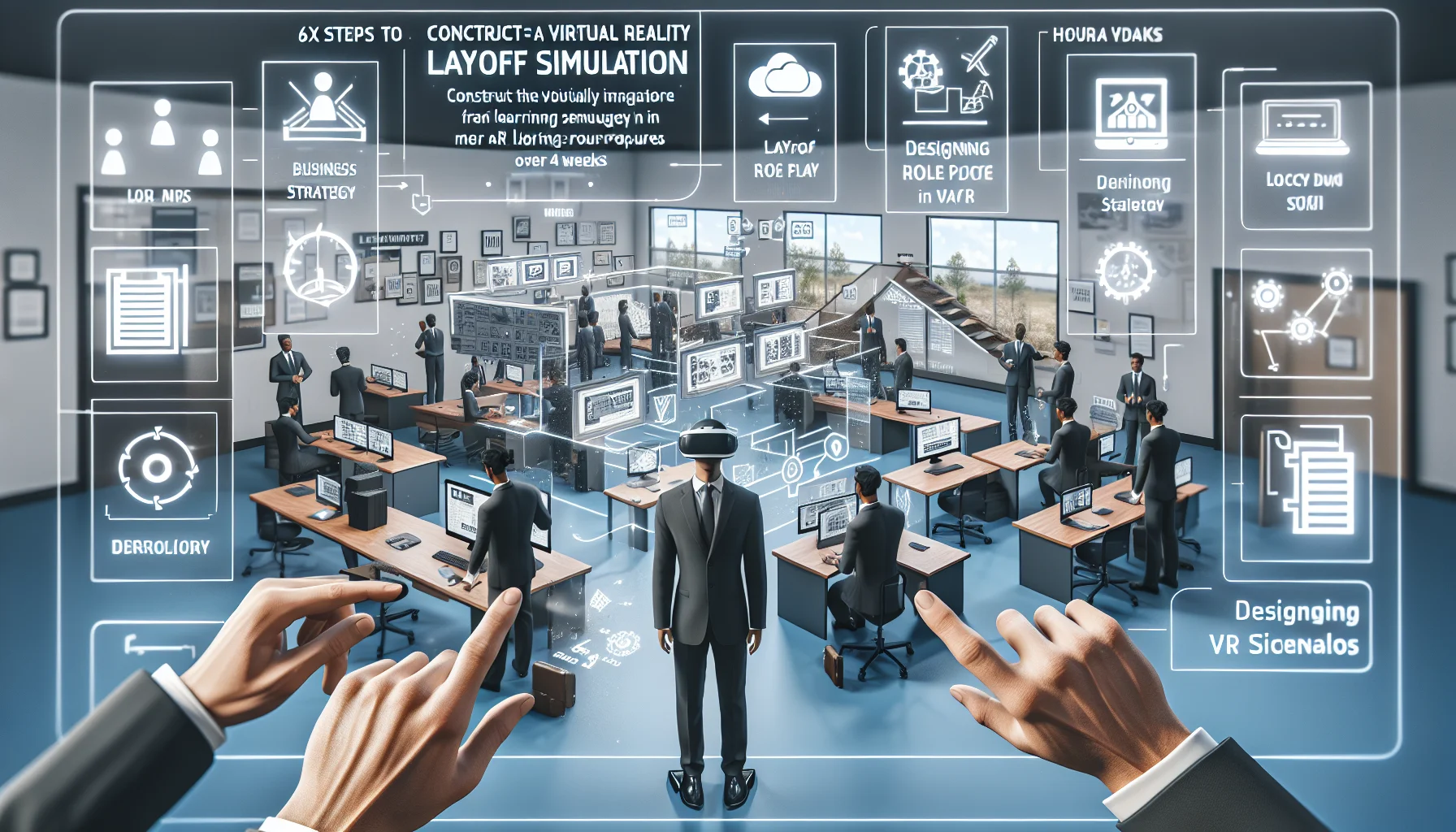
This article compares VR vs in-person roleplay for high-stakes layoffs across realism, emotional safety, facilitator control, scalability, and TCO. It recommends paired pilots (VR and in-person), a decision matrix, and facilitator training. Use VR for repeatable, data-driven baseline practice and in-person for legally sensitive, high-emotion calibrations; hybrid programs often perform best.
VR vs in-person roleplay is increasingly the central question for HR teams preparing managers for high-stakes layoffs. In our experience, the choice isn't binary: each modality has distinct strengths across realism, emotional safety, facilitator control, scalability, and assessment fidelity. This article compares the two, gives concrete scenarios and mini case examples, and presents a decision matrix and pilot checklist so HR leaders can choose wisely.
When debating VR vs in-person roleplay, realism is often the first consideration. In-person simulations deliver human-to-human cues: microexpressions, unpredictable questions, and real-time emotional escalation. That level of unpredictability builds a different kind of muscle memory.
By contrast, VR can reproduce environmental fidelity—office layout, interruptions, or simulated witness reactions—and can scale standardized scenarios where every participant faces the same stimuli. Studies show that consistent exposure improves measurable behavioral change when paired with targeted feedback.
Assessment fidelity ties directly to how "real" the experience feels. In our experience, when learners believe the scenario is authentic, they engage deeper and demonstrate stronger retention. That said, high perceived realism in VR depends on quality of avatars, voice synthesis, and scenario scripting; low-fidelity VR can perform worse than a well-run in-person exercise.
Additional nuances: VR excels when you need repeatable exposure to rare but high-risk interactions — for example, a manager practicing responses to an aggressively defensive employee or a simultaneous witness in the room. Virtual roleplay benefits include the ability to run dozens of near-identical scenarios to test specific phrasing, while in-person simulation pros cons often hinge on the variability of role players and scheduling constraints. For many organizations the optimal approach blends both: use VR to build baseline competence and in-person to tune emotional intelligence skills.
High-stakes layoff roleplay carries psychological risk. The choice between VR vs in-person roleplay should account for emotional safety and equitable access. In-person simulations can be intense and may re-trigger participants with lived experiences of job loss; facilitators need clinical-level sensitivity training.
VR offers emotional safety advantages because designers can modulate intensity, pause or rewind interactions, and introduce debrief overlays. That control can protect participants while still exposing them to difficult exchanges. However, VR can also create dissociation that prevents meaningful emotional processing if used without skilled facilitation.
Short answer: sometimes. VR reduces physical proximity and immediate embarrassment; this helps some learners open up. But emotional safety depends more on scenario design and post-simulation debrief than the medium itself. Ensuring access to hardware and quiet spaces is essential to avoid disadvantaging rural or lower-income employees—equity issues that training budgets must address.
Practical safety tips: always include a pre-brief that clarifies learning goals and triggers, provide optional opt-outs, and ensure a trained facilitator or counselor is available during or immediately after sessions. Accessibility considerations include captioning for audio, comfortable headset fits, and alternative delivery for neurodivergent participants. These steps reduce psychological risk irrespective of whether you're doing vr vs in person for layoffs or standard development work.
Facilitators trade control for scale when choosing between VR vs in-person roleplay. A skilled in-person facilitator can pivot instantly, escalate scenarios ad hoc, or interrupt to coach in real time. That flexibility is invaluable for nuanced conversations about layoffs and legal risk mitigation.
Conversely, VR systems enable automated metrics: speech sentiment analytics, pause frequency, phrasing patterns, and timing. These analytics enhance objective assessment fidelity and can be aggregated for program-level quality assurance. Tools like Upscend help by making analytics and personalization part of the core process—removing friction between measurement and action and enabling leaders to see which scripts and coaching tactics actually reduce downstream grievances.
Objective metrics plus human judgment consistently outperform subjective scoring alone for behavioral training.
Assessment fidelity in VR is quantifiable: exact timestamps, repeated-play comparisons, and standardized prompts. In-person scores often rely on rater reliability and observation notes, which introduces variability. Our approach combines both: use VR to gather baseline data and in-person sessions for high-stakes calibration and qualitative review.
Examples of useful analytics include average time to deliver key messages, number of empathetic statements used, and frequency of jargon or legal-risk phrases. These metrics make clear where managers need micro-coaching. In a layoff training comparison, hybrid programs that combine analytics from virtual roleplay benefits with human-led reflections tend to show stronger application back on the job.
Cost comparisons between VR vs in-person roleplay must look beyond license fees. Total cost of ownership (TCO) includes hardware, content production, facilitator training, space, travel, participant time, and program maintenance. Return on investment (ROI) should be measured by reduced legal exposure, faster manager readiness, and lower separation-related fallout.
| Cost Element | In-Person | VR |
|---|---|---|
| Upfront | Facilitator hires, space, travel | Headsets, platform fees, content build |
| Per-event | Venue, facilitator time, extras | Licensing, support, headset logistics |
| Scaling | Linear or supra-linear costs | Marginal cost decreases with users |
| Measurement | Manual observation | Automated analytics |
Example TCO scenario: for a geographically distributed 5,000-employee company, an initial investment in VR headsets and scenarios amortized over three years often undercuts repeated travel and multi-city facilitator deployments. But for a single headquarters with frequent, small-scale layoffs, in-person may be cheaper and more effective.
To evaluate ROI, estimate avoidable costs such as average separation-related HR hours, legal case likelihood, and post-separation support needs. A simple break-even analysis often shows VR becomes more economical once you exceed a threshold of repeat events or dispersed participants. For many organizations, the cost decision is tied to strategic priorities rather than pure arithmetic.
Below is a practical matrix oriented to common HR scenarios. Use it to match objectives to modality.
Case 1: A fintech scale-up used VR for standardized layoff scripts across 12 offices. The result: consistent messaging and a 35% drop in post-separation questions to HR, attributed to clearer manager phrasing captured in VR analytics.
Case 2: A healthcare provider ran in-person simulations for leadership facing unionized layoffs. The deeper, live negotiation practice surfaced legal nuances that the VR scenarios had not captured—avoiding a potential grievance.
Case 3: A global consumer brand blended approaches: VR for every manager to practice the initial notification and common questions, followed by small-group in-person calibration for directors handling complex transitions. The hybrid rollout reduced time-to-competency by accelerating baseline readiness and reserving high-touch resources for the most sensitive conversations.
Choosing between VR vs in-person roleplay often begins with a focused pilot. Pilots reveal real costs, hardware logistics, content effectiveness, and facilitator readiness. Here’s a step-by-step pilot checklist we’ve used.
Facilitator competence is a linchpin. VR introduces new facilitator skills—interpreting analytics dashboards, troubleshooting hardware, and debriefing using recorded play. In-person facilitation requires mastery of emotional containment and live legal framing. Common pitfalls include:
Training investment checklist:
Sample debrief prompts to include across modalities: What phrase created the most defensiveness? Where did empathy land well? What legal or policy clarifications are needed? These concrete reflection questions help convert simulated learning into applied practice. Also plan stakeholder communications: legal, IT, facilities, and employee support teams should be included early to align on risk, logistics, and post-separation services.
Deciding between VR vs in-person roleplay is a strategic call that depends on scale, risk tolerance, budget, and learner needs. Our recommendation: start with a pilot that pairs VR and in-person arms, measure both behavioral outcomes and TCO, and use iterative design to refine scenarios.
Key takeaways:
Ready to design a pilot or need a decision workshop for stakeholders? Schedule a cross-functional planning session that includes HR, legal, learning design, and IT to map TCO and equity safeguards, then run a 60–90 day paired pilot to gather the evidence you need. Whether your question is vr vs in person for layoffs or seeking to understand virtual roleplay benefits versus in-person simulation pros cons, a data-driven pilot will give you clarity on what works for your organization.
The Upscend Team provides actionable insights on technology and business strategy.
Book a walkthrough and we'll show you how it applies to your own content.
 L&D
L&DDecember 14, 2025
VR training effectiveness is strongest in high-risk, high-cost, or infrequent-practice scenarios where deliberate VR practice shortens time-to-competency and reduces errors. Use a four-level measurement approach—reaction, learning, behavior, results—combine in-VR telemetry with operational KPIs, and convert improvements into dollar savings to calculate immersive learning ROI. Run a 60–90 day pilot with clear KPIs.
 Business Strategy&Lms Tech
January 25, 2026
This article gives a practical pre-launch checklist for simulating layoffs in VR, covering informed consent, data capture and retention, psychological-safety protocols, accessibility accommodations, and jurisdictional legal review. It recommends conservative pilots, layered consent, data minimization, facilitator training, and legal sign-off to reduce litigation risk and protect employee wellbeing.
HrFebruary 3, 2026
Immersive VR onboarding uses headset-driven scenarios to accelerate role-specific competence, often cutting time-to-productivity 20–60% and improving retention and safety. The article presents an ROI framework, vendor selection criteria, a phased pilot-to-scale roadmap, and governance best practices to help HR and operations evaluate and justify a 90-day pilot.
 Business Strategy&Lms Tech
February 5, 2026
Match modality to task variables—use immersive VR for psychomotor and spatial tasks, screen-based simulation for cognitive and workflow training, and hybrid models for high-stakes retention. Compare lifecycle costs, scalability, and assessment capabilities. Start with a 90-day two-arm pilot tracking task time, error rates, retention (30/90/180 days), and cost per competent clinician.