

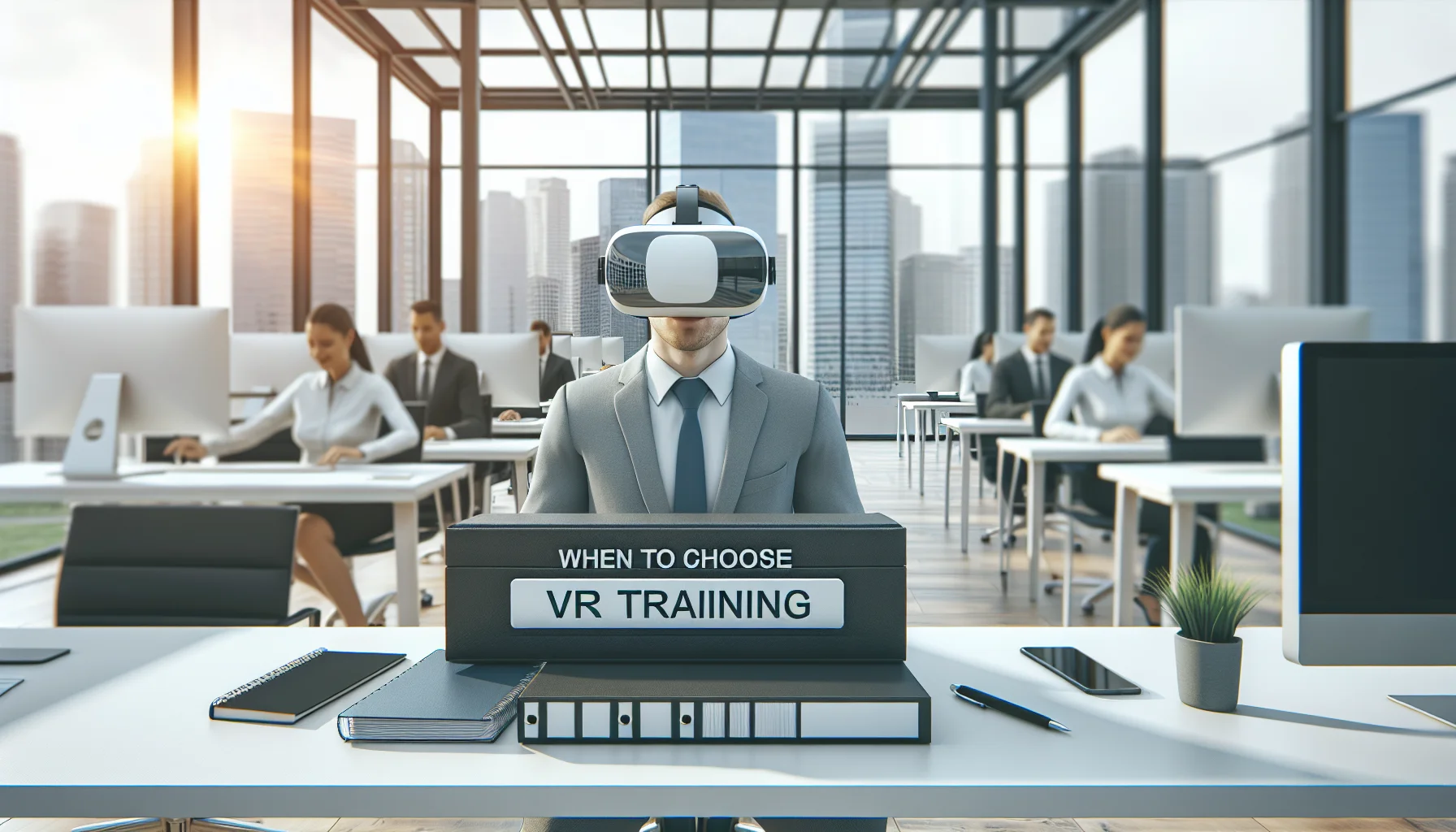
This article gives a practical framework for deciding when to choose VR training versus e-learning or blended approaches. It maps task complexity, risk exposure, and emotional fidelity to modality, shows ROI and expected-loss calculations, and provides a decision tree and stakeholder checklist to scope measurable pilots.
Deciding when to choose VR training is no longer a simple question of technology enthusiasm — it's a strategic learning decision. In our experience, teams that treat immersive learning as a modality choice rather than a novelty get better outcomes. This article presents a clear, actionable framework to help stakeholders choose VR training versus simpler e-learning or blended options, with examples, decision trees, and a short stakeholder checklist.
Choose VR training when the learning goals require more than knowledge transfer — when performance depends on practiced behavior, spatial judgment, or sensory cues that 2D courses cannot reproduce. We've found that teams often overestimate the reach of slide-and-quiz formats; the right decision starts by mapping the learning objective to the training modality.
Start with three questions: (1) Does the task require physical or spatial skills? (2) Is there significant safety or financial risk if learning fails? (3) Does the learner need realistic, repeatable practice to transfer skills to the job? If you answer "yes" to two or more, you should strong consider whether to choose VR training.
VR vs e-learning is often framed as immersive versus non-immersive, but the practical distinction is in experiential fidelity and rehearsal frequency. E-learning excels at scalable knowledge dissemination; VR excels at actionable rehearsal and contextual decision-making.
Use VR when you need high-fidelity practice, safe failure, or emotional conditioning that replicates real-world pressure. For many organizations, the right approach is blended: e-learning for core knowledge, VR for applied practice.
Complexity of physical tasks is a central axis in the learning modality decision. Tasks with multi-step physical sequences, hand-eye coordination, or spatial navigation benefit from immersive practice. Examples include surgical procedures, heavy-equipment operation, and aircraft cockpit workflows.
We recommend a graded fidelity matrix: low, medium, high. Low-fidelity tasks (information lookup, compliance reading) should not drive the decision to choose VR training. Medium-fidelity tasks (system navigation, soft skills role-play) may be served with simulations or AR overlays. High-fidelity tasks (procedural skill, fine motor control, situational awareness) often justify VR investment.
Compare modalities by capability:
Risk exposure is one of the clearest triggers for selecting VR. When failures cause harm, regulatory penalties, or multimillion-dollar losses, the value of safe rehearsal is quantifiable. Studies show that high-fidelity practice reduces on-the-job errors in safety-critical domains.
We recommend calculating a simple expected-loss reduction estimate: multiply the current incident rate by average loss per incident and estimate the percentage reduction expected from training. If the anticipated annual loss reduction exceeds the amortized VR program cost, it's a strong signal to choose VR training.
Suppose an operation experiences 10 incidents/year at $50,000 each = $500,000. If VR practice can reasonably cut incidents by 30%, expected savings = $150,000/year. If a VR program costs $300,000 capital + $50,000/year operations, the payback period is within two years — often acceptable for many organizations.
Emotional learning and behavioral change are areas where VR provides unique advantages. In our experience, VR's ability to recreate psychological pressure and contextual cues produces stronger attitudinal shifts than traditional e-learning role-play.
For de-escalation training, diversity and inclusion scenarios, or leadership under stress, VR enables stakeholders to experience consequences, receive real-time feedback, and iterate safely. This is where the distinction between VR vs e-learning is critical: e-learning can teach concepts; VR can cause experiential insight.
While traditional systems require constant manual setup for learning paths, some modern platforms like Upscend demonstrate how dynamic, role-based sequencing can reduce administrative overhead and support blended VR-eLearning pathways.
Example A: A compliance slide deck explains microaggressions — learners pass a quiz but behavior persists. Example B: A VR scenario simulates a tense conversation with branching outcomes and immediate coaching; learners demonstrate measurable behavior change in follow-up assessments. When the objective is behavioral transfer, organizations should strongly consider whether to choose VR training.
When calculating whether to choose VR training, stakeholders should evaluate both direct costs and opportunity costs. Key cost elements: hardware, content development, platform licensing, integration, and maintenance. Benefits include reduced incidents, faster time-to-competency, increased retention, and lower long-term training hours.
Use a three-year TCO model and compare against projected benefits. We recommend these thresholds as practical rules of thumb:
Major cost drivers are bespoke content and integration. Mitigate by prioritizing modular scenarios, reusing assets, and starting with a minimum viable experience. Pilots that focus on measurable KPIs (error rate, cycle time, NPS) generate the data needed to scale investments responsibly.
To operationalize when to choose VR training, use this decision tree and checklist. The tree reduces bias and aligns stakeholders on measurable criteria.
Decision tree (simplified): If (1) task requires physical/spatial practice OR (2) failure carries high risk OR (3) emotional fidelity is essential — then evaluate ROI. If ROI positive within 2–4 years and reuse is high, proceed to pilot. Otherwise, consider AR, simulation, or blended solutions.
Common mistakes include overselling VR as a universal solution and misaligning learning objectives with modality. Avoid these by starting with a pilot that isolates one measurable objective, using blended pathways where appropriate, and ensuring SMEs drive scenario fidelity rather than vendors alone.
Choosing to choose VR training should be a methodical, evidence-driven decision, not a technology-first impulse. Use the frameworks above to map objectives to modality, quantify risk and ROI, and pilot with clear success criteria.
We’ve found that when organizations apply these filters — complexity, risk, transfer requirements, emotional fidelity, and robust cost-benefit analysis — they make better modality decisions and avoid common pitfalls like misaligned objectives or unnecessary expense.
Next step: Run a 60–90 day pilot focused on one high-fidelity objective with clearly defined KPIs and a three-year TCO projection. Use the checklist and decision tree in this article to scope the pilot and evaluate whether to scale VR across the organization.
The Upscend Team provides actionable insights on technology and business strategy.
Book a walkthrough and we'll show you how it applies to your own content.
 The Agentic Ai & Technical Frontier
January 4, 2026
This article explains minimum specs for VR training hardware on a budget, comparing standalone VR headsets and tethered PC VR requirements. It outlines component priorities, cost bands, lifecycle expectations, procurement tips, a decision flow for matching fidelity to objectives, and a low-cost pilot checklist to validate assumptions before scaling.
 Business Strategy&Lms Tech
January 25, 2026
This article compares VR vs in-person roleplay for high-stakes layoffs across realism, emotional safety, facilitator control, scalability, and TCO. It recommends paired pilots (VR and in-person), a decision matrix, and facilitator training. Use VR for repeatable, data-driven baseline practice and in-person for legally sensitive, high-emotion calibrations; hybrid programs often perform best.
Business Strategy&Lms TechJanuary 27, 2026
This article compares AR vs VR learning for corporate training, outlining core differences, a criteria matrix, six real-world scenarios, and a decision flowchart. It explains when to choose AR, VR, or a hybrid, lists common pain points with mitigations, and provides a roadmap plus analytics checklist to pilot and scale immersive learning.
HrFebruary 3, 2026
This article explains how to design interactive VR training design for onboarding using cognitive load management, microlearning VR modules, and immersive learning principles. It outlines design patterns, assessment methods, accessibility checks, authoring workflows, and rapid A/B testing to pilot and scale effective VR onboarding.