

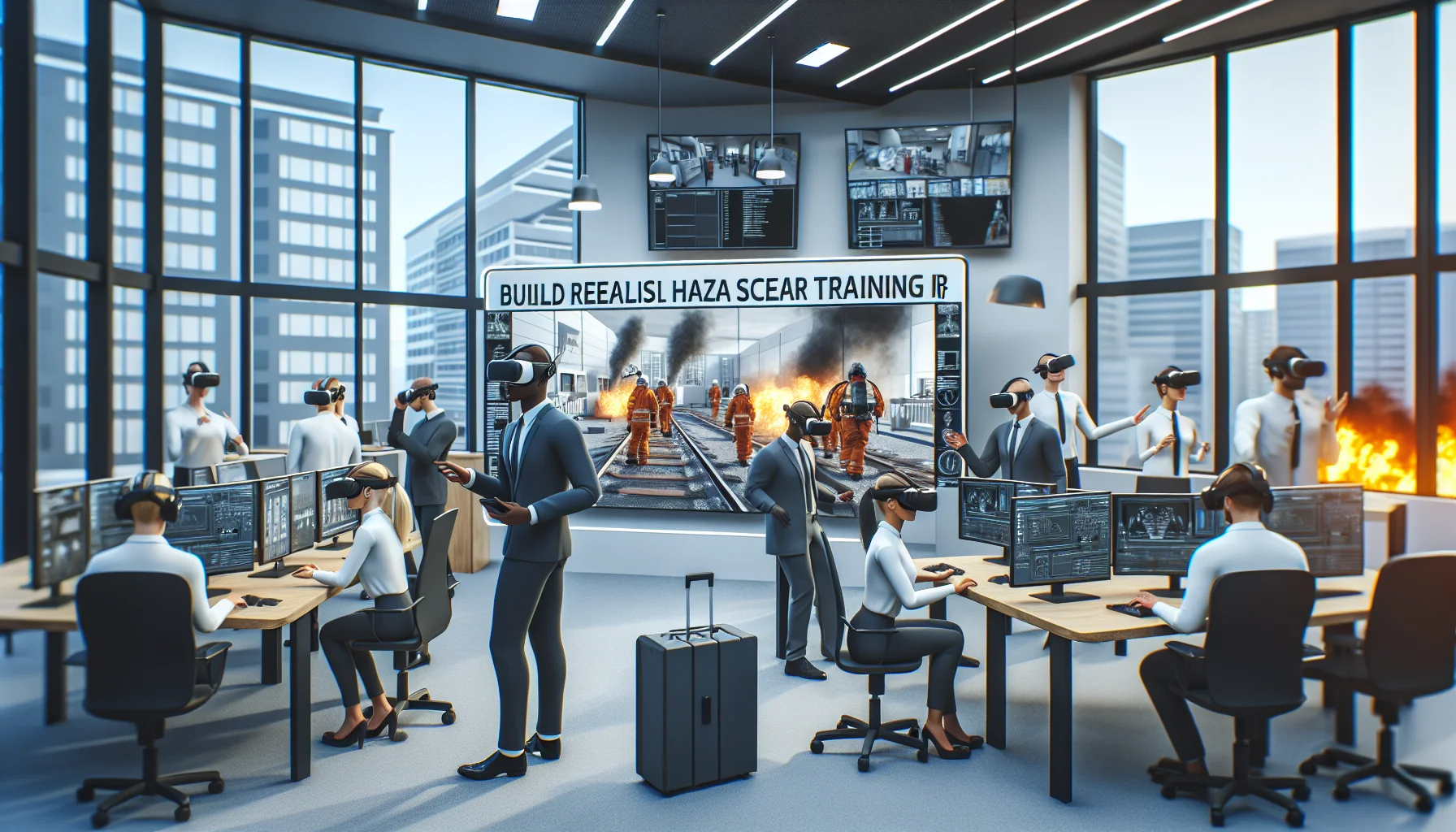
This article outlines a practical methodology for building realistic hazard scenario training with AR/VR digital twins. It covers hazard analysis, measurable learning objectives, fidelity axes, branching outcomes, controlled randomness and stressors, and rigorous debrief and validation. Use the gas-leak and confined-space templates, pilot cohorts, and SME validation to improve measurable transfer.
Building effective hazard scenario training with AR/VR digital twins means balancing technical fidelity with clear learning design. In our experience, teams that start with a structured methodology avoid overfitting visuals at the expense of measurable outcomes. This article walks through a practical scenario design methodology—beginning with hazard analysis, moving to learning objectives, defining fidelity levels, mapping branching outcomes, adding controlled randomness and stressors, and designing a rigorous debrief and assessment cycle for sustained learning.
Throughout, we'll highlight industry best practices and common pitfalls in creating immersive hazards for emergency response training, and offer checklists you can apply immediately. The goal is to make realistic training experiences that are repeatable, measurable, and safe.
Start every build with a compact, documented hazard analysis. A focused analysis identifies the specific threats, likely failure modes, and the critical decisions trainees must make. Use job task analysis and past incident reports to build scenarios that reflect operational reality.
From that analysis extract clear, measurable learning objectives. For example: "Isolate and ventilate a simulated gas leak within 8 minutes" or "Perform safe extrication in a confined-space event without PPE breaches." These objectives drive scenario parameters, assessment metrics, and allowable interventions.
Use a layered approach: combine historical incident frequency with consequence magnitude and controllability. Assign each hazard a simple priority score and map high-priority items to immersive hazards first. This prevents wasting high-fidelity development on unlikely or low-impact events.
Objectives should be observable and time-bound. Pair each objective with at least one quantitative metric (time to action, exposure level, PPE integrity) and a qualitative judgement (communication clarity, leadership). These metrics form the backbone of scenario scoring.
Define fidelity in three axes: visual, physical interaction, and behavioral. Not every training need requires cinema-level graphics; often sensory cues (sound, haptics, gas sensor readouts) and accurate process flow matter more for transfer to the field.
Segment architecture into modular components: environment, equipment, agents (people, animals), and systems (alarms, HVAC). This modularity enables reuse, faster iteration, and clearer validation of individual elements.
Match fidelity to the objective. For procedural checklists, low-to-medium visual fidelity with high interaction accuracy suffices. For decision-making under uncertainty, elevated behavioral fidelity (realistic NPCs, team voice comms) and induced ambiguity are essential.
Map decisions to branches early. Create a decision tree where each branch has meaningful consequences; avoid binary pass/fail forks. Branches should test different competencies and feed different debrief threads so performance feedback is targeted and actionable.
Introduce randomness and stressors to simulate unpredictability without creating unsafe psychological states. Randomness improves transfer by preventing rote memorization; stressors build resilience but must be capped to avoid harm.
We recommend a tiered stressor matrix: sensory overload (alarms, smoke), time pressure, conflicting information, and equipment failures. Implement configurable sliders so instructors can tune intensity per learner or cohort.
Safety controls are non-negotiable: automated abort triggers, clear on-screen consent prompts, and real-time monitoring let instructors intervene. Technical safeguards should also prevent physical collisions in shared AR/VR spaces.
Design debriefs as the primary locus of learning. A realistic scenario without structured reflection wastes practice. Build debrief flows that pair objective logs with trainee self-assessment and instructor notes.
Assessment should combine quantitative metrics (times, exposures, task completion) and qualitative ratings (communication, leadership). Use structured rubrics aligned to the objectives defined in the framework to ensure reliability and fairness.
Real-time feedback and post-run analytics are essential for adaptive learning paths. In practice, this requires event-level instrumentation and synchronized telemetry across AR/VR systems so every action maps to a scored outcome (we've found granularity at the second and event level produces the most actionable insights).
(Real-time feedback and session analytics — available in platforms like Upscend — can surface disengagement, task drift, and performance trends that inform scenario tuning and remediation.)
Define primary and secondary metrics. Primary metrics tie directly to learning objectives (e.g., containment time). Secondary metrics capture transference indicators (decision latency, communication errors). Use pre/post testing and spaced repetition to measure retention.
Structure debriefs in three parts: rapid factual review, instructor-led analysis of decision points, and learner reflection with action planning. Use replay tools and annotated timeline views to focus discussion on high-impact moments.
Concrete examples make methodology actionable. The two scenarios below illustrate how hazard analysis, fidelity, branching, randomness, and debrief tie together in practice.
Objective: detect and isolate a simulated gas leak, evacuate non-essential personnel, and ventilate the area within a time limit. Key metrics: detection time, isolation accuracy, exposure duration.
Objective: apply lockout/tagout, atmospheric testing, and safe extraction while maintaining team comms. Metrics include PPE compliance, rescue time, and PPE integrity.
Validation ensures scenarios are realistic without becoming harmful. A pattern we've noticed is that teams who validate against a standard operating procedure and subject matter expert (SME) review avoid introducing unrealistic cues that degrade training transfer.
Ethical considerations include informed consent, psychological safety, and data privacy. When physiological monitoring is used, consent and clear opt-out pathways are essential. Store and present collected data in de-identified, role-based access formats.
Use triangulation: SME review, pilot runs with novices and experts, and field comparison where possible (measure similar tasks in live drills). Studies show that validated scenarios produce higher transfer rates to real-world performance than unvalidated, high-fidelity simulations.
Finally, maintain a change log for scenario updates so trainers can trace how modifications affect outcomes over time—this supports continuous improvement and auditability.
High-quality hazard scenario training with AR/VR digital twins is achievable when teams follow a disciplined methodology: start with a rigorous hazard analysis, define clear learning objectives, select appropriate fidelity, design meaningful branching outcomes, control randomness and stressors, and build a robust debrief and validation loop. We've found that integrating measurable metrics and SME validation early prevents wasted development and improves trainee transfer.
Begin by piloting one focused scenario—use the gas leak or confined-space template above—instrument events at the second level, and run three pilot cohorts with iterative adjustments. Maintain ethical guardrails and instructor controls, and use structured debriefs tied to objective metrics.
To implement these practices, assemble a small cross-functional team: an operations lead, an SME, an instructional designer, and a technical lead for the AR/VR environment. Run rapid pilots, document outcomes, and scale what demonstrates measurable improvement.
Next step: Choose one high-priority hazard from your operations, draft three measurable objectives for it, and run a tabletop review with SMEs this week to start converting risk into repeatable digital practice.
The Upscend Team provides actionable insights on technology and business strategy.
Book a walkthrough and we'll show you how it applies to your own content.
 ESG & Sustainability Training
January 5, 2026
This article compares virtual, in-person and blended crisis training across speed, realism, reach, cost and assessment fidelity, and concludes blended crisis training is the pragmatic default when speed and fidelity matter. It includes a decision matrix, role-based mixes, sample schedules, cost/time trade-offs, and a 6–8 week pilot checklist with metrics.
 ESG & Sustainability Training
January 5, 2026
This article describes key future metaverse training trends—AI-driven personalization, synthetic scenario pools, edge-enabled persistent environments, interoperability standards, and mixed reality—and explains how they turn episodic VR drills into continuous risk reduction. It recommends concrete steps: run a 90-day pilot, require model governance and data portability, and form a cross-functional steering group.
 ESG & Sustainability Training
January 5, 2026
This article outlines prioritized, practical controls to secure immersive learning: identity and access management, encryption, network segmentation, and patch management. It details operational steps—monitoring, incident response, logging—provides a vendor SLA questionnaire, and an audit checklist to assess posture and remediate unmanaged endpoints, firmware flaws, and rogue access.
 Business Strategy&Lms Tech
January 27, 2026
Rushing AR pilots creates predictable failures: incompatible devices, overload content, organizational resistance, and privacy gaps. This article explains why those failures happen and provides a practical mitigation playbook — cross-device testing, instructional-design checks, privacy-by-design, a risk-assessment template, and red/green go/no-go triggers to protect budget and safety.