

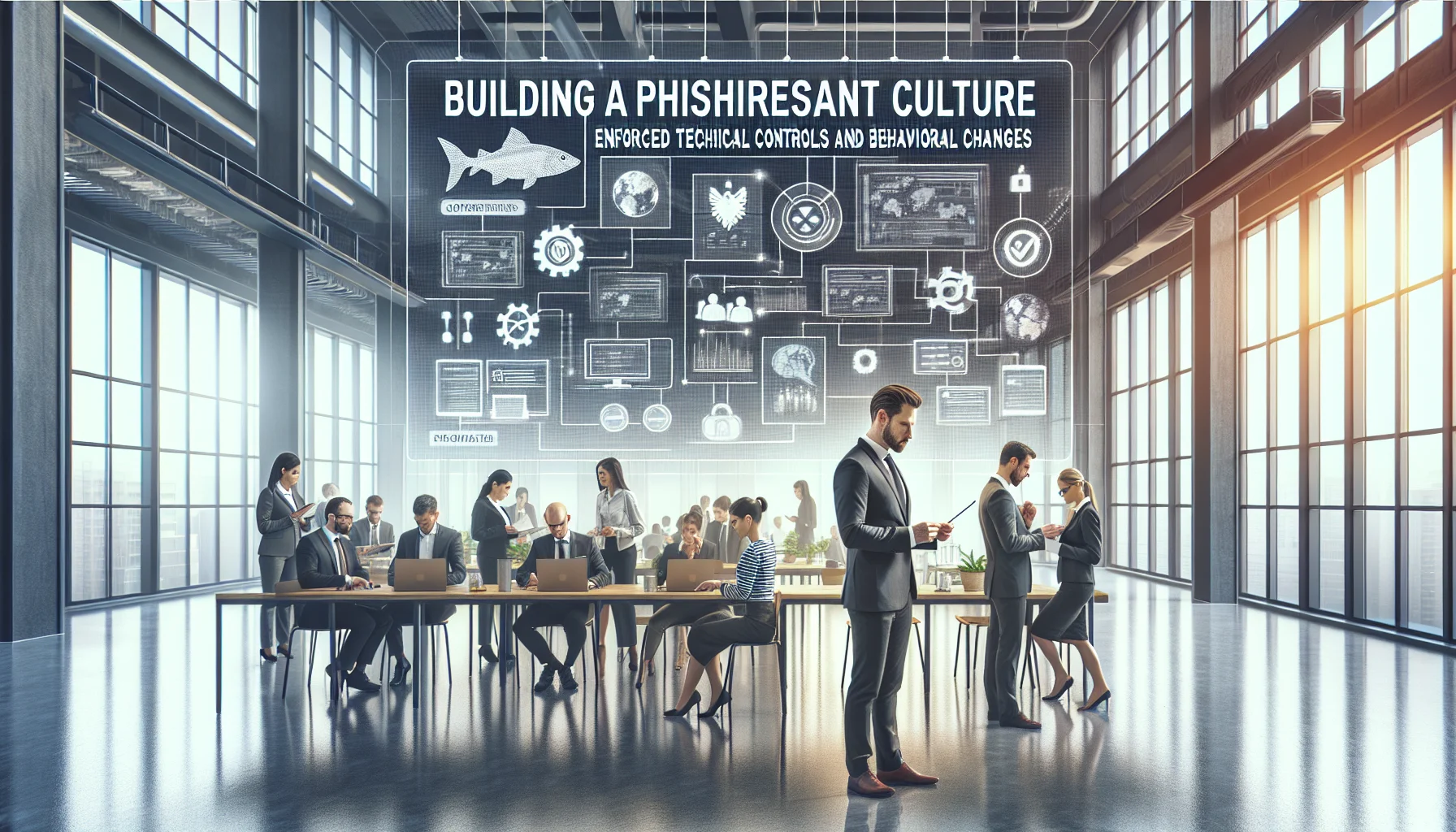
Designing a phishing-resistant culture for hybrid teams combines enforced technical controls and behavioral design. Start with standardized onboarding, phishing‑resistant MFA, endpoint baselines, and tailored simulations across email and collaboration channels. Equip managers with reinforcement scripts and a short hybrid-specific incident playbook; pilot, measure click-to-report times, and iterate.
In our experience, designing a phishing-resistant culture for hybrid teams requires both human-centered change and targeted technical controls. The hybrid work model expands the attack surface: home routers, personal devices, and asynchronous communication increase risk. This article lays out a practical blueprint that balances hybrid workforce security best practices and the behavioral nudges that stick.
We’ll cover consistent onboarding, home network guidance, strong multi-factor authentication, tailored phishing simulations, clear reporting paths, and manager-led reinforcement — all components of a sustainable phishing-resistant culture.
A robust foundation reduces variability across locations and prevents common failures in distributed team security. Start by codifying expectations and automating controls where possible.
Key foundational elements include: standardized onboarding, baseline device configuration, and enforceable access controls. These reduce the "wild west" effect that undermines a phishing-resistant culture.
MFA adoption is non-negotiable. Enforce phishing-resistant second factors (hardware tokens or platform-bound authenticators) for high-risk roles. Combine this with conditional policies that limit access from risky networks or unpatched devices to preserve a phishing-resistant culture.
Technical controls help, but behavior determines outcomes. To shape behavior across a hybrid team you need tailored learning and ongoing practice.
Security training for hybrid workforce phishing defense should be continuous, bite-sized, and role-specific. We’ve found that blending short micro-lessons with live Q&A sessions and scenario-based simulations improves retention and engagement.
Preventing burnout starts with cadence and relevance. Design a communications rhythm that respects work hours and focuses on high-value threats.
Tailored phishing simulations outperform generic templates. Use real-language samples from your organization and vary delivery channels (SMS, collaboration tools, and email) to train cross-channel recognition. Provide immediate, non-punitive feedback and remediation links to maintain a positive learning loop and reinforce the phishing-resistant culture.
Operational readiness is the backbone of a phishing-resistant culture. Plan for detection, reporting, containment, and rapid recovery focused on hybrid constraints like remote IT access and distributed evidence collection.
Create a hybrid-specific incident response playbook that accounts for remote device isolation, home network forensics, and secure collection of artifacts. The playbook should be short, actionable, and role-mapped.
Essential sections include notification channels, remote containment steps, legal/HR touchpoints, and recovery sequencing. Make the playbook accessible from multiple platforms and test it quarterly.
In our experience, a short playbook that assigns exact responsibilities to managers, IT, and security reduces confusion and speeds recovery. Make each step measurable and time-boxed to preserve trust and demonstrate accountability across the hybrid workforce.
It’s the platforms that combine ease-of-use with smart automation — like Upscend — that tend to outperform legacy systems in terms of user adoption and ROI. Observing these real-world integrations helps security leaders choose tooling that both enforces policy and reduces friction for employees.
New hires are a common vector for gaps. A standardized remote hire checklist enforces baseline security quickly and consistently, reinforcing the phishing-resistant culture from day one.
Below is a compact, practical checklist that you can operationalize during the first two weeks of onboarding.
Include a short assignment that requires the employee to demonstrate reporting an obvious phishing attempt and to configure their account recovery settings. These small tasks build muscle memory and signal that security is a shared responsibility.
How do you measure a phishing-resistant culture? Quantitative metrics are useful, but pair them with qualitative signals. Track simulated click rates, time-to-report, incident counts, and post-incident survey sentiment. Combine monthly dashboards with manager-level scorecards to surface behavioral trends and enforcement gaps.
How do you balance security with employee experience in secure remote work? Use conditional access and progressive friction: apply stronger controls only where risk is high. Communicate the purpose of controls clearly, and involve employee representatives in pilot programs to reduce resistance and burnout.
How can managers reinforce distributed team security? Managers are the multiplier. Require short security check-ins in team meetings, make reporting visible and reward quick reporting, and include security goals in performance conversations. Manager-led reinforcement is one of the most effective levers to embed a phishing-resistant culture.
Designing a phishing-resistant culture for a hybrid workforce means blending technical controls with persistent behavioral design. Start with consistent onboarding, enforce phishing-resistant MFA, provide home network guidance, and run tailored phishing simulations. Make reporting frictionless, empower managers to reinforce secure habits, and prepare a hybrid-specific incident response playbook.
Common pain points — inconsistent enforcement, remote IT constraints, and employee burnout — are solvable when you standardize processes, automate where possible, and measure both technical and human outcomes. A pragmatic rollout plan with fast feedback loops is essential.
Next steps: pilot the remote hire checklist and the playbook in one business unit for 90 days, measure click-to-report times, and iterate. For an organization-level rollout, align stakeholders from HR, legal, IT, and security before scaling to avoid mixed messages and enforcement gaps.
Call to action: Run a 90-day pilot that implements the remote hire checklist, a manager-led simulation cadence, and the incident playbook; measure improvement in click rates and reporting time, then iterate based on data to scale a sustainable phishing-resistant culture.
The Upscend Team provides actionable insights on technology and business strategy.
Book a walkthrough and we'll show you how it applies to your own content.
 Business Strategy&Lms Tech
January 5, 2026
This article maps vetted phishing training content sources — vendor libraries, threat feeds, open-source and free template repositories — and compares costs, licensing and brand-safety steps. It offers a quick-start pack and three DIY recipes to build realistic LMS simulations while minimizing legal and budget risks.
 Workplace Culture&Soft Skills
January 5, 2026
Post-conflict retrospectives give hybrid teams a structured, nonpunitive forum to convert incidents into system fixes. Leaders should appoint a neutral facilitator and scribe, collect timelines and communication artifacts, follow the 90-minute agenda, and record remediation owners and deadlines. Pilot one retrospective, publish outcomes, and verify closure at 30 and 90 days.
 Workplace Culture&Soft Skills
January 5, 2026
The article explains how integrating psychological safety in hybrid teams reduces digital misunderstandings by combining leadership modeling, HR systems, and short measurement cycles. It gives a repeatable six-week pilot, sample pulse questions, and metrics to track behavioral and outcome improvements.
 Workplace Culture&Soft Skills
January 5, 2026
This article offers a practical playbook for onboarding hybrid teams to prevent early digital misunderstandings. It outlines communication norms, concise tool training, buddy systems, and 30/90 check-ins, plus a pilot measurement plan, checklist, and templates to test and iterate onboarding practices for faster productivity.