

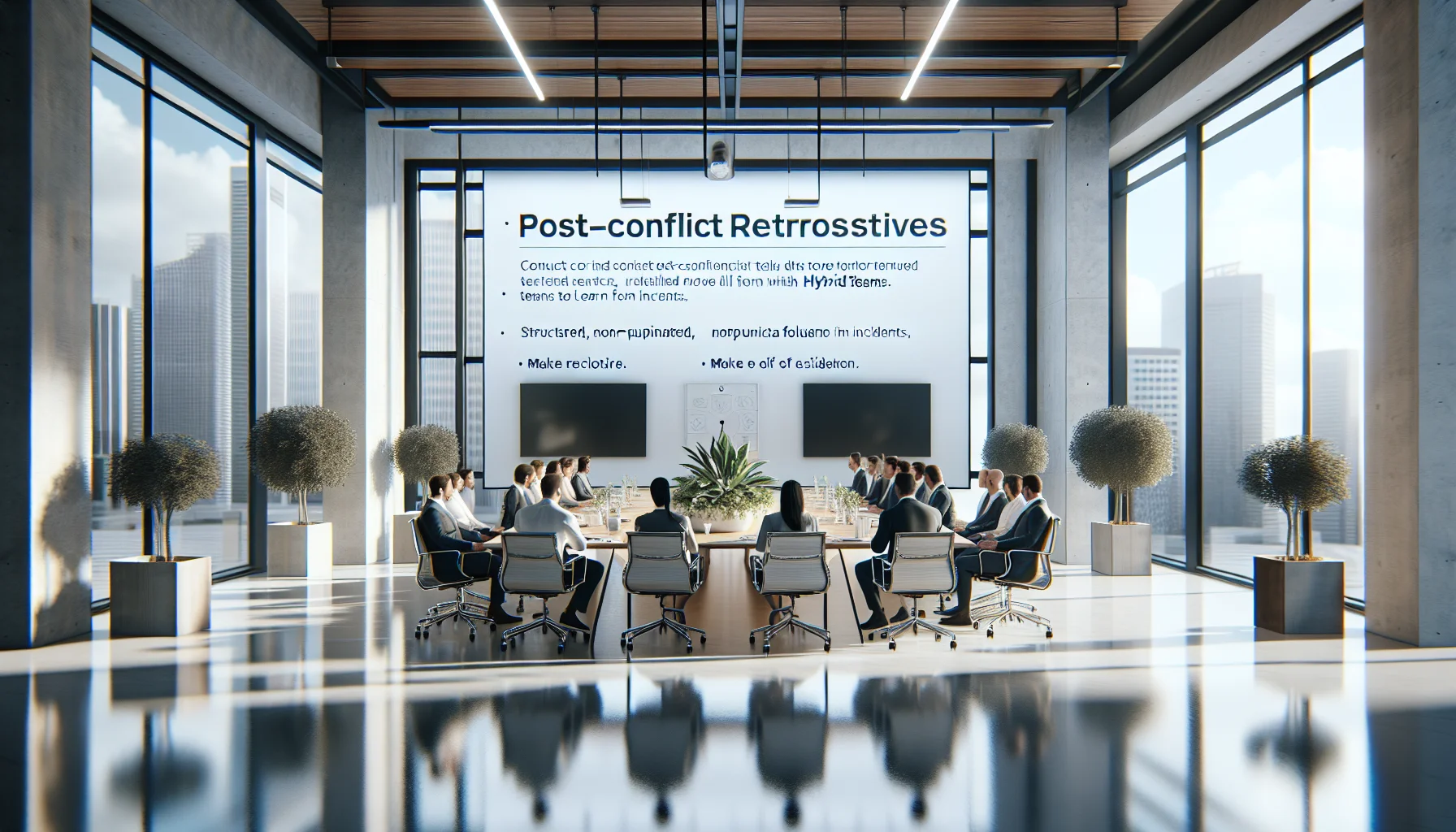
Post-conflict retrospectives give hybrid teams a structured, nonpunitive forum to convert incidents into system fixes. Leaders should appoint a neutral facilitator and scribe, collect timelines and communication artifacts, follow the 90-minute agenda, and record remediation owners and deadlines. Pilot one retrospective, publish outcomes, and verify closure at 30 and 90 days.
Post-conflict retrospectives are essential for repairing relationships, restoring productivity, and preventing repeat incidents in hybrid teams. In the first 60 words: post-conflict retrospectives create a structured space to examine what happened, who was involved, what decisions were made, and how to improve processes. This article gives a pragmatic playbook for leaders on how to run post-conflict retrospectives in hybrid teams, with templates, roles, agenda, data collection, and remediation plans.
Hybrid work mixes synchronous and asynchronous interactions, which increases the risk of misunderstandings and documentation gaps. A proper post-conflict retrospective converts a moment of friction into an institutional learning opportunity instead of a blame event.
Leaders benefit from regular post-conflict retrospectives because they reduce turnover, speed decision recovery, and improve cross-location collaboration. Studies show that structured incident reviews correlate with faster recovery times and fewer repeat incidents, especially when documentation and follow-through are enforced.
When you ask "why" and "how" with a nonpunitive lens, teams restore trust faster. Framing the session as an improvement activity — not a fault-finding mission — is the first step toward psychological safety.
Preparation sets the tone. We’ve found that small investments in preparation reduce defensiveness and speed meaningful outcomes.
Roles should be assigned in advance. Appoint a neutral facilitator and a scribe. The facilitator manages flow and psychological safety; the scribe captures timelines, evidence, and action items. Optionally include a senior observer for escalation only.
Collecting evidence prevents memory distortions and documentation gaps. For hybrid teams this typically includes:
Collect timelines that show the sequence of events and decision points. A clear timeline reduces finger-pointing and focuses discussion on causality and systems.
Begin with a safety protocol: a read-out of norms, a reaffirmation that the retrospective’s aim is learning, not punishment, and an option for private statements. Use these rules:
Psychological safety is the linchpin. Without it, teams default to silence or blame, and documentation fails to capture root causes.
Below is a reproducible agenda leaders can use immediately when running post-conflict retrospectives in hybrid teams. Time estimates assume a 90-minute session.
Retrospective agenda (90 minutes):
When running an incident review hybrid teams benefit from visual timelines and shared screens for synchronous participants, and threaded notes for asynchronous participants to contribute ahead of time.
Facilitators should use neutral language and enforce the safety rules. Keep the discussion anchored to the collected evidence and the timeline. If the session becomes personal, pause and redirect to behavior and process.
Facilitator responsibilities: set norms, manage airtime, synthesize findings. Scribe responsibilities: record timestamps, link to evidence, and capture action items verbatim.
Below are ready-to-use templates you can copy into your internal docs. They are designed for hybrid execution and to close documentation gaps.
Use this as the meeting document header. Parties fill fields before and after the meeting.
These prompts help move from blame to systems thinking. Including explicit questions about documentation gaps highlights recurring causes.
Capture remediation items in a simple table with owners and deadlines. Publish the table in a shared workspace and track to closure.
| Action | Owner | Deadline | Success Criteria |
|---|---|---|---|
| Update escalation playbook | Owner: Ops Lead | 2026-02-10 | Playbook published; team training completed |
| Add message-thread retention policy | Owner: IT Manager | 2026-02-03 | Retention configured; audit completed |
Make owners accountable by assigning follow-up dates and a single point of record for each remediation item.
Practical tooling matters: some teams integrate real-time engagement metrics and structured feedback into their platforms to spot conflicts earlier (available in platforms like Upscend). This mode of integration exemplifies how synchronous and asynchronous signals can be combined to inform an after-action review remote conflict.
Short, focused examples illustrate how structured post-conflict retrospectives change outcomes.
Situation: A hybrid team missed an SLA after conflicting priorities between on-site engineers and remote support. The incident review hybrid teams ran identified two documentation gaps: unclear escalation ownership and missing ticketing tags.
Outcome: The post-conflict retrospective produced a remediation action plan: update escalation RACI, add mandatory tags, and run a 30-minute role clarification session. Within six weeks, SLA breaches from the same root cause fell by 80%.
Situation: Repeated tension arose when asynchronous decisions were made without notifying distant teammates. After an after-action review remote conflict, the team instituted a "decision announce" channel and a 24-hour silent period before final decisions absent emergency flags.
Outcome: These simple protocol changes, captured in post-conflict retrospective templates for hybrid teams, reduced repeated conflicts and improved trust scores on the quarterly pulse survey.
Leaders often struggle with two recurring pain points: blame culture and documentation gaps. Address both explicitly.
Blame culture shows up as accusatory language and quick calls for punishment. Avoid it by enforcing norms, focusing questions on systems, and by having a neutral facilitator. If accountability is needed, separate the learning session from formal HR action paths.
Documentation gaps mean evidence disappears into DMs or ephemeral calls. Close gaps by requiring evidence links in the retrospective template, creating retention policies, and mandating a timeline in the session note.
Post-conflict retrospectives are a repeatable method to convert conflict into durable improvements for hybrid teams. By assigning a neutral facilitator and scribe, collecting timelines and communication artifacts, using a clear agenda, and recording a measurable remediation action plan, leaders can reduce blame and close documentation gaps.
Start with one pilot retrospective for a recent, nonpunitive incident. Use the provided conflict retrospective template and remediation table, publish the outcomes, and measure follow-through at 30 and 90 days. Consistent practice turns isolated learning into organizational memory.
Call to action: Run a pilot post-conflict retrospective this month using the templates above, assign owners for remediation items, and schedule a 30-day follow-up to verify closure and measure impact.
The Upscend Team provides actionable insights on technology and business strategy.
Book a walkthrough and we'll show you how it applies to your own content.
 General
December 14, 2025
This article explains how to diagnose and fix remote work issues in hybrid teams by categorizing problems (communication, engagement, process, technology) and running a short audit. It provides a meeting and documentation playbook, engagement programs, policy design principles, tooling checklist, and a four‑phase assess–design–pilot–scale roadmap to run 90‑day experiments.
 Workplace Culture&Soft Skills
January 5, 2026
This article explains legal considerations when resolving hybrid team conflicts, covering jurisdiction, evidence preservation, data privacy, discrimination law, cross-border and union obligations. It provides a pre-escalation checklist, sample preservation and counsel‑notification wording, plus lessons from anonymized cases to help managers reduce liability and resolve disputes fairly.
 Workplace Culture&Soft Skills
January 5, 2026
The article explains how integrating psychological safety in hybrid teams reduces digital misunderstandings by combining leadership modeling, HR systems, and short measurement cycles. It gives a repeatable six-week pilot, sample pulse questions, and metrics to track behavioral and outcome improvements.
 Workplace Culture&Soft Skills
January 5, 2026
This article presents four hybrid team conflict case studies across industries — a startup, consultancy, manufacturer, and nonprofit — each with diagnosis, interventions, timelines, stakeholders, tools, and measurable outcomes. Readers get a repeatable playbook: define ownership, set async norms, centralize docs, design equitable meetings, and track 2–3 KPIs in a 6–12 week pilot.