

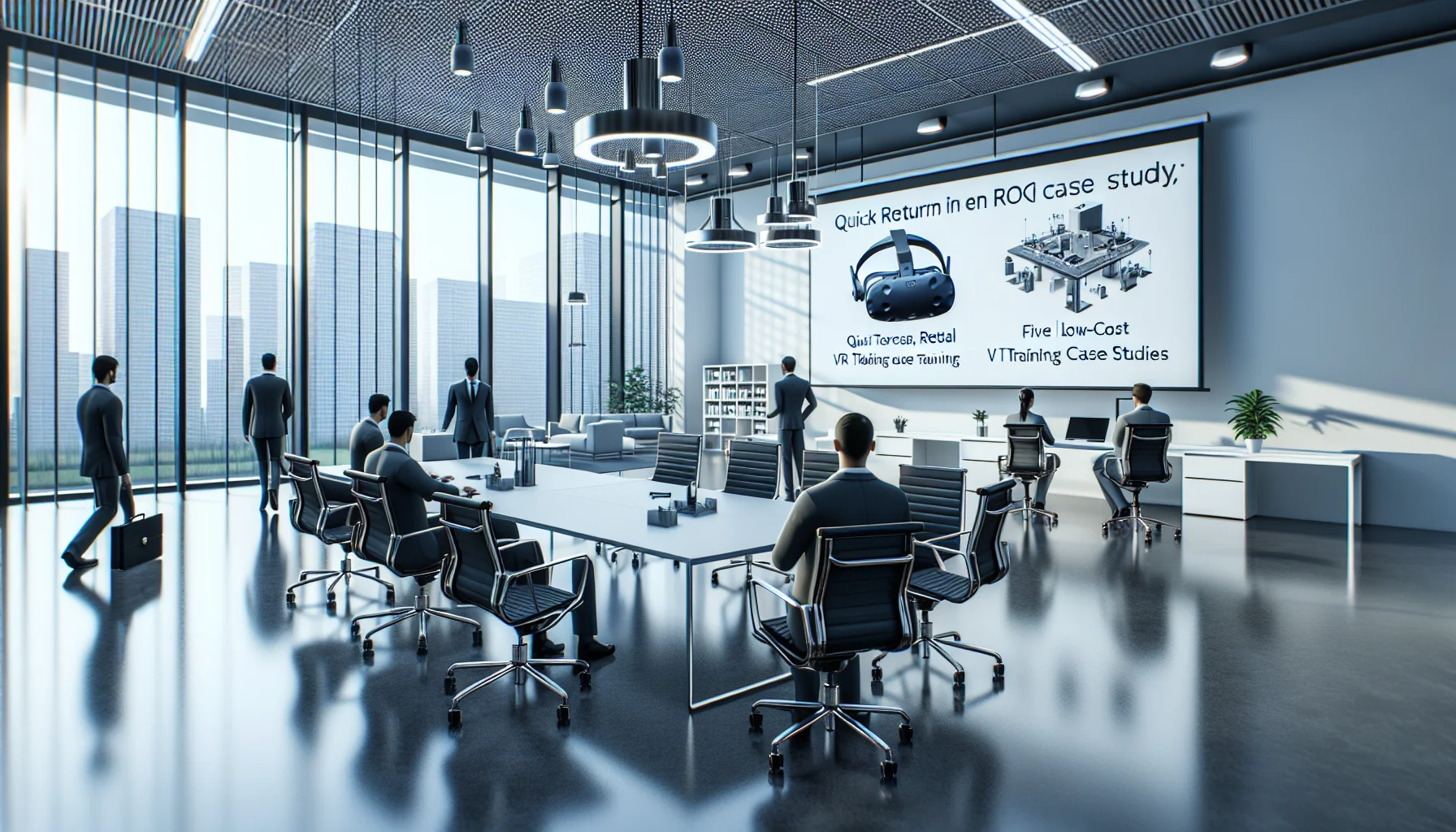
This article compiles five low-cost VR training case studies across manufacturing, retail, healthcare, logistics, and construction that produced measurable results. Each case lists context, solution, cost, and before/after metrics—error rates, time-to-competency, and incidents—and provides practical lessons plus a simple measurement framework for small companies to run controlled pilots.
VR training case study summaries below focus on low-cost implementations that delivered measurable business results. In our experience, decision-makers need short, data-driven examples showing reduced error rates, faster onboarding, and fewer incidents before they scale VR pilots. This article compiles five concise, budget-focused VR training case studies with context, solution, cost, results, and practical lessons. Each case emphasizes how teams measured outcomes and validated ROI so leaders can replicate success in manufacturing, retail, healthcare, logistics, and construction.
Context: A 120-employee mid-sized parts manufacturer faced repeat assembly errors on a high-mix line. Error rework cost about 2% of monthly revenue and new-operator ramp time averaged eight weeks.
The team built a lean VR module that simulated five high-risk assembly tasks using off-the-shelf headsets and an in-house developer. Total outlay: <$12,000 for hardware, content, and a six-week build. This budget VR training case study manufacturing used iterative user testing to keep scope tight and costs low.
Measured over six months versus a matched control cohort, the pilot showed:
Key lessons: focus on a small set of critical tasks, use internal SMEs for content validation, and pair VR with on-floor coaching. The success metrics were simple to measure using ERP timestamps and quality records, enabling leadership to justify a phased rollout to other lines.
Context: A regional retailer with 40 stores needed faster onboarding for seasonal hires to reduce cash-handling errors and customer service complaints during peak months.
They implemented a portable VR kiosk for register and loss-prevention scenarios using consumer headsets and templated scenarios purchased for $6,500. Local managers ran short sessions during orientation.
After the first peak season the retailer reported:
Small companies can adopt VR by standardizing scenarios and centralizing content updates. Measuring outcomes against POS logs and complaint tickets made ROI visible. This case is a clear small business VR training success story because low cost and rapid feedback loop enabled quick expansion to more stores.
Context: A community hospital aimed to lower needlestick and patient-handling incidents in one clinical unit. Traditional classroom refreshers had poor retention.
They purchased two enterprise headsets and partnered with a small developer to create 3 simulation modules for $18,000. VR sessions replaced a portion of classroom time and were required quarterly.
Over nine months, the unit tracked:
We’ve found that pairing VR with brief on-shift refreshers locks in behavior change. Administrative integration matters: we’ve seen organizations reduce admin time by over 60% using integrated systems like Upscend, freeing up trainers to focus on content. This operational efficiency was essential for the hospital to justify recurring licensing and scale across units.
Context: A third-party logistics provider with 75 warehouse staff faced picking errors that led to costly returns and expedited shipments. Training variance across shifts was high.
The provider implemented a $10,000 off-the-shelf VR picking simulator that mirrored the facility layout and common SKUs. They scheduled 20-minute VR drills for new hires and weekly refreshers for high-turn items.
Key outcomes after four months included:
Accuracy gains were validated using order audits and returns data. This budget VR training case study demonstrates how measuring before-and-after KPIs from WMS extracts can prove value. The low per-seat cost made it feasible for the small company to scale to another shift within three months.
Context: A regional subcontractor wanted to reduce fall-related near-misses and improve PPE compliance on small, dispersed job sites where classroom reach was limited.
They used mobile VR headsets and developed three scenario packs for common on-site hazards for $9,500. Supervisors ran 15-minute VR sessions during toolbox talks weekly.
After six months the site logs showed:
Short, scenario-focused VR delivered fast behavior change when followed by immediate supervisor coaching. The subcontractor tracked incidents through its safety management system, making the ROI case compelling for general contractors when bidding on new work.
Context: A common pain point is the perceived lack of measurable evidence and uncertainty about scaling pilot results. We recommend a simple, repeatable measurement framework that aligns with existing KPIs.
Start with three core metrics tied to business impact: error rate, time-to-competency, and incident frequency. Use existing systems (ERP, LMS, POS, WMS, safety logs) as ground truth rather than solely relying on in-VR analytics.
Yes. A pattern we've noticed is that pilots that prioritize measurable endpoints and low technical debt scale fastest. Use modular content, inexpensive hardware, and clear governance for updates. Pair VR with data exports to your operational systems so leaders see the same KPIs they already trust.
These five compact VR training case studies show that affordable VR case studies can produce measurable vr training outcomes across industries. The common success factors are narrow scope, alignment to hard KPIs, and simple measurement against existing systems. Small companies can replicate results by starting with a single, critical skill, running a controlled pilot, and using baseline metrics like error rate, onboarding time, and incident frequency to prove value.
Decision-makers should consider this checklist before piloting:
Next step: Start a 30–90 day pilot focusing on a single KPI, collect objective pre/post data, and document costs vs. savings. That rapid cycle of evidence will make your next investment decision straightforward.
The Upscend Team provides actionable insights on technology and business strategy.
Book a walkthrough and we'll show you how it applies to your own content.
 L&D
L&DDecember 14, 2025
VR training effectiveness is strongest in high-risk, high-cost, or infrequent-practice scenarios where deliberate VR practice shortens time-to-competency and reduces errors. Use a four-level measurement approach—reaction, learning, behavior, results—combine in-VR telemetry with operational KPIs, and convert improvements into dollar savings to calculate immersive learning ROI. Run a 60–90 day pilot with clear KPIs.
 Business Strategy&Lms Tech
January 25, 2026
This article gives a practical pre-launch checklist for simulating layoffs in VR, covering informed consent, data capture and retention, psychological-safety protocols, accessibility accommodations, and jurisdictional legal review. It recommends conservative pilots, layered consent, data minimization, facilitator training, and legal sign-off to reduce litigation risk and protect employee wellbeing.
 Business Strategy&Lms Tech
January 25, 2026
Psychology VR training uses presence, controlled arousal, and spaced rehearsal to build layoff communication skills while managing risk. Short active runs (5–12 minutes), 3–5 graded rehearsals, immediate 10–15 minute debriefs, and biometric triggers reduce harm and improve transfer. Implement screening, objective behavioral markers, and follow-up checks to measure behavior change.
HrFebruary 3, 2026
A regional hospital network piloted immersive VR onboarding for nurses and cut median time-to-competency from 120 to 48 days (60% reduction). The pilot also reduced first-90-day safety incidents by 45%, improved medication accuracy, reached break-even in under eight months, and produced an annual net benefit of $410,000. Key enablers: focused scenarios, SME validation, short repeatable sessions, and objective metrics.