

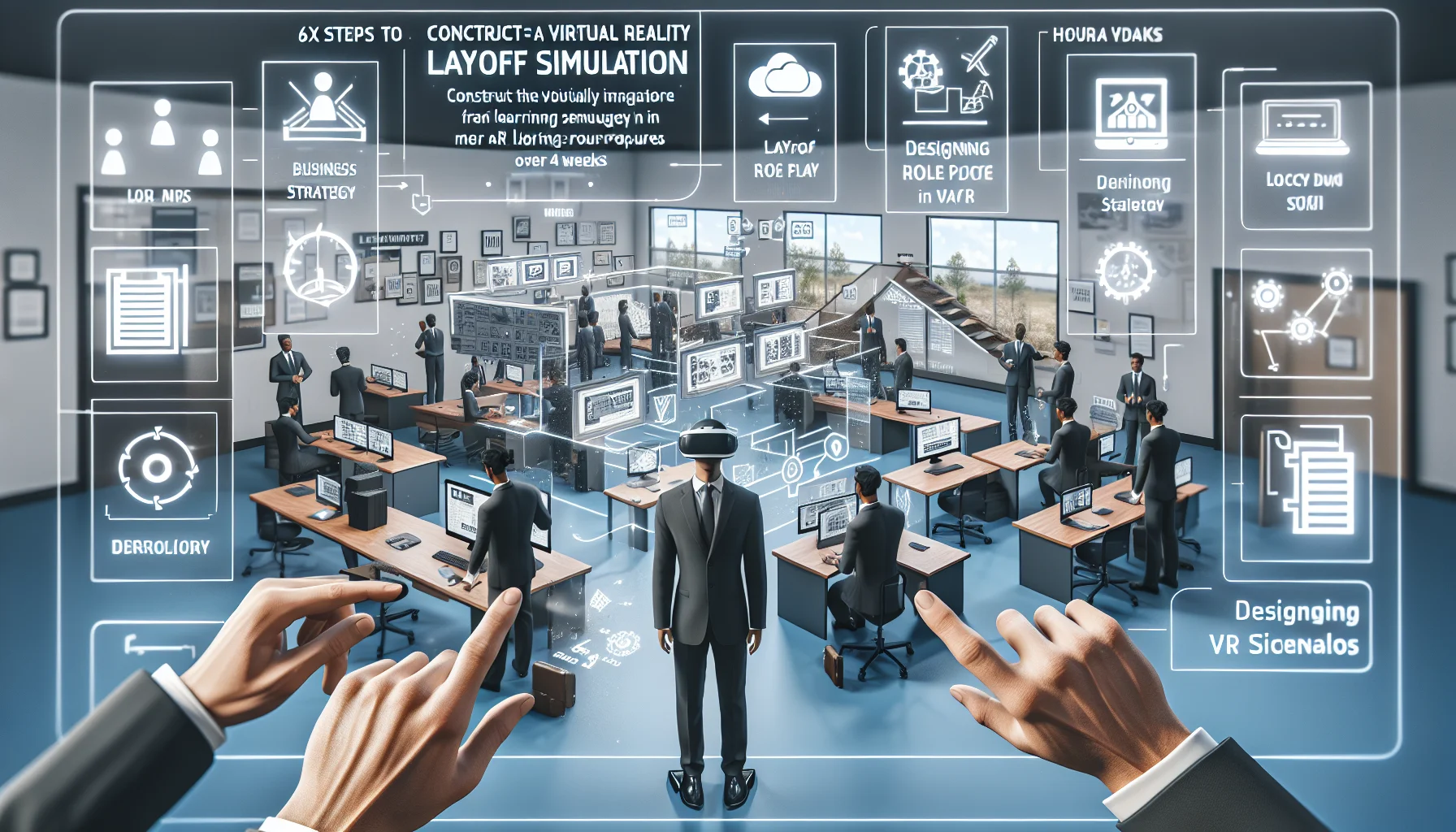
Psychology VR training uses presence, controlled arousal, and spaced rehearsal to build layoff communication skills while managing risk. Short active runs (5–12 minutes), 3–5 graded rehearsals, immediate 10–15 minute debriefs, and biometric triggers reduce harm and improve transfer. Implement screening, objective behavioral markers, and follow-up checks to measure behavior change.
psychology vr training offers a controlled, repeatable space to practice high-stakes conversations like layoffs while revealing how presence, arousal, and memory consolidation interact to produce learning — and risk. In our experience designing and observing simulations, the core mechanisms that make mixed reality effective are psychological: the sense of being there, physiological stress responses that shape encoding, and iterative rehearsal that supports durable behavior change. This article synthesizes cognitive science, practical guidelines, and safety steps so L&D teams can design humane, effective programs that use psychology vr training responsibly.
Understanding psychology vr training starts with three cognitive mechanisms. First, presence — the subjective feeling of "being there" — increases attention and situational appraisal (Slater & Sanchez-Vives). Second, physiological arousal (heart rate, cortisol spikes) gates consolidation: moderate arousal can enhance memory encoding while extreme arousal impairs it (McGaugh's consolidation research). Third, spaced rehearsal and feedback in simulated contexts support reconsolidation and skill transfer (Bandura's social learning principles and modern reconsolidation studies).
Presence amplifies cues that would be weaker in role-plays. When trainees feel present, they attend to subtle facial expressions, timing, and the emotional weight of statements — which strengthens episodic encoding. That stronger encoding makes later reflection and debriefing more effective: rehearsal followed by guided consolidation is where durable behavior change emerges.
Designers must anticipate stress-related memory biases. High stress narrows attention (tunnel memory), increasing recall for central actions but decreasing recall for peripheral details. Recency effects, confirmation bias in post-simulation debriefs, and social desirability pressures during peer observation are common. Good designs use video playback, physiological metrics, and structured reflection to counteract these biases while leveraging presence for stronger learning.
psychology vr training leverages emotional engagement to provoke adaptive learning but must deliberately regulate intensity. Stress inoculation techniques, pioneered by Meichenbaum, show that graded exposure paired with coping skills reduces maladaptive responses. In VR, this is called stress inoculation VR and is particularly relevant when practicing layoffs, because the training context deliberately evokes ethical conflict, empathy demands, and accountability.
We’ve found that layering coping prompts (breath cues, micro-pauses, scripted empathic lines) into early scenarios reduces runaway arousal and supports rehearsal. Physiological data (real-time heart rate variability) can be used to cue trainers to intervene or to trigger automated de-escalation in the scene.
Question: How does psychology vr training affect stress during training? The answer is nuanced. VR tends to heighten subjective stress relative to tabletop exercises because of presence and sensory realism. Studies show that immersive environments elicit larger autonomic responses than video or role-play. That heightened response can be adaptive — encoding rehearsal under stress improves transfer to stressful real-world events — but only if managed correctly.
Practically, we recommend gradual escalation of intensity. In one program we observed, trainees who completed three graded VR rehearsals with guided reflection showed lower physiological reactivity in later live interactions. That pattern aligns with research on stress inoculation and reconsolidation: repeated, supported exposure can reduce pathological responses while preserving adaptive urgency.
To operationalize this in large-scale L&D, teams often combine platforms that provide analytics, branching scenarios, and personalization. The turning point for most teams isn't just creating more content — it's removing friction. Tools like Upscend help by making analytics and personalization part of the core process, enabling teams to track who needs more low-intensity rehearsal and who is ready for high-intensity practice.
Presence plus controlled arousal equals stronger encoding — but only if follow-up consolidates the learning and protects well-being.
Optimal stress for learning follows an inverted-U: moderate arousal fosters attention and consolidation; extremes impair working memory and increase the risk of retraumatization. Use biometric baselines to calibrate: target heart rate increases of 10–20% over baseline during peak moments rather than sustained maxima.
Good design balances exposure with recovery. Below are concrete recommendations rooted in learning science and field experience:
These steps reflect a layered approach: cognitive scaffolding before immersion, supportive scaffolding during interaction, and consolidation after the fact. That sequence aligns with established memory and behavioral theories and minimizes harm while maximizing retention.
Question: Can practicing layoffs in VR retraumatize employees? Yes — if poorly designed. Realism and presence that make VR effective also increase risk. To protect trainees, follow an explicit safety checklist and monitoring plan.
| Risk | Mitigation |
|---|---|
| Re-traumatization | Screening, opt-out, alternative learning paths |
| Over-arousal | Short runs, automated calming, trainer pause |
| Poor transfer | Structured debrief, spaced rehearsal, metrics |
Use a checklist for every cohort. In our experience, teams that formalize safety routines reduce adverse events and increase the percentage of trainees who pass transfer assessments.
Behavior change in mixed reality requires alignment across scenario design, assessment, and organizational context. Measure learning at three levels: simulation performance (behavioral markers), physiological regulation (HR/HRV), and workplace transfer (manager ratings, outcomes). That mix captures skill acquisition and real-world impact.
For reliable measurement, define 4–6 objective behavioral markers for each scenario (e.g., "uses pause-and-name technique," "provides clear next steps," "affirms dignity"). Use automated scoring where possible and human review for nuance. Pair these with follow-up surveys at 2 weeks and 8 weeks to measure transfer.
Behavior change mixed reality programs succeed when they integrate analytics into learning pathways — not as an add-on. In our work, teams that connected simulation metrics to coaching workflows saw faster improvement and clearer ROI. Balance quantitative signals with qualitative narratives from trainees to maintain the human-centered ethos that makes these programs ethical and effective.
psychology vr training can accelerate skill acquisition for emotionally charged tasks like layoffs by leveraging presence and learning mechanisms and controlled arousal. The benefits are real: stronger encoding, safer rehearsal, and better transfer — when programs follow evidence-based scaffolding. However, the same mechanisms drive risk: heightened stress, potential retraumatization, and ethical concerns if safeguards are absent.
Practical next steps:
Final checklist to minimize trainee harm and maximize retention
When teams combine rigorous design, safety-first protocols, and thoughtful measurement, psychology vr training becomes a high-value tool for difficult organizational conversations. For teams ready to pilot responsibly, start small, prioritize well-being, and iterate based on data and human feedback.
Call to action: If you’re planning a pilot, map one scenario to concrete behavioral markers, schedule three spaced sessions with built-in debriefs, and run a small safety screening; use the first cohort as a proof point to refine timing and supports.
The Upscend Team provides actionable insights on technology and business strategy.
Book a walkthrough and we'll show you how it applies to your own content.
 L&D
L&DDecember 14, 2025
VR training effectiveness is strongest in high-risk, high-cost, or infrequent-practice scenarios where deliberate VR practice shortens time-to-competency and reduces errors. Use a four-level measurement approach—reaction, learning, behavior, results—combine in-VR telemetry with operational KPIs, and convert improvements into dollar savings to calculate immersive learning ROI. Run a 60–90 day pilot with clear KPIs.
Business Strategy&Lms TechJanuary 25, 2026
This article gives HR leaders a tactical blueprint to build VR layoff simulations: define measurable objectives, secure stakeholder buy-in, script branching scenarios, and select hardware and analytics. It covers facilitator rehearsal, confidentiality, pilot scoring rubrics, and common pitfalls, plus a 4‑week sprint plan to launch a small pilot and iterate.
 Business Strategy&Lms Tech
January 25, 2026
This article gives a practical pre-launch checklist for simulating layoffs in VR, covering informed consent, data capture and retention, psychological-safety protocols, accessibility accommodations, and jurisdictional legal review. It recommends conservative pilots, layered consent, data minimization, facilitator training, and legal sign-off to reduce litigation risk and protect employee wellbeing.
 Business Strategy&Lms Tech
January 25, 2026
Debriefing after MR simulations is the critical step that turns immersive VR practice into lasting behavior change. Use structured reflection, video playback, peer feedback and SMART action plans in a time-boxed script. Train facilitators, protect debrief time, and track 7/30/90 follow-ups to measure real-world application.