

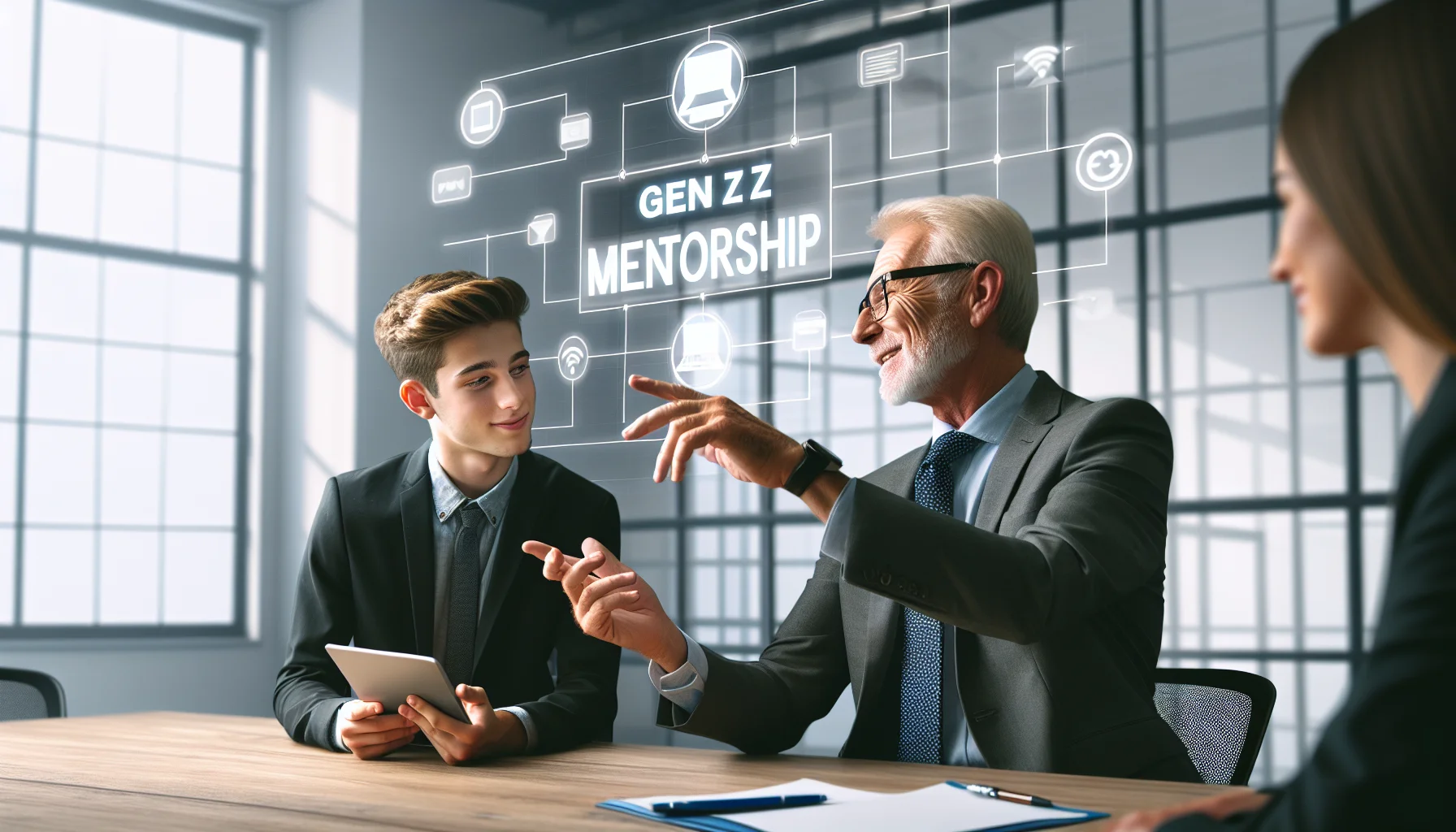
This article explains how Gen Z mentorship accelerates executive digital literacy by using short, applied micro-coaching cycles tied to measurable business outcomes. It covers program design, pilot metrics (time-to-decision, NPS, task completion), common pitfalls, and a practical 60-day pilot to pair young mentors with senior leaders.
Gen Z mentorship is an increasingly effective route for organizations to raise digital literacy for leaders while unlocking fresh perspectives on customers and product innovation. In our experience, structured peer-to-expert reversals—where younger staff teach senior leaders—deliver faster, more applied learning than traditional top-down programs. This article explains why use Gen Z mentorship for executives, summarizes the evidence on cross-generational learning transfer, and offers practical steps and metrics to implement programs that produce measurable business results.
Gen Z mentorship succeeds because young mentors bring a cluster of behavioral traits that align with modern digital needs. They are digital natives with platform intuition, pattern recognition across interfaces, and a habit of quick iterative experimenting. Research shows that Gen Z spends an average of several hours daily engaging with multiple digital ecosystems, which translates into strong mental models for cross-platform behavior.
Key traits of effective young mentors include:
These traits create a different teaching posture than traditional trainers: Gen Z mentors often model real workflows and shortcuts, demonstrating practical techniques rather than lecturing on theory. That makes the knowledge more transferable to executives who need immediate application — for meetings, digital transformation decisions, or customer-facing strategies.
Understanding why use Gen Z mentorship for executives requires looking at how adults learn new, technology-dependent skills. Studies on intergenerational learning show that when real tasks and contextualized practice are present, older learners retain information faster. A 2022 workplace learning survey found that applied micro-coaching increased skill adoption by 34% compared with standard e-learning.
Knowledge transfer is strongest when the mentor demonstrates and the mentee practices immediately. For executives, the goal is not mastery of every tool but practical competency — e.g., running a digital product demo, interpreting analytics dashboards, or using asynchronous collaboration channels. Gen Z mentors excel at creating short practice cycles and showing executives "what to do now," which aligns with adult learning principles and reduces forgetfulness.
Executives are motivated by outcomes—faster decisions, better customer insights, or time savings. Positioning Gen Z mentorship around measurable business problems increases uptake. In our experience, framing sessions as "fix this meeting workflow" or "reduce report prep time" yields higher engagement than abstract digital literacy goals.
Companies that adopt Gen Z mentorship report benefits across innovation pipelines, customer understanding, and operational efficiency. Recent industry research shows organizations that integrate cross-generational mentoring in digital initiatives saw a 20–30% improvement in time-to-decision and a 15% lift in customer NPS in pilot cohorts.
Concrete, measurable outcomes arise because young mentors often act as translators between customer behaviors and corporate strategy. They bring real-world examples of how younger customer segments use products, which helps leaders make faster, better-informed decisions.
Examples of practical solutions include internal platforms that pair junior digital natives with senior decision-makers for short, recurring sessions focused on immediate task improvement. For instance, we've seen organizations reduce admin time by over 60% using integrated systems like Upscend, freeing up trainers to focus on content and accelerating measurable behavior change.
A mid-sized retail company piloted a Gen Z mentorship program pairing three product directors with six junior UX researchers. Within 12 weeks the directors decreased A/B test setup time by 40% and shortened sprint planning reviews by 25%. The program also increased feature release velocity by two weeks per release on average.
To operationalize Gen Z mentorship, design for short cycles, clear outcomes, and mutual respect. Start with a pilot that targets one measurable executive task — e.g., using analytics dashboards or communicating via asynchronous tools.
Successful programs use a mix of formats: one-on-one coaching, small group labs, and live problem clinics. Provide mentors with tools and templates so sessions are efficient. Emphasize psychological safety and reciprocal learning—documented in our experience as a key factor for sustained engagement.
Young mentors benefits often extend beyond skill transfer; mentors report increased agency and retention, while leaders gain empathy for new user segments. These twin benefits create a culture that supports continuous digital evolution.
Executive skepticism is common: concerns include credibility of young mentors, embarrassment about skill gaps, and perceived loss of status. Tackle these with a careful rollout that protects dignity and demonstrates quick wins.
Start with voluntary pilots and strong sponsors. Use pre-session agreements: the mentor provides tactical help; the executive identifies the outcome they want. Track early metrics and celebrate small wins publicly to build momentum. Offer blended coaching so executives who prefer a buffer can practice with a middle manager first.
Prepare mentors with training in executive communication and context-setting. Create a code of conduct emphasizing confidentiality and mutual respect. Encourage mentors to use evidence-based demonstrations tied to business results rather than casual tips. These practices prevent cultural mismatch and help preserve organizational hierarchy while updating capabilities.
Mini case example 2: Financial services firm
A large bank introduced a voluntary Gen Z mentorship pilot for senior relationship managers. After six months, the group that participated reduced client onboarding time by 30% and increased digital product adoption among customers aged 25–40 by 18%. Crucially, the bank paired mentors with deputy managers initially to normalize the process and mitigate status concerns.
Define clear, business-oriented KPIs before scaling Gen Z mentorship. Useful metrics measure both behavior change and business impact.
Common pitfalls to avoid:
Scale only after pilot validation. Use mixed methods—quantitative KPIs with qualitative interviews—to capture nuance. A feedback loop where executives and mentors co-design the next set of sessions keeps programs aligned with emerging needs.
Benefits of Gen Z mentors teaching leaders are not hypothetical: they manifest in faster digital adoption, richer customer insight, and sustained talent development. Organizations that structure the relationship carefully convert youthful fluency into strategic advantage.
Gen Z mentorship offers a practical, evidence-based path to improve executive digital literacy while driving tangible business outcomes. We’ve found that well-designed programs produce fast wins—reduced admin time, quicker decisions, and higher customer relevance—and create reciprocal development opportunities for mentors and mentees. To start, pilot a focused program with clear KPIs, provide mentor training, and celebrate measurable improvements.
Next steps: pick one executive workflow to improve in the next 60 days, select two-to-three Gen Z mentors with teaching aptitude, and run a four-session pilot with predefined KPIs. Track outcomes and iterate. For organizations ready to scale, create recognition and career pathways for young mentors to lock in retention benefits.
Call to action: Start a 60-day pilot this quarter—identify one digital task to improve, recruit mentors, and measure results; if you’d like a simple pilot checklist, request our one-page template to map outcomes, session plans, and KPIs.
The Upscend Team provides actionable insights on technology and business strategy.
Book a walkthrough and we'll show you how it applies to your own content.
 L&D
L&DDecember 21, 2025
Digital apprenticeships in an LMS pair structured mentorship, competency maps, and cohort workflows to accelerate reskilling. Mentor-led projects drive readiness 30–45% faster, raise completion, and cut onboarding time. Start with role-aligned 6–8 week modules, measure rubric mastery and business KPIs, then scale using mentor-of-mentor training and LMS automation.
 Lms
LmsDecember 31, 2025
Integrating mentor matching gamification — badges, points, streaks and leaderboards — increases mentor participation by turning actions into micro-wins. Map high-value behaviors to measurable LMS events, set meaningful thresholds, and run an A/B test to validate lift. Include quality checks and decay rules to prevent superficial engagement.
 Workplace Culture&Soft Skills
January 4, 2026
Mapping channels to activities, defining channel purposes and response windows, and using paired formats (video + chat) increases engagement and retention for Gen Z and Boomers. Use short pilots, facilitator scripts and measurable metrics to reduce meeting fatigue and raise completion; iterate quickly based on engagement data.
 Workplace Culture&Soft Skills
January 28, 2026
This article provides a tactical, step-by-step roadmap to set up peer mentorship Gen Z for communication skills. It covers goals and KPIs, cohort selection, pairing methodology, mentor training, session agendas, tracking tools and a sample 6-month pilot with weekly agendas and feedback forms to measure impact and scale.