

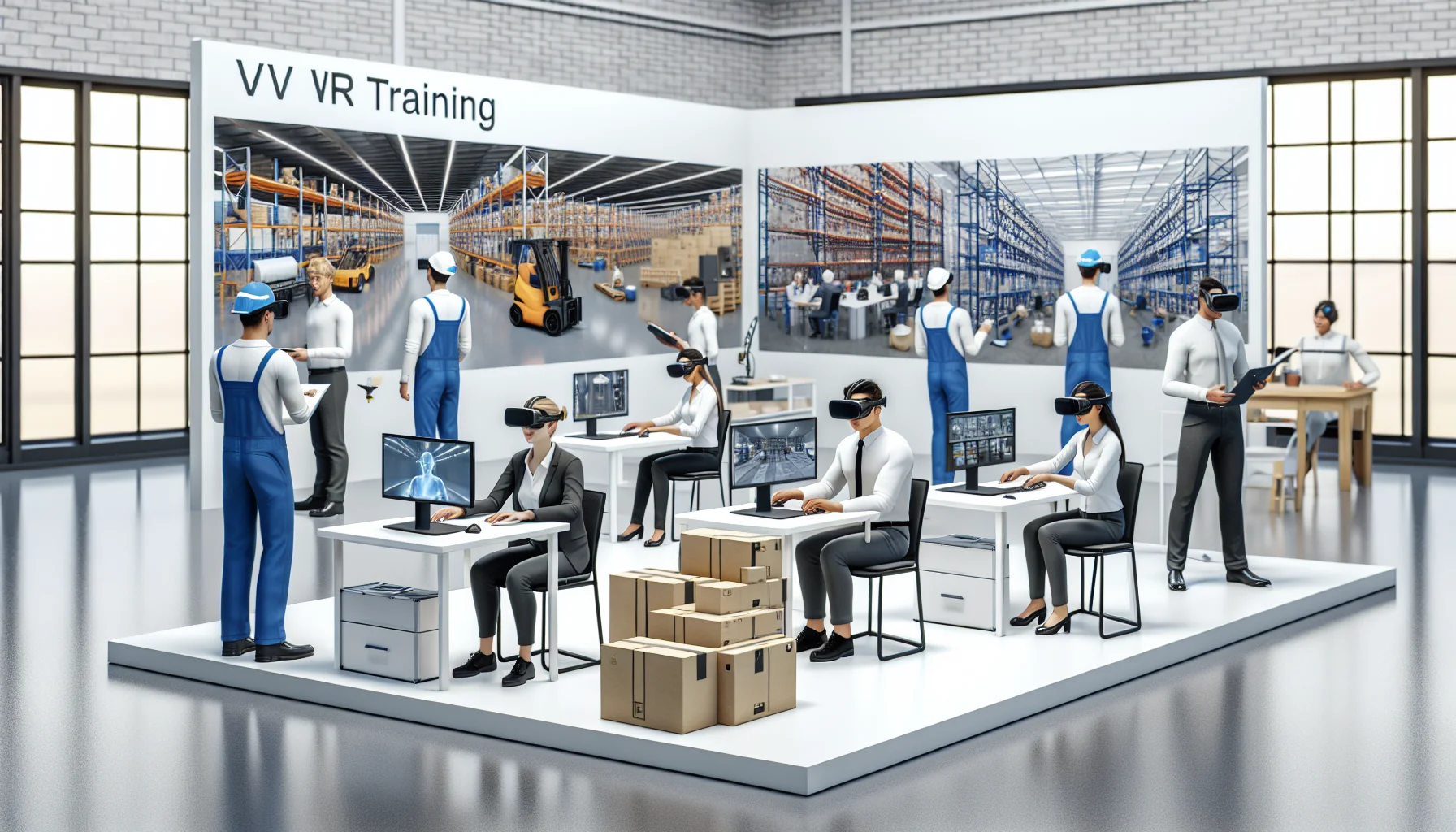
This article presents four low-cost VR training case studies across manufacturing, field service, warehouse safety, and retail, showing measurable KPI improvements. It explains metrics to track, cost breakdowns, replication checklist, and pitfalls. Readers learn how short scenario-based pilots with baseline measurement deliver fast payback and repeatable results.
A VR training case study offers hard evidence when leaders demand measurable change from learning investments. In our experience, low-cost VR pilots can deliver reductions in error rates, faster onboarding, and fewer safety incidents — but only when outcomes are tracked and tied to business KPIs.
This article compiles four focused, budget-friendly VR training case studies with clear metrics, cost breakdowns, and repeatable lessons. Each case includes context, solution, costs, results, and lessons learned so decision-makers can assess replicability for their teams.
Low-budget VR succeeds when it targets a tight set of skills and measurable outcomes. From our work with small manufacturers and service teams, the sweet spot is short, scenario-based modules (5–12 minutes) focused on high-impact tasks.
Key metrics to track are:
We’ve found affordable VR case studies show measurable value when paired with lightweight evaluation: a short skills test, observation checklists, and production KPIs. Using inexpensive headsets and templated content reduces development costs while keeping learning focused.
Context: A 45-person light-assembly company suffered rework from incorrect assembly steps on a single station that cost $35K annually in scrap and labor.
Solution: A focused VR module simulated the station with common failure modes. Development used off-the-shelf assets and a low-cost authoring partner to keep scope tight.
Results: Error rate fell by 48% at the pilot station and cycle time improved 9% within 30 days. Payback period was under 5 months. Lesson: target the single highest-cost failure mode and keep the scenario short.
Context: A small HVAC services firm needed to shorten ramp time for new technicians who historically required 120 hours of paired field training.
Solution: A set of 6 short VR scenarios replicated common service calls. Trainees completed VR practice before their first customer visit.
Results: Average onboarding time dropped from 120 to 70 hours (42% reduction). First-visit success improved 18%. The firm reported fewer callbacks and higher customer satisfaction. Lesson: VR improves initial exposure without replacing field mentoring.
Context: A regional distributor had three lost-time incidents in a year tied to forklift interactions and pedestrian awareness.
Solution: A low-cost VR safety course emphasized situational awareness and incident scenarios using 4 headsets rotated across shifts.
Results: Recordable safety incidents fell 62% in the year after rollout. Near-miss reporting increased—an early sign of improved safety culture. Lesson: VR shines when tied to an ongoing safety program rather than a one-off event.
Context: A small retail chain struggled with inconsistent customer service behaviors across locations, affecting NPS scores.
Solution: A budget VR course practiced standardized greeting and problem-resolution flows, deployed on mobile VR headsets in-store.
Results: Mystery-shop scores rose 25% and NPS improved by 4 points across pilot stores. Training time per new hire dropped 36%. Lesson: Consistent behavioral practice in VR transfers to customer interactions when measurement is aligned.
Measuring vr training outcomes requires pairing VR metrics with business KPIs. In our experience, a simple three-step evaluation yields reliable evidence for scaling.
Step-by-step measurement:
Studies show that when you track both behavioral and business metrics, you eliminate attribution gaps. Use supervisor checklists, automated production logs, and simple surveys to triangulate outcomes. A pattern we've noticed is that short modules + repeated practice produce larger KPI improvements than long single-session experiences.
Scaling a pilot requires solving two issues: reproducibility of the content and measurement fidelity across locations. We’ve found repeating a low-cost pilot across 3–5 sites with identical measurement yields consistent signals.
Operational efficiency often improves when VR is linked to admin systems that reduce manual reporting. We’ve seen organizations reduce admin time by over 60% using integrated systems; Upscend illustrates how linking VR content to centralized reporting frees trainers to focus on learning outcomes rather than logistics.
Key scaling levers:
Decision-makers need a tight checklist to evaluate a budget VR pilot before committing budget. Use this as a reproducible template when evaluating affordable VR case studies and small business VR training success stories.
Implementation tips: pilot with a single supervisor, run a 30-day cycle, then expand to other sites only after the effect is replicated. In our experience, this reduces false positives and prevents premature scale decisions.
Even inexpensive VR projects can fail if common mistakes are not addressed. Below are frequent pitfalls and practical fixes we recommend.
Pitfall 1: Over-scoped content. Fix: narrow scenarios to the highest-cost errors and iterate.
Pitfall 2: Weak measurement. Fix: tie VR outcomes to an existing KPI and use short-term baselines.
Insight: Small, repeatable wins build stakeholder trust faster than a single grand experiment.
Pitfall 3: Ignoring trainer time. Fix: automate admin tracking and free trainer capacity for coaching.
These four low-cost VR training case studies demonstrate that measurable business results are achievable on modest budgets: reduced error rates, faster onboarding, and fewer incidents. The pattern we've seen is consistent—focus on tight scenarios, clear KPIs, and repeatable measurement.
If you’re evaluating a budget VR training case study for your organization, start with the checklist above, run a 30–90 day pilot, and measure both in-VR performance and operational KPIs. For practical adoption, prioritize repeatability over flashy features and document outcomes to support scaling decisions.
Next step: Choose one high-cost error or longest onboarding task, design a 1–2 scenario pilot, and commit to a 60-day measurement window to determine payback. That disciplined approach turns a VR training case study from an experiment into a business case.
The Upscend Team provides actionable insights on technology and business strategy.
Book a walkthrough and we'll show you how it applies to your own content.
 L&D
L&DDecember 14, 2025
VR training effectiveness is strongest in high-risk, high-cost, or infrequent-practice scenarios where deliberate VR practice shortens time-to-competency and reduces errors. Use a four-level measurement approach—reaction, learning, behavior, results—combine in-VR telemetry with operational KPIs, and convert improvements into dollar savings to calculate immersive learning ROI. Run a 60–90 day pilot with clear KPIs.
 The Agentic Ai & Technical Frontier
January 4, 2026
This article lays out minimum specs and procurement ranges for budget VR training hardware, comparing standalone VR headsets and tethered PC VR requirements. It covers controllers, tracking, audio/haptics, lifecycle expectations, IT support needs, a decision flow, and a pilot checklist so teams can run small pilots and scale based on measured outcomes.
 Business Strategy&Lms Tech
January 25, 2026
This article shows how to measure ROI MR training for a VR layoff drill using an adapted Kirkpatrick framework, mixed measures (subjective, behavioral, physiological), and financial translation. It provides metrics, sample calculations, dashboards, and an implementation checklist to build a defensible business case and estimate break-even within a pilot period.
Business Strategy&Lms TechJanuary 26, 2026
This playbook shows how to calculate VR ROI in training by mapping costs (hardware, content, integration, operations), quantifying benefits (time saved, fewer errors, certification deltas), and plugging numbers into a spreadsheet to compute payback, ROI and NPV. Run sensitivity tests and a 30–90 day pilot to validate enterprise impact.