

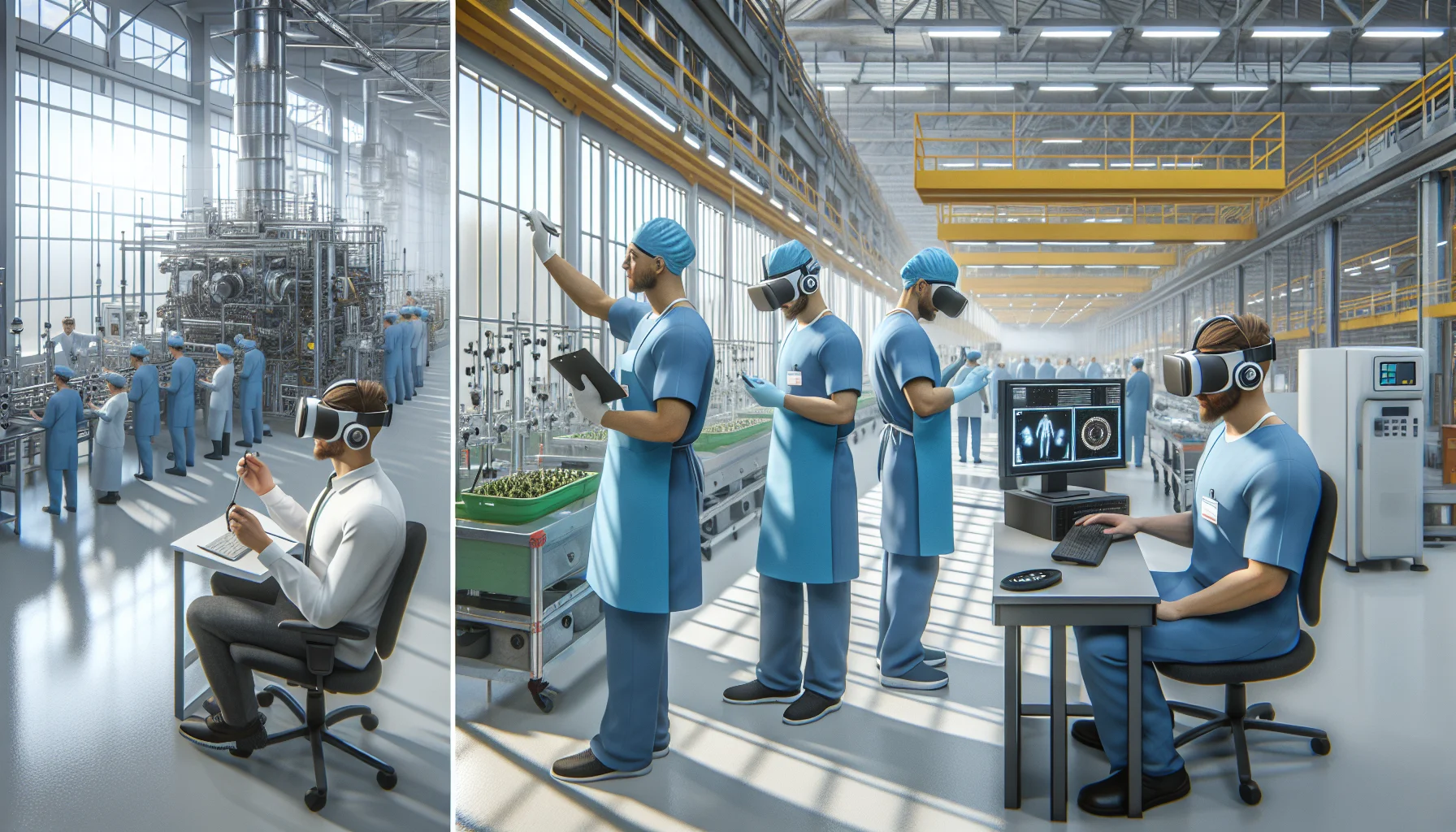
This article examines six budget-friendly VR training industries—manufacturing, healthcare, utilities, retail, logistics, and oil & gas—showing use cases, ROI levers, and short case studies. It offers a decision matrix and a three-step starter checklist to prioritize pilots that target high-risk, high-repeatability scenarios and measurable KPIs.
When leaders ask which industries should prioritize immersive learning, the clear answer points to sectors with high operational risk, expensive physical setups, or frequent regulatory retraining. In our experience, VR training industries deliver outsized returns when pilots focus on measurable outcomes: error reduction, faster competency, and lower simulation costs. This article analyzes six sectors—manufacturing, healthcare, utilities, retail, logistics, and oil & gas—offering use-case fit, ROI levers, budget-focused case studies, and a decision matrix to prioritize pilots.
Manufacturing VR simulation is a top candidate when physical rigs are costly or dangerous to reproduce. In our experience, assembly line onboarding, maintenance walkthroughs, and quality-inspection training produce rapid, measurable gains. VR lets trainees practice fault diagnosis and tool changes repeatedly without shutting down production lines.
Expected ROI levers include reduced downtime, fewer scrap parts, and faster ramp-up for new hires. A pattern we've noticed: when manufacturers pair VR modules with short competency tests, time-to-competency drops 20–40% and first-pass yield improves.
Scenario examples:
Small electronics plant: Using off-the-shelf headsets and a modular manufacturing scenario, the plant reduced setup costs by 70% compared with building a physical mock-up. Trainers reported a 30% decrease in onboarding time after three cohorts.
Healthcare VR training shines where mistakes have high human costs and where patient access for practice is limited. Simulation of rare emergencies, procedural steps, and bedside communication builds both technical and non-technical skills with no patient exposure.
Expected ROI levers include reduced medical errors, decreased malpractice exposure, and improved throughput in simulation labs. Studies show scenario repetition in VR transfers to faster decision-making in live care.
Common modules:
Community hospital: Implemented low-cost VR scenarios for emergency airway management. The program used tablet-based simulators and mid-range headsets; trainee pass rates improved 25% while simulation lab hours freed up for complex cases.
Utilities need simulations that reproduce high-voltage, confined-space, and plant-process environments. VR training industries that include utilities can lower risk by enabling repeatable, controlled practice of procedures that would otherwise require expensive shutdowns.
ROI is driven by fewer safety incidents, reduced permit-to-work costs, and faster crew mobilization. We’ve found that scenario-driven drills for switchgear operations and emergency isolation reduce incident response times meaningfully.
High-value simulations:
Regional utility: Adopted desktop VR for switchyard training to avoid full-site drills. The pilot cut permit and staffing costs for physical drills by half and improved procedural compliance rates by 18%.
Retail VR training is most effective for soft-skill development, store layout rehearsals, and point-of-sale procedures. Recreating peak-period stress with virtual customers helps staff practice upselling, handling returns, and loss-prevention scenarios.
Key ROI levers are higher conversion rates, fewer shrinkage incidents, and reduced time for new-store openings. A pattern we've noticed is that retail teams improve customer-handling KPIs faster when VR is used alongside microlearning and shadow shifts.
Retail modules often include:
Franchise convenience chain: Leveraged smartphone VR viewers and a single shared headset per store. After a six-week pilot, stores saw a 12% lift in average basket size and a 9% reduction in returns due to better POS handling.
Logistics and warehousing benefit from immersive practice of equipment handling, pick-and-pack efficiency, and route planning. VR training industries deploying logistical scenarios reduce accidents and speed up onboarding for seasonal workers.
ROI levers include lower damage claims, shorter equipment training, and optimized space utilization. We've found that time-stamped performance metrics from VR sessions provide actionable insights for operational tweaks.
Effective simulations include:
Third-party logistics provider: Built a phased VR rollout focused on high-risk equipment operators. Using an analytics-driven curriculum, they reduced minor equipment incidents by 40% within two quarters.
Oil & gas operations combine high environmental risk, strict compliance, and geographically dispersed crews. For these reasons, VR training industries including oil & gas can simulate rigs, flares, and emergency shutdowns far cheaper than repeated site training.
ROI drivers include avoided HSE incidents, reduced travel for specialist trainers, and faster qualifications for contractors. In our experience, scenario complexity pays off when paired with clear performance metrics and regulatory alignment.
High-impact modules:
Midstream operator: Created simplified platform evacuation scenarios using modular assets. The budget pilot avoided two full-scale drills and met regulator objectives while trimming training travel by 60%.
Use a simple scoring matrix that balances impact, feasibility, and cost. Below is a compact decision tool to prioritize pilots across the six industries analyzed. In our experience, leaders who score honestly and run short, measurable pilots reduce risk and accelerate adoption.
| Criteria | Score 1–5 (Low→High) |
|---|---|
| Risk reduction potential | — |
| Repeatability of scenarios | — |
| Cost to recreate environment physically | — |
| Regulatory/Compliance impact | — |
| Integration with existing L&D systems | — |
Scoring guidance: prioritize projects with high risk reduction, high repeatability, high physical recreation costs, and clear compliance drivers. We've found that combining these scores and running a 4–6 week pilot gives a reliable signal for scaling.
Practical tip: start with a single, high-frequency scenario that maps to a clear KPI (incident rate, time-to-certification, or conversion). Use basic analytics to measure baseline vs. post-VR performance.
When integrating VR with broader L&D ecosystems, pragmatic platforms and workflow automation matter. We’ve seen organizations reduce admin time by over 60% using integrated systems like Upscend, freeing up trainers to focus on content and rapid iteration.
Summing up, the best industries for VR training adoption are those with high risk, high repetition needs, and expensive physical setups. Manufacturing, healthcare, utilities, retail, logistics, and oil & gas each present clear, budget-friendly entry points where pilots can show fast ROI.
Common pitfalls to avoid:
Next steps: pick one high-impact scenario, score it with the decision matrix, and run a short pilot focused on a single KPI. If you want a simple starter checklist, use the following three-step approach:
Ready to prioritize your first pilot? Start with the scenario that scores highest on risk reduction and repeatability, and keep the scope tight. Practical pilots deliver the evidence leaders need to scale VR across operations.
The Upscend Team provides actionable insights on technology and business strategy.
Book a walkthrough and we'll show you how it applies to your own content.
 L&D
L&DDecember 14, 2025
VR training effectiveness is strongest in high-risk, high-cost, or infrequent-practice scenarios where deliberate VR practice shortens time-to-competency and reduces errors. Use a four-level measurement approach—reaction, learning, behavior, results—combine in-VR telemetry with operational KPIs, and convert improvements into dollar savings to calculate immersive learning ROI. Run a 60–90 day pilot with clear KPIs.
 The Agentic Ai & Technical Frontier
January 4, 2026
This article lays out minimum specs and procurement ranges for budget VR training hardware, comparing standalone VR headsets and tethered PC VR requirements. It covers controllers, tracking, audio/haptics, lifecycle expectations, IT support needs, a decision flow, and a pilot checklist so teams can run small pilots and scale based on measured outcomes.
 The Agentic Ai & Technical Frontier
January 4, 2026
This article explains minimum specs for VR training hardware on a budget, comparing standalone VR headsets and tethered PC VR requirements. It outlines component priorities, cost bands, lifecycle expectations, procurement tips, a decision flow for matching fidelity to objectives, and a low-cost pilot checklist to validate assumptions before scaling.
 The Agentic Ai & Technical Frontier
January 4, 2026
Assess affordable VR headsets for training by scoring optical fidelity (PPD), FOV and latency, plus ergonomics and enterprise tools. Pilot 10–20 units with real content, measure PPD/FOV in-context, and factor sanitation, warranties, and TCO. Match headsets to fine-motor or spatial training profiles before scaling.