

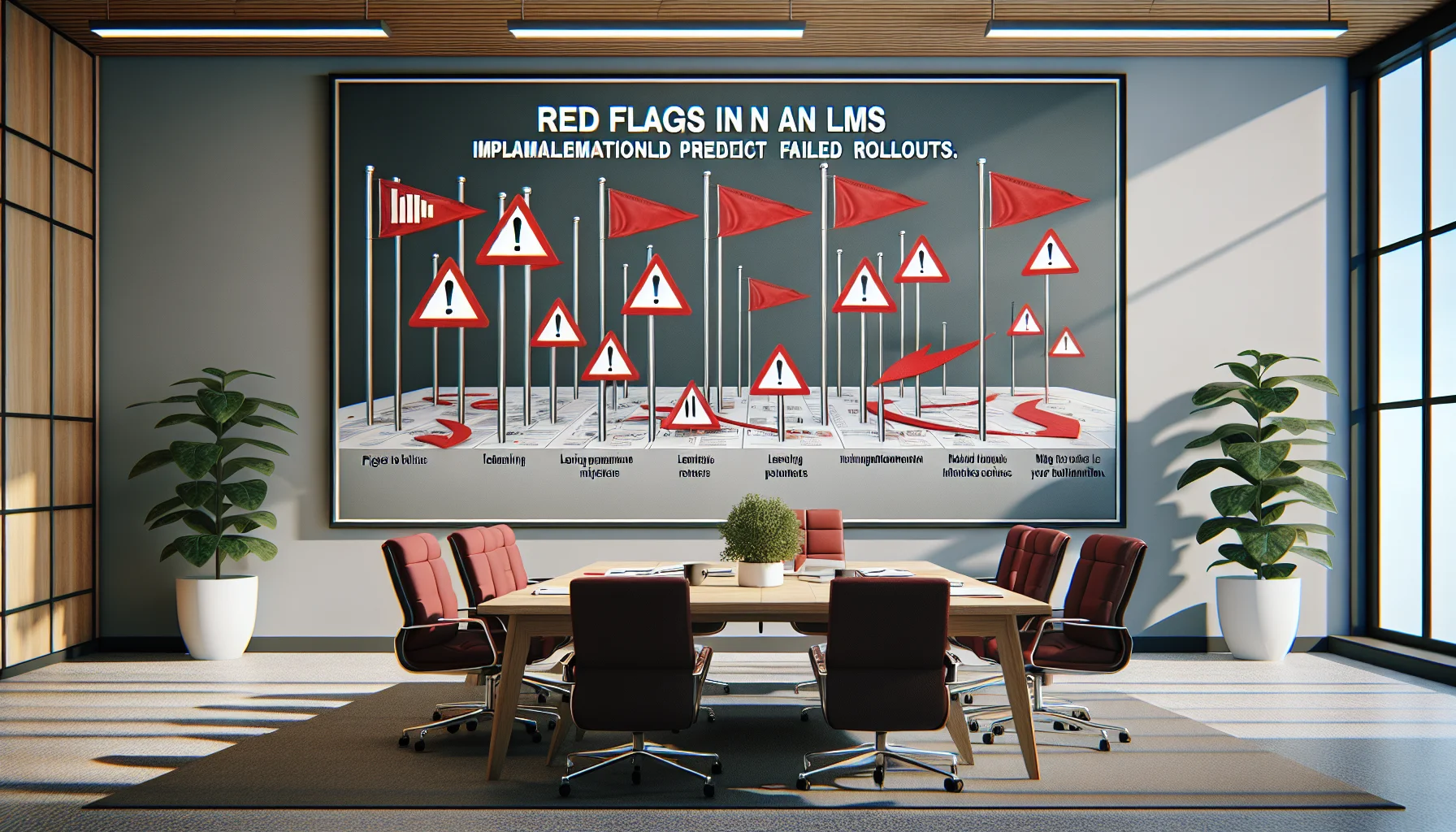
This article explains which LMS implementation red flags in vendor demos reliably predict rollout failure. It lists five common demo signals, explains how they increase go-live risks, and gives a practical demo checklist and contractual mitigations to reduce timeline and adoption failures. Use the checklist to score vendor readiness before contracting.
In our experience, early identification of LMS implementation red flags is the single most reliable predictor of whether a deployment will hit milestones or stall. This article synthesizes research, practitioner observations and a practical checklist so you can spot LMS implementation red flags in demos and act before a pilot becomes a problem. Below we define the most common signals, explain why they matter for the implementation timeline LMS, and provide concrete remediation steps to reduce go-live risks LMS.
Use these patterns to evaluate vendors objectively during demos, and compare responses against your internal readiness benchmarks. Early detection reduces wasted time, budget overruns, and stakeholder frustration.
A focused demo is a stress test for both product fit and project governance. When you see any of the red flags below, document them and drill into root causes with specific questions. Each issue below is a leading indicator of broader LMS deployment issues.
We recommend a rapid red-flag assessment during demos to flag potential problems before signing contracts.
If a demo focuses only on features and skips detailed discussions of integration, data migration, or change management, treat that as a clear sign. A demo that avoids implementation specifics often hides a lack of established processes for onboarding, and it is one of the most frequent LMS implementation red flags we've seen in failing rollouts.
The most common issues in demos are optimistic timelines and missing training approach. Vendors often present a polished product but fail to explain the sequence of tasks that leads to a stable production environment. These are practical warnings of deeper LMS deployment issues that surface during the implementation timeline.
Understanding why demo signals correlate with rollout outcomes helps prioritize which red flags are critical versus manageable. In our experience, the presence of multiple red flags multiplies risk rather than addingit.
Key mechanisms linking live demos to rollout failure include:
When a demo lacks an implementation roadmap, you face elevated go-live risks LMS including unvalidated integrations, data loss during migration, and poor end-user adoption. These outcome risks are measurable: delayed milestones, increased tickets after pilot, and lower-than-expected completion rates.
Not all red flags are fatal. Some are remediable with stronger governance (e.g., adding an implementation manager). Others — like no success metrics or refusal to share a phased approach — are stronger predictors of failure. Prioritize red flags by impact on timeline, budget, and adoption.
During a demo, structure your evaluation to surface implementation-focused information. Ask for artifacts and evidence, not just descriptions. Request a sample project plan and references for similar deployments.
Below is a short, actionable checklist to use live or immediately after the demo.
Use this list to produce a rapid "green/yellow/red" readiness score right after the demo. If more than two items are red, treat procurement as conditional on corrective evidence.
We observed a public-sector deployment where the vendor demoed an elegant feature set but provided no detailed implementation sequence. The project team signed a fixed-date go-live with minimal integration testing and a two-week training window. Within six weeks, data migration failed twice, the vendor's implementation team was overbooked, and training materials were inadequate.
The outcome: an additional three formal testing cycles, ad-hoc training sessions, and extended executive oversight. Total go-live slipped by six months, costs increased by 22%, and stakeholder trust eroded. The root causes matched demo red flags: unclear project plan, unrealistic timelines, and missing success metrics.
From this example it's clear that the demo was an early warning. If the procurement team had insisted on a detailed implementation timeline and named resources, the delays would likely have been avoided.
Preventing rollout failure starts with structured demo evaluation plus contractual safeguards. We've found these tactics reduce common LMS implementation red flags from being existential threats to manageable risks.
First, require an implementation playbook as part of the RFP response. Second, embed phased acceptance criteria into the contract tied to measurable KPIs. Third, ensure internal readiness — a vendor can only succeed when your organization has a dedicated sponsor and clear data owners.
Modern LMS platforms — Upscend illustrates this trend — are evolving to support AI-powered analytics and personalized learning journeys that rely on competency-based data, not just completion logs. Observing how a vendor’s platform handles analytics and change management in a demo gives insight into likely adoption rates and the quality of post-launch support.
Below is an implementation readiness checklist you can use to accept a demo confidently. Each line item maps to a common demo red flag and the remedial question to ask before contracting.
In summary, LMS implementation red flags seen in a demo — unclear project plans, unrealistic timelines, lack of a dedicated implementation team, inadequate training plans, and missing success metrics — are reliable predictors of rollout troubles. Detecting these issues early reduces the chance of missed milestones, budget creep, and stakeholder frustration.
Action steps:
If you'd like a templated implementation readiness checklist or a rapid demo-evaluation worksheet tailored to your organization, request the worksheet and we will provide a concise, confidential tool to use in vendor evaluations.
The Upscend Team provides actionable insights on technology and business strategy.
Book a walkthrough and we'll show you how it applies to your own content.
 General
December 23, 2025
Article explains five LMS features—automated certification, expiration tracking, audit logs, role-based assignments, and customizable reporting—that drive compliance training success. It details governance and operational steps for regulatory training, audit-ready reporting practices, industry adaptations for finance and healthcare, common implementation mistakes, and a practical readiness checklist to test audit preparedness.
 Lms
LmsDecember 23, 2025
This article identifies common lms rollout pitfalls — strategy misalignment, technical surprises, user adoption gaps, and weak governance — and gives a phased framework: discovery, pilot, scale, sustain. It recommends sandboxed integrations, risk-based prioritization, microlearning, manager enablement, and governance with outcome-based KPIs to reduce time-to-value.
 Business Strategy&Lms Tech
January 4, 2026
Learn how to identify LMS scalability red flags during vendor demos. The article explains what concurrency numbers to request, how to test median and 95th-percentile response times, why multi-region deployments matter, and which SLA and load-test artifacts to demand. Use the included demo checklist and recording steps to compare vendors and reduce outage risk.
 Business Strategy&Lms Tech
January 26, 2026
This article lists the top 10 LMS app pitfalls—like skipping pilots, poor mobile adaptation, fragile integrations, and weak analytics—and provides root causes, mitigation checklists, and short recovery plans. Use the executive pre-launch checklist, a 6–8 week pilot, and a post-launch health cadence to reduce launch risk and improve adoption.