

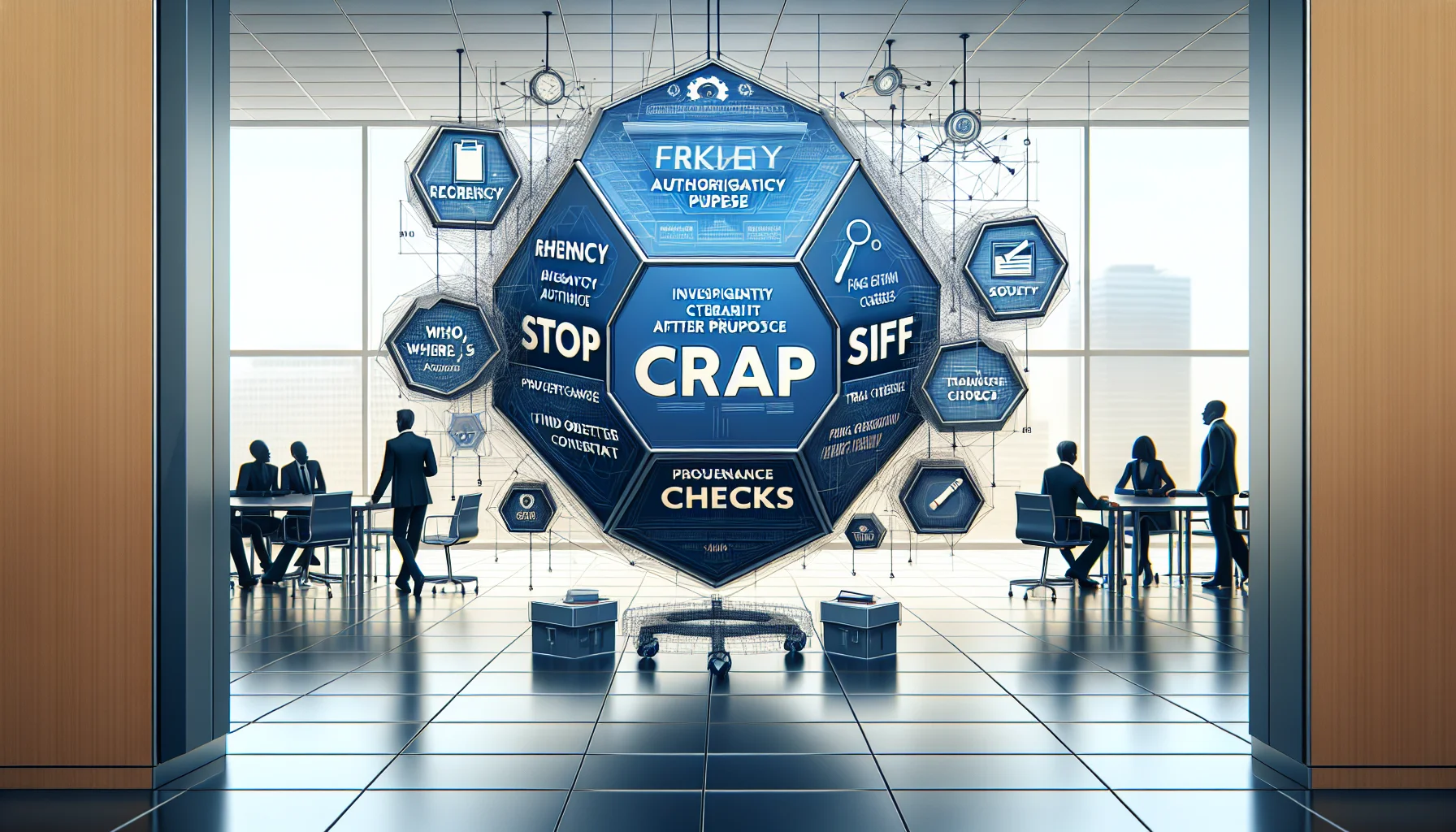
This article compares CRAAP, SIFT and provenance checks and shows how to adapt them for AI outputs by adding provenance, model confidence, reproducibility and citation fidelity. It supplies compact and detailed rubric templates, a case study, and a two-week pilot plan to reduce inconsistent assessments across reviewers.
In our experience, effective use of fact-checking frameworks is the single best way to bring consistency to reviewing AI-generated content. The challenge is that AI outputs blend synthesis, plausible-sounding statements, and citations in ways that traditional checks weren't designed for. This article compares proven frameworks, shows how to adapt them for AI, and provides ready-to-use rubric templates you can apply today.
We focus on practical, repeatable methods: the CRAAP test, the SIFT method, and provenance checks, then translate core principles into evaluation criteria tailored for models. Expect step-by-step rubrics, scoring examples, and a short case study that compares outcomes to reduce inconsistent assessments under time pressure.
AI outputs are not traditional authored texts; they are probabilistic generations that can mix facts, hallucinations, and rephrased sources. That requires adapting how we apply fact-checking frameworks. Quick heuristics often fail because AI can fabricate plausible metadata (like invented citations) and mask provenance.
We’ve found that two patterns cause most verification failures: overconfidence in machine-provided citations and inconsistent assessor heuristics. Using a consistent, written framework reduces variability and speeds decisions under pressure.
AI evaluation frameworks must add dimensions beyond accuracy: source provenance, machine-reported confidence, and reproducibility of outputs. These additions convert a binary "true/false" check into a graded assessment that supports remediation (edit, retract, annotate).
At minimum, a verification framework intended for AI should answer three questions: Is the claim supported by verifiable sources? Can the generation path be reconstructed? Is the model’s confidence or ambiguity captured? Answering these relies on combining traditional information credibility frameworks with metadata and process logs.
Start with frameworks that people trust. The CRAAP test evaluates Currency, Relevance, Authority, Accuracy, Purpose. SIFT (Stop, Investigate the source, Find better coverage, Trace claims) emphasizes rapid triage. Provenance checks focus on authoring and sourcing chains — critical for AI outputs.
Each framework brings strengths: CRAAP is thorough; SIFT is fast; provenance checks expose origin metadata. When combined, they form a layered defence against errors in AI content.
CRAAP remains useful but needs reinterpretation. For AI: Currency becomes model version and data freshness; Authority becomes traceable source links or training data signals; Accuracy requires reproducible evidence; Purpose flags whether the model was prompted in a way that biases results. Treat CRAAP as a detailed second-pass assessment.
SIFT is ideal for first-response under time pressure: stop and evaluate the claim's plausibility, investigate quickly, locate better coverage, and trace original sources. For AI, SIFT can triage outputs before applying a full CRAAP-style audit.
To make any fact-checking frameworks effective on AI outputs, add four core AI-specific criteria: source provenance, model confidence, reproducibility, and citation fidelity. These augment traditional checks and create operational clarity.
Below are practical definitions you can copy into team SOPs and into automated checks.
Here’s a compact rubric for rapid use. Score 0–2 for each criterion, where 0 = fail, 1 = partial, 2 = pass. Total ≥7/8 = reliable; 4–6 = needs review; ≤3 = reject or flag for major revision.
Below are two ready-to-use rubric templates: a compact triage rubric and a detailed audit rubric. Copy these into your workflows or refine them for specific domains. These function as evaluation criteria you can automate or use manually.
Templates are intentionally simple so teams can adopt them quickly under time pressure.
| Compact Triage Rubric | Score (0-2) |
|---|---|
| Claim plausibility | 0/1/2 |
| Source traceable | 0/1/2 |
| Citation fidelity | 0/1/2 |
| Recommend action (Pass/Review/Reject) |
| Detailed Audit Rubric | 0 | 1 | 2 |
|---|---|---|---|
| Provenance | None | Partial trace | Full trace |
| Citation fidelity | No support | Indirect support | Direct support |
| Reproducibility | Not reproducible | Reproducible with conditions | Reproducible |
| Model confidence | No indication | Ambiguous | Explicit/confidence intervals |
Example scoring: An AI answer with traceable sources (2), partial citation fidelity (1), reproducible with seed (2), and no confidence flag (0) scores 5/8 → needs review and annotation.
We evaluated the same AI passage about vaccine efficacy using both a CRAAP-adapted audit and a SIFT triage. The passage cited two journal titles and provided a DOI-like string.
Using the CRAAP-adapted checklist, the passage scored low on Authority (journals were real but DOIs mismatched) and on Accuracy (data points didn't match source tables). Total: fail. Using SIFT, the output failed the "Trace" step quickly when the DOI resolved to a different article, so it was triaged out for immediate correction.
SIFT detected the problem fastest because its explicit "Trace" step and focus on source verification is optimized for quick triage. CRAAP provided a fuller explanation of why the claim failed and suggested specific edits and corrective language.
When we layered the AI-specific rubric (provenance, reproducibility, citation fidelity) on top of CRAAP and SIFT, the team produced a clear remediation: retract the claim, add corrected citations, and append an uncertainty statement. This combo prevented inconsistent assessments across reviewers.
A practical note: tools that surface source links, prompt histories, and reproducibility logs speed both SIFT and CRAAP application (available in platforms like Upscend) and reduce time-to-verification in operational settings.
Scaling verification across teams requires two things: a short triage path for high volume and a deeper audit path for high risk. A layered system using fact-checking frameworks accomplishes this: SIFT for triage, CRAAP for audits, and provenance checks wherever claims drive decisions.
Common pitfalls we’ve seen: ad hoc scoring, missing seed/metadata capture, and overreliance on model-supplied citations. Address these with simple technology and process changes.
Write the rubric into SOPs, train reviewers with paired assessments, and use inter-rater reliability checks weekly. In our experience, a two-week calibration cycle reduces variance by over 40% in initial audits.
Use SIFT-first: stop, investigate the source quickly, find better coverage if available, and trace claims only when needed. Keep the compact triage rubric on a one-page card and reserve detailed audits for cases that score in the "needs review" band.
To summarize, no single method is perfect. The best practice is a layered approach: use SIFT for quick triage, apply a CRAAP-adapted audit for high-risk items, and enforce provenance checks and reproducibility as mandatory fields in your review process. These combined fact-checking frameworks provide both speed and depth.
Start by adopting the compact triage rubric in your daily reviews and roll out the detailed audit rubric for high-impact content. Train teams with the case study above and run regular calibration sessions to reduce inconsistent assessments.
Download or copy the rubric tables above into your verification trackers and schedule a pilot: 2 weeks, 5 reviewers, 50 outputs. Evaluate inter-rater variance and iterate.
Call to action: Run a pilot with the compact triage rubric and the detailed audit rubric on 50 recent AI outputs this month; measure time-to-decision and inter-rater agreement, then refine thresholds based on results.
The Upscend Team provides actionable insights on technology and business strategy.
Book a walkthrough and we'll show you how it applies to your own content.
 Ai
AiOctober 6, 2025
This guide compares TensorFlow, PyTorch, and Keras, highlighting their strengths in scalability, user-friendliness, and integration. It helps businesses choose the right AI framework based on specific needs and future adaptability.
 Ai
AiJanuary 27, 2026
This guide frames ai quiz generation tradeoffs—speed, quality, and bias—and gives decision makers a practical checklist, vendor KPIs, and a staged roadmap. It recommends hybrid drafting with automated checks, subgroup monitoring for DIF, and a 30-day pilot to capture psychometrics before scaling.
 Ai
AiJanuary 27, 2026
This article provides a seven‑check ai quiz quality checklist for prelaunch automated assessments, including quick-test scripts, pass/fail thresholds, and sign-off templates. Follow checks for content accuracy, duplicate detection, distractor plausibility, readability, psychometrics, bias, and pilot scoring to reduce post-launch edits and scale SME review.