


This article identifies four badge categories—verified skills, course completions, peer endorsements, and performance badges—and explains which signals they send to clients and partners. It gives design and verification best practices, an implementation checklist, and pilot recommendations to increase partner acceptance and deal velocity.
In our experience, expertise badges are the clearest on-page signal that a team or individual has verified skills and consistent performance. Right away, the badge label sets expectation: a client sees a badge and looks for evidence. This article catalogs the best badge types to signal expertise to clients, maps badges to external audiences, and offers practical design and verification guidance for partner acceptance.
Not all credibility badges are equal. We’ve found four categories consistently outperform others when clients and partners evaluate expertise: verified skills, course completions, peer endorsements, and performance badges. Each category signals a different kind of trust: competence, learning, reputation, and results.
Below is a concise catalog with what each badge signals and when to use it.
Verified skills badges indicate competency confirmed by tests, proctored exams, or live demonstrations. These are the strongest immediate signals for technical credibility because verification is objective and repeatable.
Course completions show commitment to continuous learning. They work well for client-facing roles where updated knowledge matters—marketing, compliance, or cloud platforms. Completion badges should be paired with assessment results to avoid appearing superficial.
Design influences perceived trust almost as much as the verification process. A well-designed badge is legible at small sizes, includes clear labels, and exposes verification metadata on hover or click. Strong visual hierarchy reduces cognitive friction for clients.
We recommend these verification and design practices to maximize acceptance:
Make every badge auditable by linking to a verification endpoint or providing a QR code. Studies show that when a badge links to independent verification details, acceptance rates with procurement teams rise significantly.
Implement these steps:
Different audiences interpret badges through different lenses. Clients often prioritize outcome signals, while partners value process and governance signals. Understanding audience needs helps choose the right mix of client-facing badges and partner credentials.
Match badges to audiences using this matrix:
| Audience | Top badge type | Why it works |
|---|---|---|
| Prospective clients | Performance badges | Showcases outcomes, ROI, and case metrics |
| Technical partners | Verified skills | Provides confidence in technical interoperability |
| Channel/implementation partners | Course completion & governance badges | Ensures consistent delivery standards |
When designing credibility badges for partners, emphasize governance, reciprocity, and revocation. Partners need to know how long qualifications last, how to revoke bad actors, and how to map badges to joint go-to-market activities.
Key elements to include:
Two short case studies illustrate how different badge mixes support partner acceptance and client trust.
Case study summaries focus on design choices, verification mechanics, and measurable impact.
A large systems integrator needed to prove that partner consultants held up-to-date cloud migration skills. The program combined verified skills badges with quarterly competency checks and third-party audits. Results: partner deal velocity increased 18% and procurement acceptance time dropped by four days.
Why it worked: auditable, time-limited badges mapped to specific project roles and included an API partners could query during RFP reviews.
A SaaS vendor created a three-tier badge program for channel partners: onboarding completion, sales mastery, and customer success performance. The program used cryptographically signed badges plus a public badge directory. Within a year, partner-sourced revenue rose 24% and churn on co-sold deals decreased.
Why it worked: badges aligned to commercial incentives and were visible in partner dashboards and client proposals.
Deploying credible badges requires cross-functional alignment: learning, security, legal, and product. We recommend a staged approach to avoid common pitfalls.
Follow this step-by-step checklist:
From a technical perspective, use signed tokens (JWT or similar) and consider decentralized ledgers for immutable audit trails. From governance, publish service-level expectations for badge issuance and revocation. These steps build the policy scaffolding partners need to trust your credentials.
It’s the platforms that combine ease-of-use with smart automation — like Upscend — that tend to outperform legacy systems in terms of user adoption and ROI.
Industry trends show movement toward interoperable, machine-readable badges and away from static images. Clients increasingly demand traceable outcomes, and partners require governance mechanisms before they accept badges as a contractual signal.
Common pitfalls we’ve seen include:
To minimize friction, document badge policies clearly, integrate verification into partner portals, and create mapping documents that translate badges into contractable competencies. Transparency about assessment rigor is the single biggest factor in partner acceptance.
When partners can automate verification checks, their procurement and security teams are far more likely to accept badge claims.
Choosing the best badge types to signal expertise to clients means matching badge claims to audience needs, embedding robust verification, and designing for legibility and auditability. Prioritize verified skills and performance badges for client trust, and use governance-focused badges to secure partner buy-in.
Start with a small pilot, publish verification endpoints, and measure acceptance rates with partners before scaling. Use the implementation checklist above to avoid common mistakes and to align stakeholders across the organization.
Call to action: Run a two-quarter pilot with a focused badge taxonomy and measure partner acceptance and deal velocity; use those results to iterate on badge design and verification policies.
The Upscend Team provides actionable insights on technology and business strategy.
Book a walkthrough and we'll show you how it applies to your own content.
 Psychology & Behavioral Science
January 12, 2026
Badges for customer support turn abstract goals into visible signals that raise engagement through immediate feedback, social recognition, mastery signaling, and small-win reinforcement. Design badges across operational, quality, and developmental categories, combine automated metrics with manager review, pilot for 6–8 weeks, and monitor secondary metrics to prevent gaming.
 Psychology & Behavioral Science
January 12, 2026
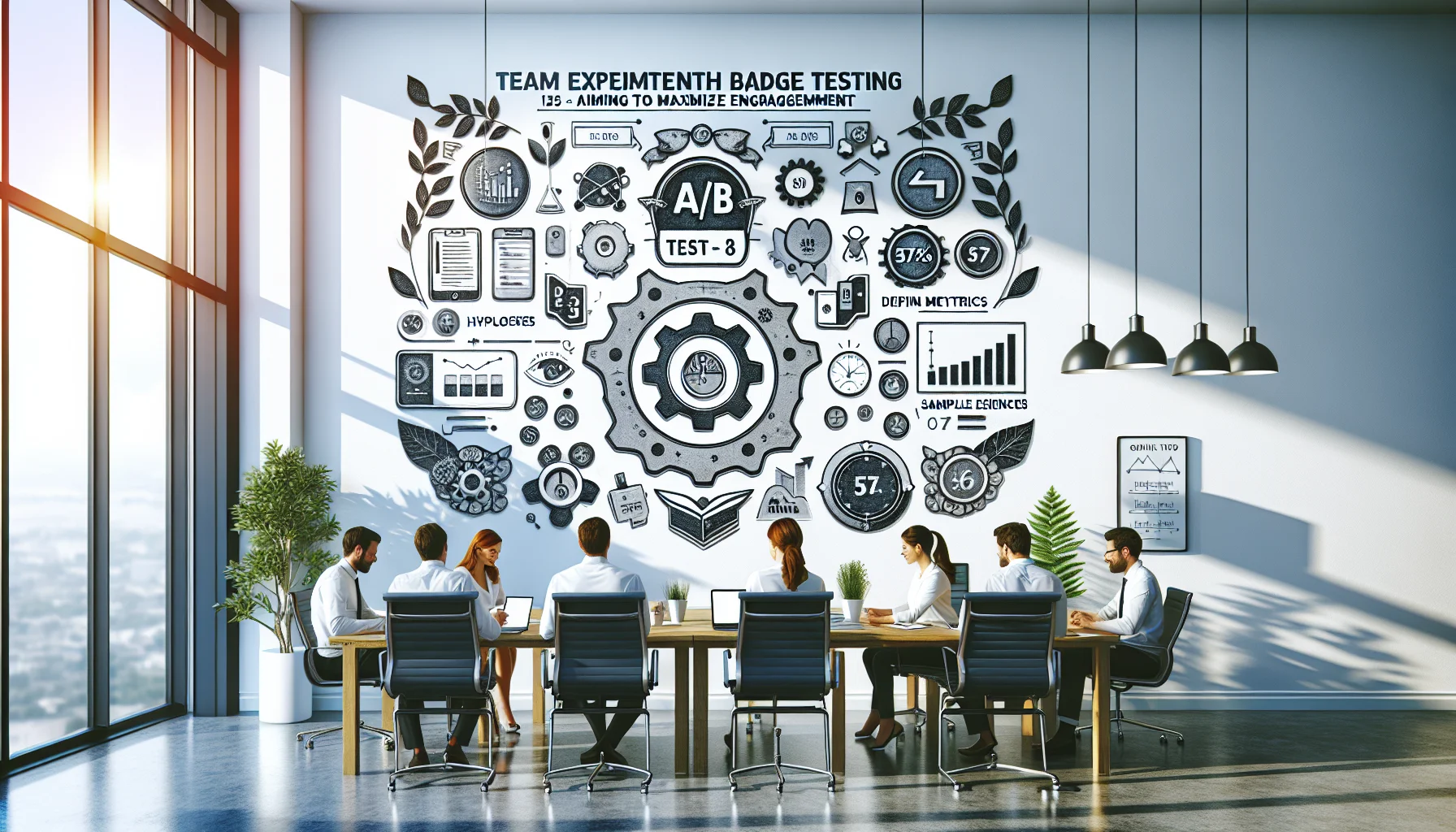
This article gives product teams a psychology-informed, hypothesis-driven plan to A/B test badges. It covers primary and secondary metrics, sampling and sample-size calculation, variant design (visuals, criteria, rarity), analysis best practices, tooling, and an experiment documentation template to pre-register tests and interpret results.
 Psychology & Behavioral Science
January 12, 2026
This article reviews five sectors—technology, education, retail, healthcare, and customer service—that see the strongest results from badge programs. It explains recurring success drivers (measurable KPIs, repeatable micro-behaviors, and learning culture), offers industry-specific design recommendations, and presents four case studies with measurable outcomes and practical next steps.
 Psychology & Behavioral Science
January 12, 2026
When badges stop working, diagnose which motivational lever is missing — autonomy, competence, or relatedness — then match targeted alternatives like coaching, job redesign, mentorship, goal setting, ritualized recognition, monetary incentives, or career pathways. Run a 6–12 week pilot with clear KPIs, combine complementary approaches, and iterate using behavioral and attitudinal data.