


This article maps where to find prebuilt quick-response training content and how to evaluate crisis training content libraries for speed, legal clarity, and technical fit. Use the buyer’s checklist, procurement clauses, and a vendor scoring spreadsheet to run two 30‑day pilots and validate SCORM/xAPI, localization, and update cadence before contract.
When a crisis strikes, the fastest route to readiness is often a crisis training content library you can deploy immediately. In our experience, teams that pre-arrange access to external libraries recover faster and reduce operational risk more effectively. This article maps where to find prebuilt quick-response training content, how to evaluate offerings, and what procurement language stops licensing surprises.
Organizations choose a crisis training content library because it shortens design time, standardizes messaging, and provides tested scenarios. A reliable library gives learners immediate access to prebuilt training modules for incident response, media handling, cyber incidents, and physical safety.
Two patterns we've noticed: smaller teams prefer ready-made crisis courses to fill gaps quickly; larger programs buy libraries as a baseline and layer custom simulations. Both want content that is current, portable, and auditable.
Prebuilt assets accelerate readiness and reduce vendor management overhead. Typical gains include:
Common failures arise from licensing surprises and stale content. We’ve found that teams often neglect to confirm update cadence or global applicability, which undermines the library's long-term value.
Knowing where to find prebuilt quick-response training content is half the battle. Options fall into clear categories; selecting the right category depends on speed, depth, and budget.
Common vendor types include LMS marketplaces, specialized vendors, publishers, and public-sector repositories. A well-curated crisis training content library might combine more than one source to cover technical, legal, and human factors.
For many procurement teams, the quickest answers to where to source prebuilt quick-response training content are LMS marketplaces and specialized crisis-content providers because they balance speed and role-specific depth.
When evaluating a crisis training content library, use a structured checklist to avoid missing critical constraints. Below is a condensed buyer’s checklist that reflects what we’ve learned from multiple implementations.
Technical fit frequently disqualifies otherwise suitable offerings. Verify SCORM and SCORM/xAPI compatibility, mobile responsiveness, load times, and accessibility compliance (WCAG). A robust crisis training content library exposes content via API or packaged formats so you can integrate it with incident systems and HR records.
Licensing restrictions are a recurring pain point. Ask whether content can be forked, whether derivative works are allowed, and if the vendor restricts offline backups. Strong contracts specify update SLAs and remediation rights if content is materially incorrect.
Procurement teams should use standardized questions to compare offerings efficiently. Below are practical questions and contract clauses that we recommend including in RFPs and SOWs for any crisis training content library.
Suggested contract clauses:
Real-world selection becomes easier when you think in archetypes. Here are three representative content sources and how they fit typical requirements for a crisis training content library.
1. LMS Marketplace — Profile: broad catalog, fast procurement. Strengths: speed to deploy, standardized packaging, multiple vendors in one contract. Weaknesses: variable content quality and licensing variance. Use when you need immediate breadth and standardized export formats.
2. Specialized Crisis-Content Vendor — Profile: deep scenario design, simulations, and tabletop exercises. Strengths: domain expertise and realistic role-play. Weaknesses: higher cost and sometimes proprietary formats. Use when operational realism and repeated exercises matter most.
3. Publisher / Government Repository — Profile: authoritative source material and low-cost licensing. Strengths: credibility and often permissive reuse. Weaknesses: limited interactivity and update cadence. Use when compliance and authority are primary drivers.
A common turning point for most teams isn’t just creating more content — it’s removing friction. Tools like Upscend help by making analytics and personalization part of the core process, enabling teams to route the right ready-made crisis courses to the right roles and measure behavior change quickly.
Use a simple scoring model to compare vendors objectively. Below is a table you can copy into a spreadsheet. Score each criterion 1–5 and weight by importance.
| Vendor | Content Type | Update Frequency | Licensing | Customization Ease | SCORM/xAPI | Localization | Total Score |
|---|---|---|---|---|---|---|---|
| Vendor A | Simulation + Modules | Quarterly (5) | Enterprise (4) | High (5) | Yes (5) | Multi-Lang (4) | 27 / 30 |
Scoring guidance: weight Update Frequency and Licensing more heavily for crisis content — outdated modules or restrictive licenses are the most common failure modes. In our experience, a vendor with strong integrability (SCORM/xAPI support) and permissive licensing reduces total cost of ownership over three years.
Two additional implementation tips:
Choosing the right crisis training content library requires balancing speed, accuracy, and legal clarity. Prioritize vendors that publish clear update cadences, allow localization and derivatives, and provide open packaging (SCORM/xAPI). Use the buyer’s checklist and procurement clauses above to avoid common licensing restrictions and relevance gaps.
We've found that blending sources — a marketplace for breadth, a specialist for depth, and authoritative publishers for compliance — yields the best mix of readiness and credibility. Score vendors objectively with the spreadsheet template, run short pilots, and require exit/transfer clauses to preserve continuity.
Next step: copy the spreadsheet template into your procurement workbook, select two pilots (one marketplace, one specialist), and run a 30-day validation with your LMS and incident team. That practical test will reveal whether a prospective crisis training content library meets both speed and legal requirements before you commit.
The Upscend Team provides actionable insights on technology and business strategy.
Book a walkthrough and we'll show you how it applies to your own content.
 ESG & Sustainability Training
January 5, 2026
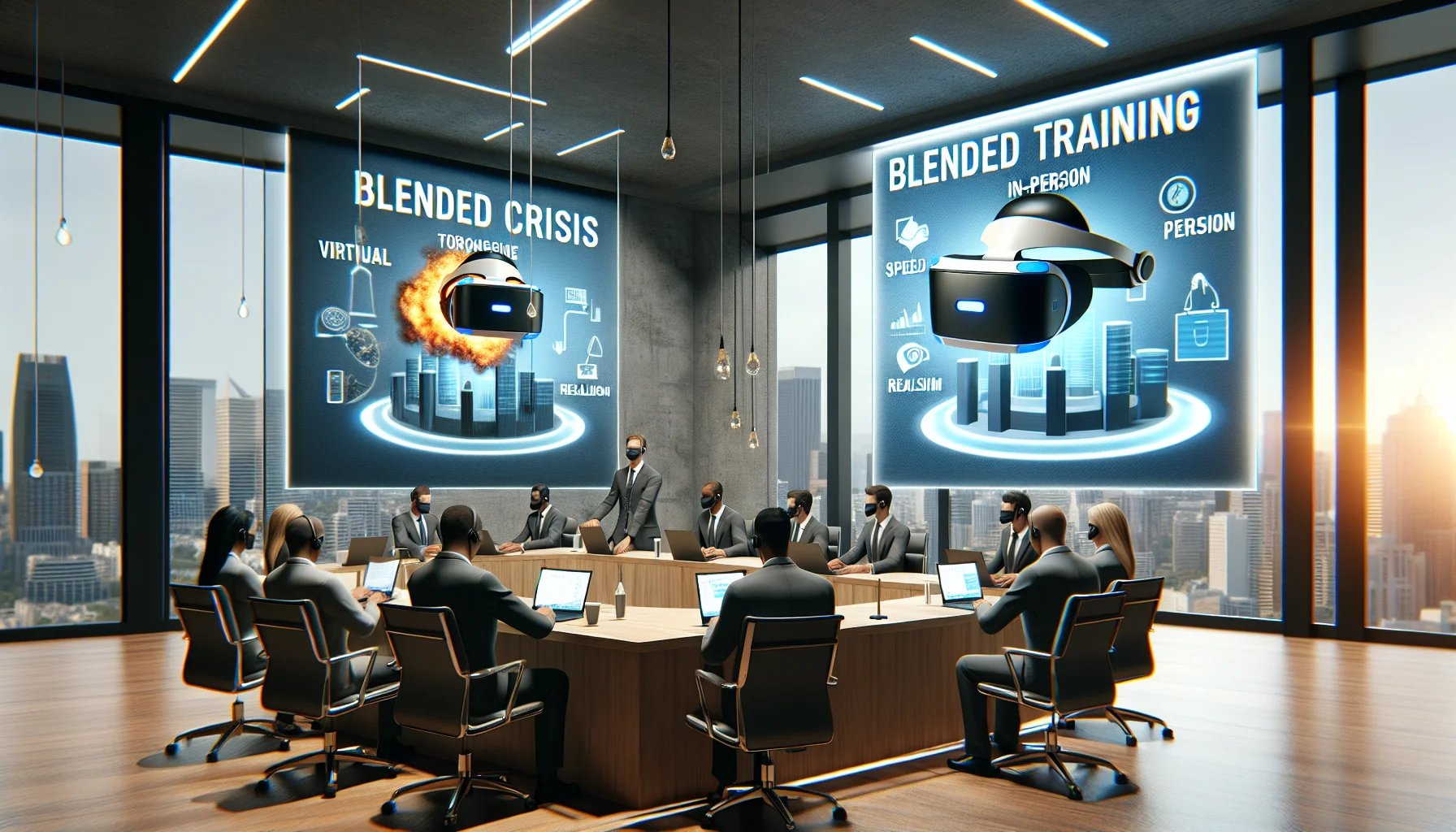
This article compares virtual, in-person and blended crisis training across speed, realism, reach, cost and assessment fidelity, and concludes blended crisis training is the pragmatic default when speed and fidelity matter. It includes a decision matrix, role-based mixes, sample schedules, cost/time trade-offs, and a 6–8 week pilot checklist with metrics.
 ESG & Sustainability Training
January 5, 2026
This article shows procurement teams how to locate turnkey crisis training vendors quickly, construct a lean training vendor RFP, and apply a weighted procurement checklist and scoring rubric to evaluate offers. It outlines sourcing channels, must-have contract clauses, and practical steps to avoid vendor lock-in while running a rapid two-week pilot.
Workplace Culture&Soft SkillsFebruary 4, 2026
Practical roadmap for decision makers to build and measure soft skills for crisis. The guide outlines five core competencies—communication, decision-making, emotional intelligence, adaptability, psychological safety—and a three-tier assessment approach, modular training (microlearning, simulations, coaching), process embeds, KPIs, and a sample 90‑day implementation plan to drive measurable improvement.
 Workplace Culture&Soft Skills
February 4, 2026
This article guides procurement and people teams through selecting soft skills assessment tools for crisis teams. It explains how to define goals, compare vendors on validity, reliability, integration, and security, and run a 4–8 week pilot with measurable gates. Includes an ROI template, vendor matrix, sample RFP questions, and a mini case.