

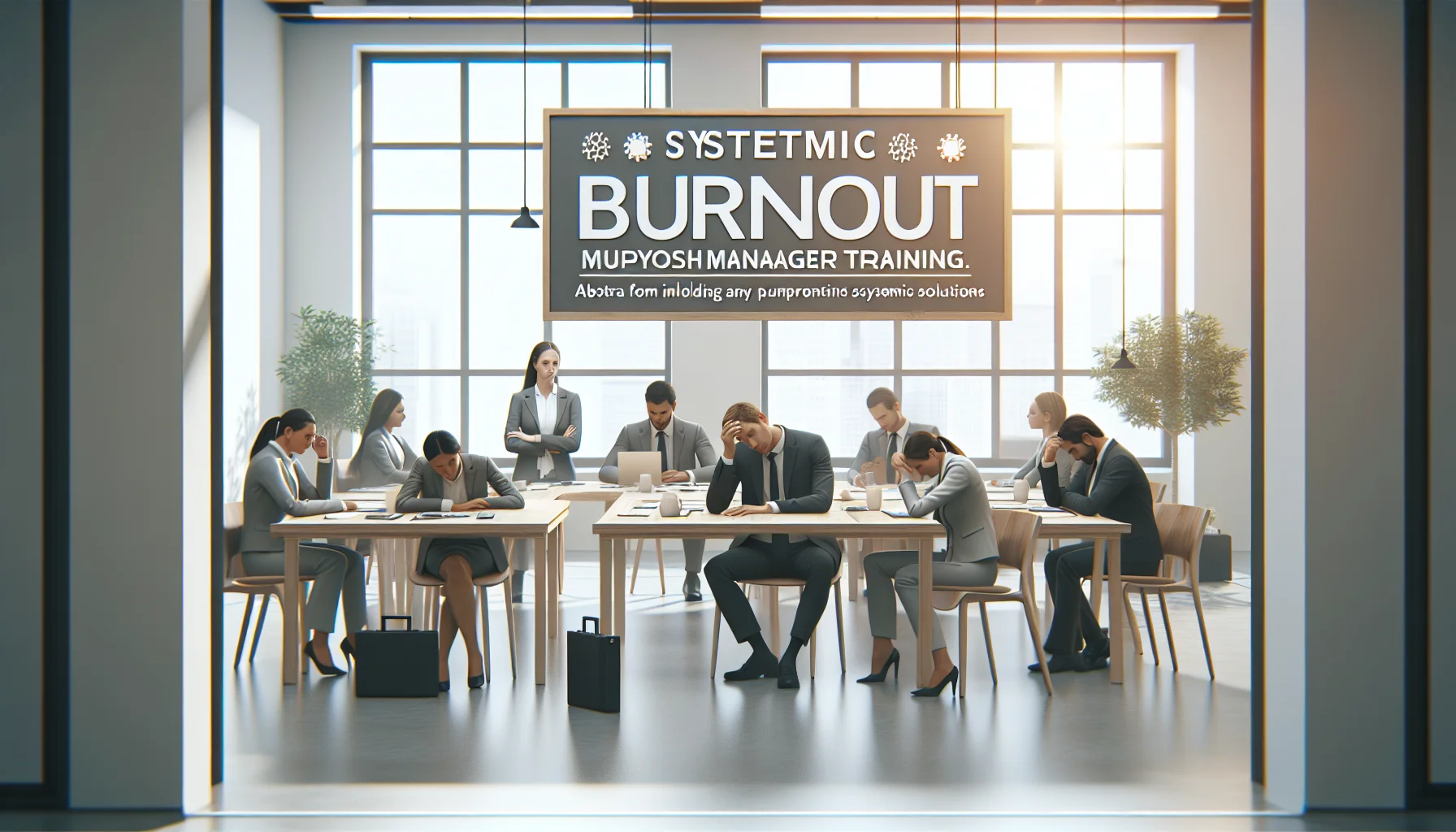
Manager training improves recognition and short-term mitigation, but is often insufficient when workload design, KPIs and resourcing drive chronic exhaustion. Systemic burnout solutions—redesigning work, shifting metrics, reallocating capacity and embedding policies—deliver durable improvements. Start with a 90-day cross-functional pilot to diagnose, test and scale.
In the first 60 seconds of a new engagement we often hear the same refrain: train managers and burnout will go away. Yet systemic burnout solutions are required when patterns of exhaustion persist despite managerial coaching, briefings and pulse surveys. In our experience, manager-level skills are necessary but rarely sufficient because they treat symptoms rather than the architecture that creates them.
Manager training focuses on recognition, conversation skills and short-term mitigation. These are important capabilities: spotting early signs, having empathetic conversations and making reasonable accommodations can prevent acute episodes. But we've found managers often become the default scapegoat for problems they cannot control.
Three constraints limit the effectiveness of manager training:
Training is most effective in environments where structural elements—reasonable workload, clear priorities and aligned incentives—are already in place. When those foundations are weak, training is a bandaid.
To move beyond symptomatic fixes, leaders must diagnose systemic drivers. These include workload design, resource allocation, performance metrics and reward structures that inadvertently encourage overwork.
Common root causes we encounter:
Addressing these requires reframing burnout as an organizational design challenge rather than a collection of individual failures.
Leaders need to probe structural levers, not just individual wellbeing: Who sets priorities? How is work routed? What outcomes do we reward? Answering these clarifies whether manager training is the right investment or just part of a broader plan.
True systemic burnout solutions use changes to structure, measurement and resourcing. We recommend five high-impact levers.
Each lever interacts. For example, changing KPIs without reallocating work simply changes behavior temporarily; combining KPI change with workload redistribution creates durable effect.
Industry practices that support these levers include continuous capacity planning and real-time work intake governance (available in platforms like Upscend) which help teams align demand with capacity and spot systemic overload earlier.
In digital environments, constant notifications and blurred boundaries are major contributors. Practical actions that form part of systemic burnout solutions are:
A roadmap ensures manager training is embedded within broader organizational change. We recommend a phased, cross-functional approach:
Each phase must involve HR, finance, operations, IT and senior sponsors. Managers remain essential as front-line implementers, but the initiative must be cross-functional to change incentives and resource flows.
Here is a compact pilot sequence that we've applied successfully:
Key metrics to track include cycle time, voluntary attrition, after-hours activity and a composite sustainability index tied to KPIs. These metrics make systemic interventions visible and defensible to executives.
We worked with a mid-size software firm where leadership had invested heavily in manager training but still faced rising burnout and turnover. Managers were trained to spot signs, but teams remained overloaded due to an aggressive quarterly roadmap and incentives tied to feature count.
Intervention steps:
Outcomes within six months: cycle time improved 22%, after-hours activity dropped 30%, and voluntary turnover in pilot teams fell 40% relative to control groups. Managers reported higher efficacy because their coaching could actually be acted on—workloads changed, not just conversations.
Common mistakes that undermine systemic change:
Manager training on burnout detection is an important piece, but it is rarely sufficient. Organizations need systemic burnout solutions that redesign work, adjust metrics and realign rewards so that healthy behavior is the path of least resistance. In our experience, the most sustainable improvements come from combined interventions that pair manager capability-building with structural change.
Quick checklist to get started:
If you're ready to move beyond training and craft a coordinated plan for systemic burnout solutions, start with a 90-day pilot that includes HR, product, finance and operations sponsors. That combined approach is how organizations turn well-intentioned manager interventions into lasting culture change and measurable wellbeing gains.
Call to action: Identify one team where managers are already trained and commit to a 90-day systemic pilot—map workload, adjust one KPI and measure outcomes to see whether structural change amplifies your manager training investment.
The Upscend Team provides actionable insights on technology and business strategy.
Book a walkthrough and we'll show you how it applies to your own content.
 General
December 14, 2025
Practical HR policies, scheduling tactics, and workload management reduce burnout risk and turnover. Implement capacity guards, protected focus time, recovery protocols, and a mixed-method early-warning scorecard. Pilot changes with a single team for 6–8 weeks, track objective and subjective signals, then scale while training managers and embedding sustainable performance criteria.
 General
December 14, 2025
Reducing burnout lowers voluntary turnover and improves sustained productivity by addressing systemic work design, manager capability, and measurement. Use a three-tier framework—prevention, mitigation, recovery—and run a 90-day pilot with targeted KPIs (engagement scores, turnover, sick days) to iterate and scale effective programs.
 Lms
LmsJanuary 20, 2026
This article identifies five LMS engagement metrics that reliably predict employee burnout: sudden drops in weekly active users, module incompletion, rising time-to-complete, declining social participation, and erratic access patterns. It explains calculations, sample thresholds, and one managerial response per metric, plus implementation tips for combining signals and reducing false positives.
Workplace Culture&Soft SkillsJanuary 28, 2026
This guide helps decision-makers reduce employee learning fatigue in always-on workplaces by combining policy, design, tooling, culture, and measurement. It provides a 0–90/90–180 day roadmap, KPI set, budget guidance and sample playbooks to raise completion rates, improve productivity, and prove ROI within 90–180 days.