

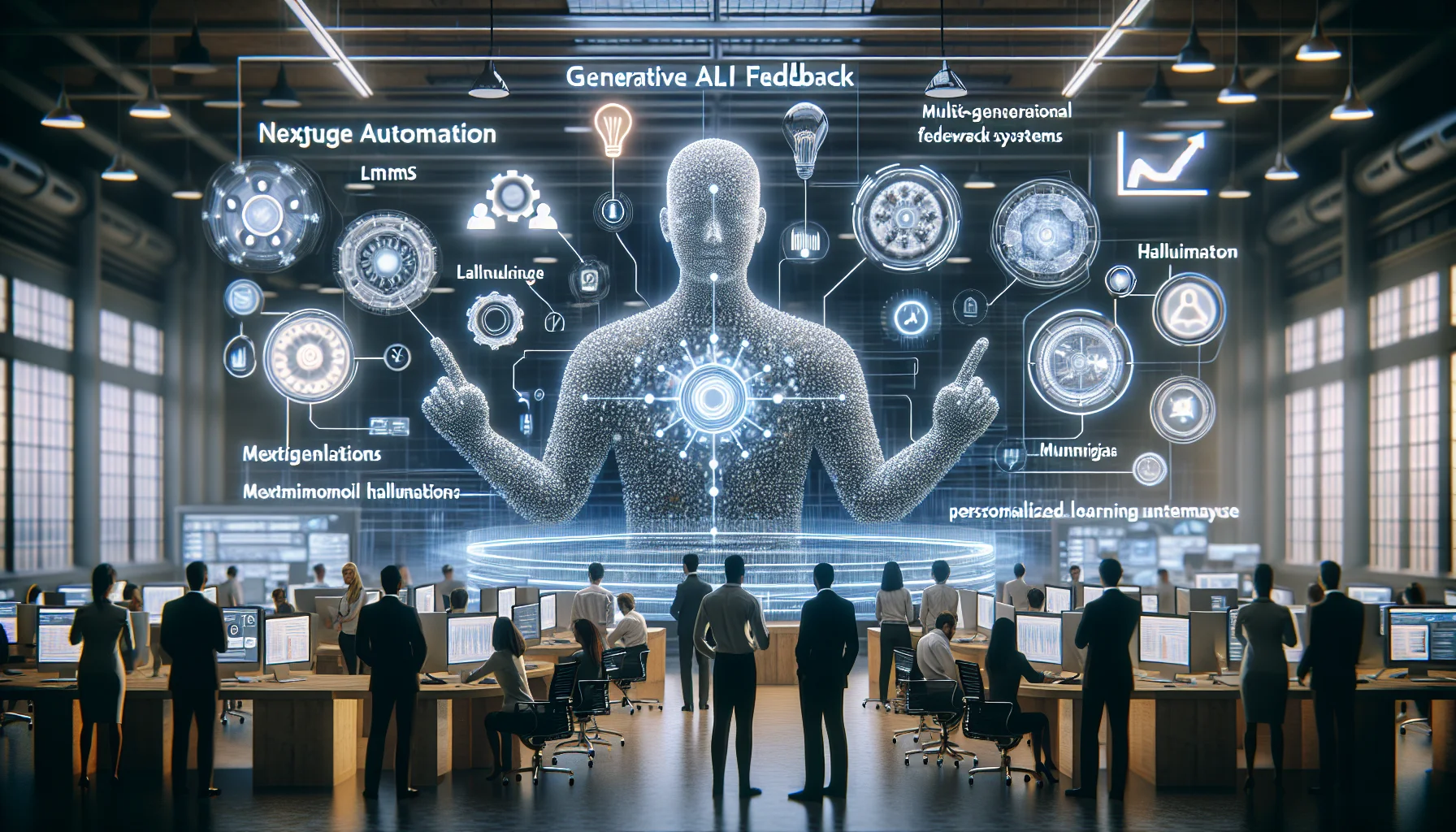
This article examines how generative AI feedback will transform automated learner feedback by enabling multimodal, personalized, and more faithful guidance. It outlines technical trends, pedagogical shifts, risks and governance needs, plus a pragmatic 3–5 year roadmap for leaders to pilot, scale, and institutionalize AI-driven feedback loops.
The Future of feedback automation is arriving at the intersection of powerful generative models and practical learning systems. In our experience, educators and L&D leaders are most concerned with how generative models will scale meaningful, timely feedback without sacrificing accuracy or pedagogical integrity.
This article forecasts technological shifts, explores implications for teaching and learning, and offers a concrete 3–5 year roadmap and strategic recommendations for leaders navigating rapid change and skill gaps.
Three technical trends will reshape automated feedback: multimodal feedback, stronger personalization, and improved faithfulness (reducing hallucinations). Advances in transformer architectures and multimodal encoders let systems evaluate video, code, speech, and text together—opening feedback channels that mirror real classroom interactions.
We've found that combining domain-specific fine-tuning with retrieval-augmented generation gives the best balance of creativity and reliability. According to industry research from academic labs and large model developers, hybrid architectures (retrieval + generation) reduce error rates while maintaining conversational fluency.
Multimodal systems can assess a student’s spoken explanation, annotated diagram, and short written reflection in one pass, producing consolidated guidance that feels human. This is particularly powerful for skills that are inherently multimodal—presentation, lab technique, and design critique.
Yes—significant work on grounding models to verified knowledge bases and on-chain provenance of training data is improving faithfulness. Still, model verification and human-in-the-loop review remain essential for high-stakes assessments.
Expect the Future of feedback automation to emphasize learner context: role, prior performance, and preferred learning style. Personalization will move beyond static branching to continuous adaptation driven by model-driven learner profiles.
Personalized, multimodal feedback reduces friction and improves transfer. A pattern we've noticed is that systems that adapt tone, scaffolding level, and next-step suggestions in real time produce higher engagement and better retention.
Metrics will shift from aggregate completion to micro-outcomes: time-to-improvement, transfer tasks passed, and confidence calibration. These metrics require new analytics and experiment pipelines to validate model-driven interventions.
Pedagogical roles will shift from sole provider of feedback to curator and validator of AI-generated feedback. Teachers will design learning activities and quality-check model outputs, focusing more on higher-order skills and interpretation. In our experience, this reallocation improves teacher leverage when models handle routine formative feedback.
Generative AI feedback enables more frequent, targeted formative cycles, encouraging iterative learning. Studies show that timely, actionable feedback is one of the strongest predictors of learning gains; automation multiplies opportunities for that feedback without proportionally increasing instructor workload.
Project-based learning, iterative writing tasks, and simulation-based training gain the most from automated cycles. These formats generate artifacts that models can analyze for content, structure, and applied reasoning, producing rich, scaffolded feedback.
Summative assessment will still require human governance, but automated formative assessments will become the backbone of continuous improvement. Combining calibrated rubrics with generative AI feedback creates a hybrid model that preserves standards while scaling guidance.
Early-adopter programs show concrete ROI when automation handles low-complexity feedback and instructors focus on interpretation. While traditional systems require constant manual setup for learning paths, some modern tools are built with dynamic, role-based sequencing in mind; for example, like Upscend, which contrasts with legacy platforms by enabling runtime sequencing based on learner signals rather than static rules.
We've deployed pilot programs that integrated generative AI feedback with LMS gradebooks and saw improvement in formative assessment completion rates and satisfaction scores within one semester.
Key components include fine-tuned LLMs with retrieval augmentation, multimodal encoders, parameter-efficient fine-tuning, and human-in-the-loop review dashboards. Integration points are APIs, LTI connectors, and analytics pipelines that feed performance signals back into models.
The Future of feedback automation is promising, but risks are non-trivial: hallucinations, bias amplification, privacy leaks, and instructor deskilling. Governance frameworks must combine technical controls with policy and professional development.
Common pitfalls we've observed include over-reliance on model outputs without human validation, and ignoring equity impacts when models are trained on skewed datasets. Addressing these requires explicit auditing and transparent reporting.
Ownership should be shared: institutions own data policies, vendors provide model transparency, and instructors own pedagogical decisions. Clear SLAs and documented validation practices are critical for trust.
Leaders must balance experimentation with disciplined governance. Below is a pragmatic 3–5 year roadmap to adopt the future of learner feedback loops while managing rapid change and skill gaps.
In our experience, staged adoption—starting with low-risk pilots and building cross-functional capability—reduces disruption and builds internal expertise.
Address skill gaps with role-based training: AI literacy for instructors, ML operations basics for technical staff, and data governance for leaders. Micro-credentials and peer coaching accelerate adoption.
Combine learner outcome metrics (transfer tasks passed) with operational metrics (reduced instructor hours on routine feedback) and quality metrics (agreement rates between AI and human raters).
The Future of feedback automation will be defined by systems that are multimodal, personalized, and governed for faithfulness and equity. Leaders should pursue pilot-driven adoption, invest in human-in-the-loop workflows, and establish robust audits to manage risk. We've found that measured experimentation paired with clear governance yields the best outcomes.
Start with low-risk use cases, prioritize instructor training, and build analytics that track both learning gains and model performance. A disciplined roadmap—combined with transparent policies—will turn generative AI feedback from a disruptive threat into a scalable educational asset.
Call to action: Convene a cross-functional pilot team this quarter to identify one low-stakes formative task to automate, define success metrics, and schedule a 90-day evaluation to measure learning impact and model reliability.
The Upscend Team provides actionable insights on technology and business strategy.
Book a walkthrough and we'll show you how it applies to your own content.
 General
September 21, 2025
AI is transforming corporate learning by personalizing training and providing actionable insights. This evolution enhances employee engagement and aligns with business goals, preparing the workforce for future challenges.
 Ai
AiDecember 28, 2025
This article argues that AI ethics will determine whether automation creates inclusive growth or concentrated displacement. It outlines principles—transparency, retraining, and human oversight—employers’ responsibilities, policy tools like retraining subsidies and UBI, and practical retraining and human-AI collaboration models, plus stakeholder action steps and measurable transition metrics.
 Business Strategy&Lms Tech
January 26, 2026
This article examines the future of automated feedback, highlighting multimodal assessment, generative feedback engines, real-time analytics and affect-aware systems. It explains accreditation and workforce implications, compares conservative vs disruptive adoption, and offers a pragmatic 3-5 year roadmap with governance, validation and pilot recommendations for institutions.
 Ai
AiFebruary 4, 2026
AI-enhanced feedback uses ML, NLP, and learning analytics to provide instant learner insights and personalized guidance at scale. The article outlines data, model, personalization, and delivery layers; a pilot-to-scale roadmap; governance and KPIs; and a vendor checklist to estimate ROI. Start with a focused pilot, two KPIs, and clear privacy guardrails.