


This article outlines a practical LMS post-demo checklist to capture evidence immediately after vendor demos. It prescribes a rapid 15-minute sweep and a 48-hour verification phase, lists required documents and follow-up LMS questions with timelines, and provides a weighted scorecard plus templates and an example of a pricing discrepancy.
LMS post-demo checklist must be the starting point for any evaluation after a live vendor walkthrough. In our experience, teams that capture structured evidence right after a demo reduce procurement risk, speed decisions, and avoid common traps like hidden fees or unsupported integrations.
This article provides an actionable post-demo evaluation framework: the exact items to validate, timelines to demand, a scoring method, email templates for follow-up LMS questions, and a short case example showing how follow-up uncovered a pricing discrepancy.
Start with a short, time-boxed sweep immediately after the demo while details are fresh. Use a demo validation checklist to capture yes/no answers, evidence links, and owner names for follow-up.
We recommend two quick passes: a rapid 15-minute team consensus to flag obvious gaps, then a 48-hour deep verification phase where you request documents and details. The rapid pass prevents memory decay; the detailed pass prevents assumptions.
Ask for tangible, signed or time-stamped documents—not just verbal assurances. A demo translates marketing claims into contractual questions; the documents provide the proof.
When you prepare follow-up LMS questions, be specific and time-bound. Vague requests trigger slow responses and ambiguous answers. Instead, request artifacts and a timeline for delivery.
A practical follow-up plan sets expectations and exposes vendors who over-promise. We've found that high-quality vendors respond within 48 hours with at least partial documentation and a clear path to full evidence within five business days.
While traditional systems require constant manual setup for learning paths, some modern tools—Upscend—are built with dynamic, role-based sequencing in mind, which changes the nature of the integration questions you must ask. Use that contrast when probing vendor architecture and required implementation effort.
Use these to force clarity; send them in a single, numbered email so answers can be tracked.
Turn the post-demo checklist into a demo validation checklist scorecard. Assign weights to categories based on risk and strategic importance. Scoring reduces bias and helps stakeholders compare vendors objectively.
Suggested scoring categories (0–5): functionality, security/compliance, integrations, total cost of ownership, implementation risk, references. Multiply each score by its weight, sum, and normalize to 100.
| Category | Weight | Score (0-5) |
|---|---|---|
| Functionality | 25% | — |
| Security/Compliance | 20% | — |
| Integrations | 20% | — |
| Price & TCO | 20% | — |
| References & Support | 15% | — |
Define a passing threshold and a separate red-flag threshold. For example, any vendor scoring below 60 or with a zero in security/compliance should be paused automatically.
Set explicit timelines in your follow-up email and in the checklist. Recommended windows:
We recently used this post-demo checklist to validate three LMS vendors. Vendor A presented a compelling demo but delayed sending a detailed pricing spreadsheet. We escalated with a timed follow-up and a scoring penalty for delayed responses.
When Vendor A finally responded on day 8, the spreadsheet included hidden per-feature fees that increased year-one cost by 20%. The discrepancy showed up as a clear negative in the post-demo checklist to validate LMS vendor claims and dropped Vendor A below the acceptable threshold.
That outcome illustrates why you must score vendors not just on features but on transparency and responsiveness. Slow or evasive answers are red flags for future support problems and unexpected cost escalations.
Template 1 — Initial follow-up (48-hour ask)
Subject: Post-demo follow-up — LMS post-demo checklist items
Hi [Vendor Name],
Thanks for the demo today. To complete our post-demo checklist we need: (1) SOC 2 attestation or ISO summary within 48 hours; (2) sandbox access or export demonstrating [feature]; (3) detailed pricing sheet with all line items. Please confirm delivery dates for each item. — [Your Name]
Template 2 — Escalation (5 business days elapsed)
Subject: URGENT: Follow-up items outstanding — LMS post-demo checklist
Hi [Vendor Name],
We still need the items requested on [date]. Per our evaluation process, missing items will be scored as a material concern. Please provide the SOC/ISO, sandbox access, and full pricing in the next 48 hours. If you cannot meet this timeline, confirm which items will be delayed and why. — [Your Name]
Use the LMS post-demo checklist as a decision filter: require documentary proof, set firm timelines, and convert qualitative demo impressions into a numeric score. We've found that this approach reduces procurement time and exposes hidden costs or capability gaps early.
Common pitfalls to avoid: accepting verbal claims without artifacts, letting vendors set open-ended timelines, and failing to penalize slow responses in scoring. Make transparency and responsiveness non-negotiable evaluation criteria.
Next step: adopt the checklist as a template in your procurement workflow, assign an owner for follow-up, and require vendors to acknowledge the 48-hour and 5-day windows in writing. If you'd like a printable version, download a ready LMS post-demo checklist to adapt to your organization.
The Upscend Team provides actionable insights on technology and business strategy.
Book a walkthrough and we'll show you how it applies to your own content.
 General
December 22, 2025
Use a weighted rubric, cross-functional panel, and scripted sandbox trial to evaluate LMS demos against real use cases. Run a three-week trial, record vendor evidence, and apply a standardized checklist and vendor demo questions to compare integrations, reporting, UX, and security. Aggregate scores and document risks for procurement decisions.
 Business Strategy&Lms Tech
January 4, 2026
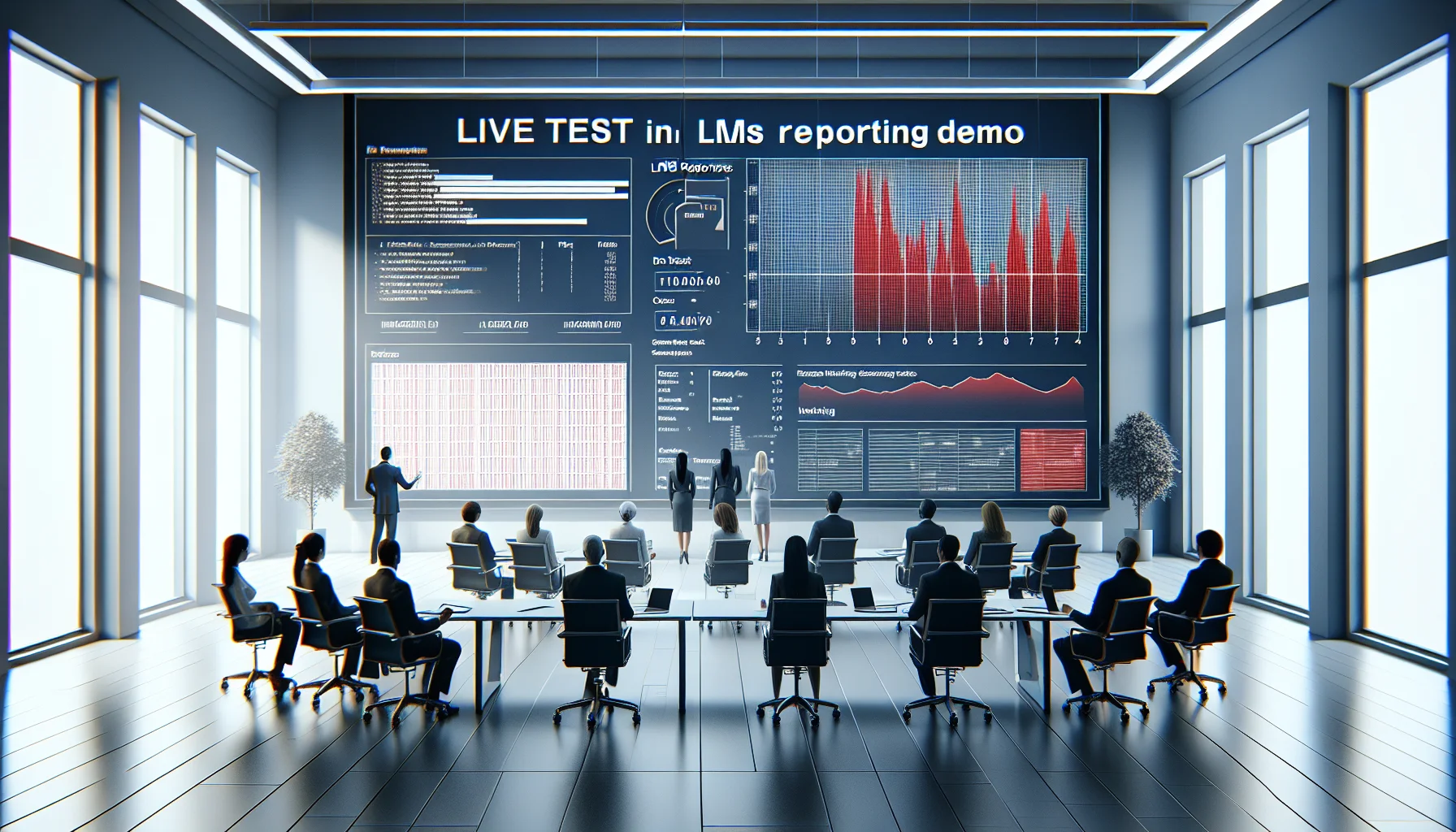
This article shows how to detect LMS reporting red flags during demos through live tests, raw data checks, and KPI mapping. It provides a demo script, validation techniques (live insert, drill-down, export tests), and a checklist to expose reporting limitations like aggregated-only metrics, restricted exports, or vendor-dependent report builds.
 Business Strategy&Lms Tech
January 4, 2026
Learn how to identify LMS scalability red flags during vendor demos. The article explains what concurrency numbers to request, how to test median and 95th-percentile response times, why multi-region deployments matter, and which SLA and load-test artifacts to demand. Use the included demo checklist and recording steps to compare vendors and reduce outage risk.
 Business Strategy&Lms Tech
January 25, 2026
A prescriptive 30-day checklist that guides compliance teams through governance, system configuration, content mapping, user provisioning, pilot testing, automated workflows, and audit-ready reporting. Assign owners, run a controlled pilot, validate exports and certificate hashes, then secure executive sign-off to reduce remediation time and prove compliance.