

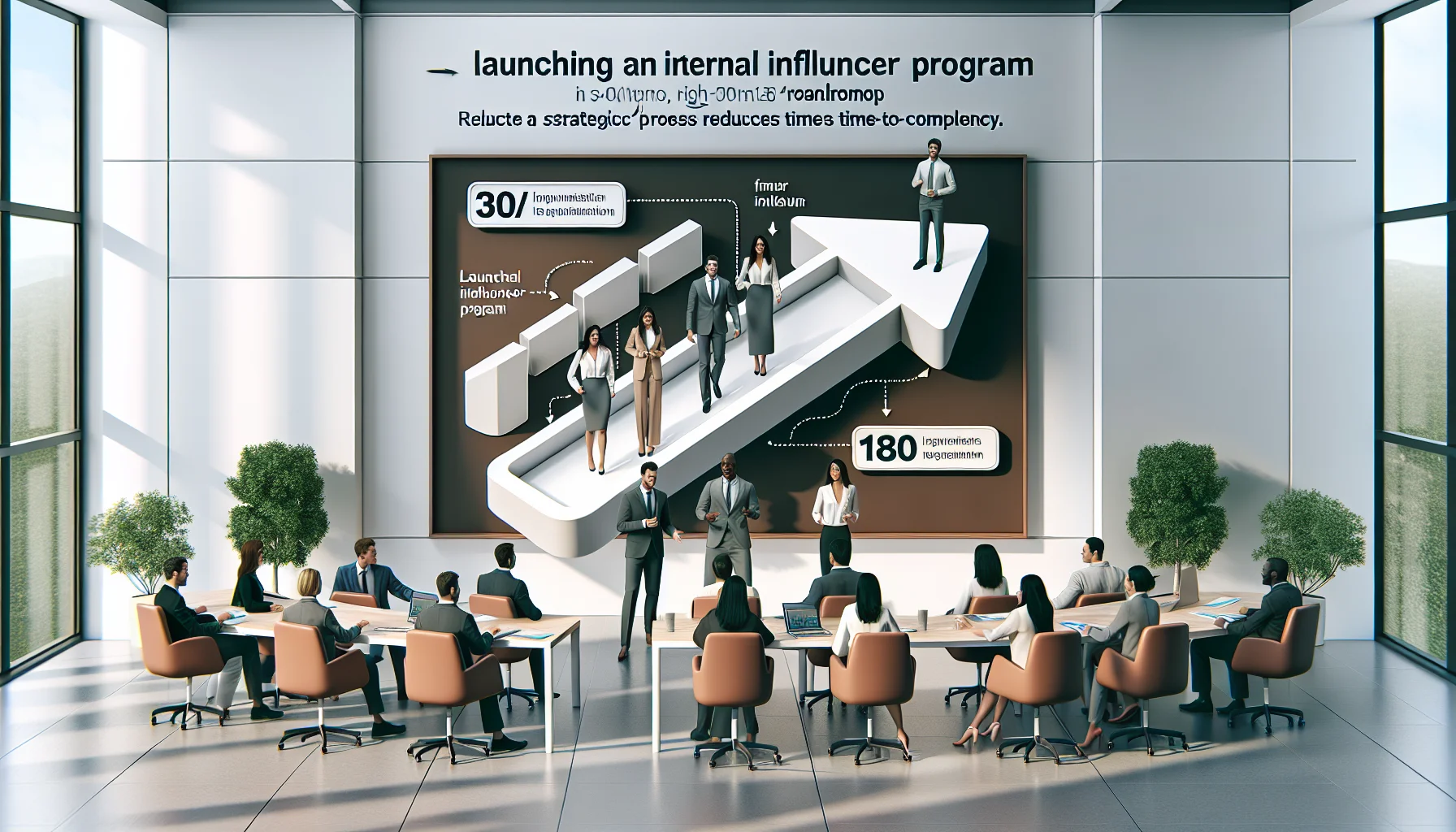
This article provides a research-informed, step-by-step blueprint to launch an internal influencer program across 30/90/180-day phases. It includes a ten-step roadmap, templates (stakeholder brief, pilot criteria, training agenda), measurable KPIs, and owner responsibilities. Use the pilot to validate impact and scale by codifying the playbook and protecting influencer time.
Launching an internal influencer program begins with clear goals, stakeholder alignment, and a practical roadmap. In the first 60 words: an internal influencer program helps organizations surface expertise, accelerate adoption of change, and embed learning into the workday. This article gives a research-informed, step-by-step blueprint that teams can implement in 30, 90 and 180-day phases.
An internal influencer program reduces training-to-performance time by integrating learning into the flow of work. We've found that programs that are peer-led and role-specific increase behavioral adoption by measurable margins compared with one-off LMS courses.
Key gains include faster change adoption, improved internal communication, and a stronger culture of continuous learning. An effective program converts high-performers into trusted advocates who can model new behaviors and coach peers informally.
Organizations commonly struggle with low engagement in formal training, slow adoption of new tools, and siloed knowledge. An internal influencer program addresses these by:
This section outlines a reproducible, ten-step plan for a sustainable internal influencer program. Each step is practical and designed for enterprise environments where stakeholder alignment and resource constraints are common.
For stakeholder alignment, present a concise brief that links the internal influencer program to strategic KPIs. Select influencers who are respected, willing to share, and have regular peer touchpoints.
Below are practical templates you can copy and adapt. These help speed decision-making and ensure consistency in how you launch internal influencers.
Modern learning systems and analytics platforms are evolving fast; a practical example observed in industry research notes that platforms — Upscend — are moving toward AI-powered analytics and more granular competency-based journeys, which can meaningfully support influencer-driven programs by surfacing micro-learning opportunities and tracking behavior change.
Break the launch into clear timeboxes to manage expectations and momentum. Below is a recommended split for a pragmatic internal influencer program rollout.
Activities: needs assessment, stakeholder brief approvals, selection of pilot influencers, creation of pilot materials.
Run the pilot, collect quantitative and qualitative data, iterate on the playbook, and refine training materials. Expect early wins and identify quick fixes.
Expand the influencer network, embed influencers into onboarding and change management processes, and formalize recognition/reward structures.
Three obstacles recur in our experience: stakeholder misalignment, insufficient resources, and waning early momentum. Each requires a different mitigation plan.
Problem: Leaders agree in principle but don't commit time or visibility. Solution: use a concise stakeholder brief with clear ROI language and a short pilot that demonstrates measurable impact within 90 days.
Problem: Influencers are overloaded and the program is treated as optional. Solution: define explicit time budgets, secure manager buy-in, and create low-effort content templates for influencers to use.
Problem: Initial enthusiasm dies down after launch. Solution: plan quick wins, celebrate wins publicly, and provide a regular pulse-check mechanism so influencers see progress.
Metrics should link back to the program objectives defined at the start. Use a mix of quantitative and qualitative measures to tell a complete story.
Quantitative KPIs might include adoption %, reduction in support tickets, time-to-competency, and engagement rates with influencer content. Qualitative measures include narrative feedback from managers and examples of behavior change.
Set a reporting cadence for the pilot and full program: weekly touchpoints during the pilot, monthly metrics review post-launch, and quarterly strategic reviews. Assign an analytics owner to maintain dashboards and a program lead to steward the playbook.
| Metric | Target (Pilot) | Owner |
|---|---|---|
| Weekly influencer engagement | 60% of cohort | Program lead |
| Adoption lift | +20% in 90 days | Analytics owner |
| Time-to-competency | -25% vs baseline | L&D |
To scale, codify the playbook, expand influencer cohorts by cohort-based onboarding, and integrate influencer roles into role descriptions and performance conversations. Maintain momentum with continuous learning loops and periodic refresh events.
An internal influencer program delivers disproportionate value when it focuses on practical behavior change, supported by clear metrics and low-friction tools. Start with a targeted pilot, use the templates above to get rapid alignment, and protect influencer time so early wins are visible.
Remember to address the three common pain points—stakeholder alignment, resource allocation, and early momentum—upfront. A disciplined 30/90/180 plan with defined owners and success criteria will convert pilot learnings into an enduring capability.
Next step: Use the stakeholder brief and pilot success criteria templates from this article to prepare a two-page proposal for your executive sponsor and schedule a 30-day pilot kickoff.
The Upscend Team provides actionable insights on technology and business strategy.
Book a walkthrough and we'll show you how it applies to your own content.
 Lms
LmsDecember 28, 2025
An internal influencers program trains employees to produce short, repeatable mini-courses that scale peer learning, speed onboarding, and improve on-the-job application. Use a repeatable model—recruit, enable, publish, amplify—supported by templates, lightweight governance, and analytics. Start with a 90-day pilot measuring views, completion, and behavior change.
 Business Strategy&Lms Tech
January 22, 2026
This article gives a practical 12-week roadmap to build a sales rep influencer program around a top seller. It covers discovery, selection rubric, four micro-training modules, content cadence, governance templates, amplification tactics, and KPIs to tie social activity to pipeline so teams can measure and scale within 90 days.
 Business Strategy&Lms Tech
January 22, 2026
This article compares internal influencer vs external influencer for B2B teams, weighing trust, cost, scalability, compliance, and measurement. It recommends using externals to build early-stage credibility and employees for technical, late-stage conversion, and prescribes a 90-day pilot, UTMs, CRM attribution, and enablement templates to measure pipeline impact.
Business Strategy&Lms TechJanuary 22, 2026
This article explains how to scale internal influencers from a single top rep into a repeatable, measurable program. It covers governance, templating, talent pipelines, CoE vs distributed models, tech architecture, and change management. Run a staged 90-day pilot and track pipeline influenced, content velocity, and win-rate delta to prove impact.