

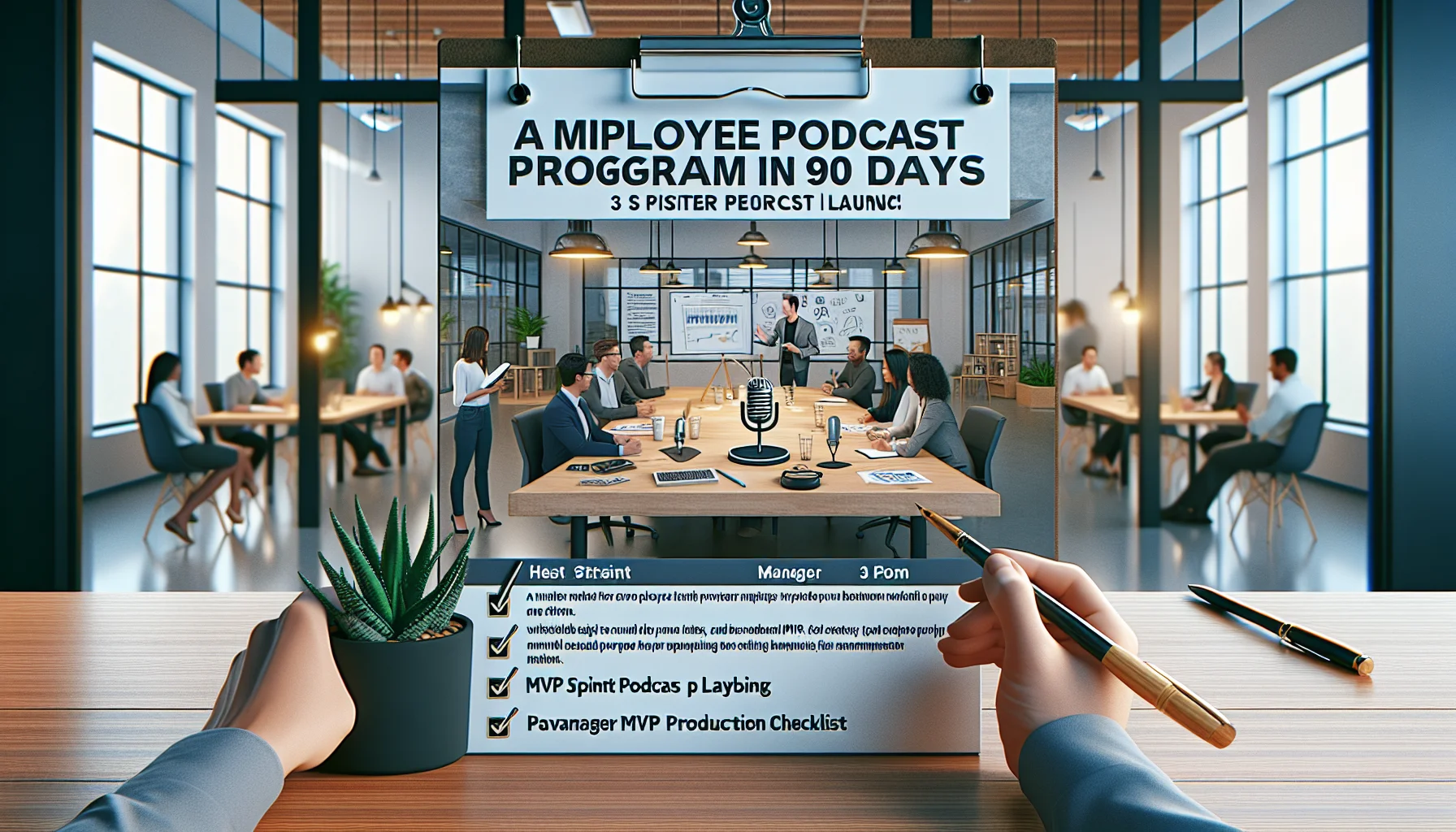
This article gives a week-by-week, 90-day playbook to launch an employee podcast program: plan, record, and scale across three 30-day sprints. It includes stakeholder roles, an MVP production checklist, vendor selection criteria, two sample calendars, a template script, manager communications, and metrics to measure adoption and impact.
An employee podcast program is a practical, low-friction channel to improve engagement, share strategy, and support learning for commuting employees. A focused program that launches with clear governance, compact production, and measurable goals converts skeptics into regular listeners within a quarter. This article provides a tactical, week-by-week playbook to launch employee podcast program in 90 days, a vendor checklist, a minimal viable production setup, two 90-day calendars (small team and enterprise), a template script, and an internal communications sequence for managers. It also includes practical tips from pilots — what to measure, how to reduce friction, and how to surface executive-level impact.
Launch efforts succeed when teams convert strategy into repeatable sprints. The step by step corporate podcast launch plan below is organized into three 30-day sprints: plan, record, distribute & iterate. Each sprint lists weekly outcomes you can assign to owners. This structure supports an internal podcast launch that balances speed with governance, creating measurable milestones to keep executives comfortable while letting producers optimize content.
Week 1: Form the core team (program lead, producer, content lead/host coach, IT/security liaison, manager sponsor). Clarify audience segments and the primary objective for your employee podcast program (e.g., leadership alignment, compliance microlearning, culture storytelling). Draft a one-page problem statement linking the program to business outcomes (retain reps, reduce policy errors, speed onboarding).
Week 2: Define editorial pillars, episode length (ideal for commutes: 10–18 minutes), frequency, and success metrics (downloads, listens per employee, completion rate, manager endorsements). Produce a 3-episode pilot outline and a content calendar with proposed guests and owners to reduce scheduling friction.
Week 3: Build a lightweight production process and risk checklist with IT for hosting and access control. Secure permissions and a modest budget. Prepare a one-page stakeholder brief for executives listing costs, expected adoption, and a simple ROI hypothesis (e.g., "If 30% of Sales listens monthly, expect a 10% reduction in onboarding time").
Week 4: Pilot-record two episodes, do basic edits, and present an internal manager preview. Use manager feedback to refine format. Collect anecdotal feedback and a brief 3-question pilot survey to establish baseline metrics.
Week 5: Finalize recording schedule and recurring blocks. Produce episodes 3–6. Establish an editing template and metadata strategy for searchability in your LMS or intranet (title conventions, tags, guest names, department codes).
Week 6: Implement distribution cadence and test mobile player integrations. Confirm analytics capture and reporting cadence. Train a small group of hosts, including managers, on interview techniques for commuting listeners: short questions, concrete examples, and a tempo suited to headphone listening.
Week 7: Create supporting assets: show notes, time-stamped highlights, transcripts, and microlearning follow-ups if relevant. Prepare manager-facing one-pagers to embed episodes in team meetings with conversation prompts that take under five minutes.
Week 8: Launch the pilot to a subset of employees (region, function, or managerial band). Collect quick feedback via a 3-question survey and a listener panel. Track early KPIs and adjust frequency, length, or editorial pillars before enterprise rollout.
Week 9: Analyze pilot metrics, adjust cadence or format, and fix production bottlenecks (turnaround time, editing backlog, host availability). Run a brief retrospective with manager sponsors to capture qualitative impact: did episodes shape team discussions or prompt applied recommendations?
Week 10: Onboard more hosts and scale production capacity. Implement automation for distribution (RSS to internal players, LMS import, push notifications). Batch recording days to improve efficiency and reduce calendar conflicts.
Week 11: Run manager onboarding sessions to make podcast listening a supported behavior. Provide sharing assets and meeting prompts that encourage discussion and suggest short activities tied to episode themes.
Week 12: Full enterprise rollout with a 12-episode backlog and recurring governance cadence. Present pilot ROI to sponsors and secure next-quarter budget. Announce broadly and recommend manager incentives (recognition for teams demonstrating listen-to-action adoption).
Launch friction is usually organizational, not technical. The right roles and lightweight SLAs reduce friction. An employee podcast program needs clear ownership and predictable production rhythms.
Managers are critical distribution partners because they control team rituals and commute time. Use this short checklist:
Manager endorsement is the single largest predictor of early adoption for a corporate podcast program.
Production doesn't need a broadcast studio. A focused employee podcast program needs reliable tools, simple templates, and a vendor selection rubric to prevent scope creep. Consistent quality matters more than polish: clarity and relevance drive repeat listens.
Tip: For commuting employees, prioritize mobile playback, episode chapters, and concise runtimes (10–18 minutes). Chapters help listeners jump to relevant segments.
Use a weighted checklist covering security, onboarding, analytics, integration, and cost. Key demo criteria:
Platforms that combine ease-of-use with automation—like Upscend—tend to outperform legacy systems in adoption and ROI. Prioritize automated transcripts, easy mobile playback, and embedded analytics to reduce production overhead.
| Budget Line | Estimate (Small) | Estimate (Enterprise) |
|---|---|---|
| Microphones & accessories | $800 | $8,000 |
| Hosting & analytics (annual) | $1,200 | $18,000 |
| Producer / editing (annual) | $12,000 | $120,000 |
| Training & manager onboarding | $1,000 | $10,000 |
Budget notes: small programs can pilot for under $15k annually. Enterprise forecasts should include localization, multiple hubs, and SLA-backed support. Consider offsets like reduced training hours when episodes serve microlearning.
Below are pragmatic calendars reflecting pacing differences between a small centralized team and a distributed enterprise program. Each calendar suggests cadence, backlog management, and episode theme examples.
Both calendars use the same governance elements: clear owner, delivery SLA, and manager amplification. Address common pain points early—limited resources, lack of buy-in, and production bottlenecks—by allocating 10–20% of budget for coaching, producer time, or automation.
Commuting employees are time-constrained. Design assets to reduce cognitive load: short scripts, ready-to-use meeting prompts, and one-click survey links. These make it easy for managers to surface episodes in team rituals.
Intro (20–30s): Host intro: "Welcome to [show]. I’m [host]. Today’s topic: [one-line hook]." Use a consistent jingle to build recognition.
Segment 1 — Framing (2 min): One-paragraph context and the practical question the episode answers, tied to a business outcome.
Segment 2 — Core interview / story (6–8 min): Three focused prompts for the guest. Keep questions short and concrete:
Segment 3 — Takeaways (1–2 min): Host summarizes 3 action items and points to show notes. Consider a listener challenge: "Try this in 7 days and tell your manager."
Outro (15–20s): Call to action: "Share this with your manager and bring one insight to your next team meeting." End with a consistent sign-off and where to find transcripts and resources.
Pro tip: Keep language simple and avoid corporate jargon—clarity earns repeat listens.
Use a three-email cadence to generate awareness, drive first listens, and convert managers into champions. A/B test subject lines and preview text.
Capture quantitative and qualitative data to refine the employee podcast program:
Measure short-term engagement and longer-term outcomes:
Common production bottlenecks include scheduling conflicts, long editing queues, and inconsistent metadata that reduces discoverability. Mitigate with strict editing SLAs (48–72 hours), host prep sheets, and metadata templates. Maintain an evergreen library of short episodes to slot in when guests cancel.
Launching an employee podcast program in 90 days is achievable when you break work into 30-day sprints, appoint clear owners, and design for commuting consumption. Start with governance, a lightweight MVP production kit, and manager enablement to accelerate adoption. Programs that prioritize manager adoption and mobile accessibility outperform those focused only on production gloss.
Quick checklist to move from decision to launch:
Next step: Use the template script and email sequence above to create your pilot this week. Export the weeks into your PM tool, assign owners, and set a 90-day milestone review with executives. With clear roles, simple production rules, and manager buy-in, your employee podcast program will become a repeatable channel that scales with minimal incremental cost.
Call to action: Choose one episode idea, assign a host, and schedule your first 60-minute recording block within seven days to begin your 90-day launch. For first-time teams, pilot in one function—sales or customer success—to validate assumptions, then scale using lessons learned.
The Upscend Team provides actionable insights on technology and business strategy.
Book a walkthrough and we'll show you how it applies to your own content.
 Business Strategy&Lms Tech
January 22, 2026
This article provides copy-ready approaches to scriptwriting for employee podcasts, including timing rules, voice rubrics, production checklists, and three fill-in-the-blank podcast script templates (interview, microlesson, narrative). It explains structure, commuting-length guidance, guest prep, and simple measurement ideas to turn templates into measurable internal podcast content.
 Business Strategy&Lms Tech
January 22, 2026
This article outlines practical methods to distribute employee podcasts to distributed workforces: adopt a hybrid mobile-first plus LMS architecture, enable offline/background downloads, schedule regional release windows, and integrate episodes into corporate comms. It also covers promotion tactics, A/B tests, and key metrics to measure reach and completion for iterative improvement.
Business Strategy&Lms TechJanuary 22, 2026
This playbook shows how podcasts for onboarding can scale consistent, human-centered new-hire orientation by mapping journey moments to short episodes, integrating audio with mentors and LMS, and measuring impact. Use a 30/60/90 episode plan, manager prompts, and an 8-week pilot to increase completion and reduce time-to-first-contribution.
 Business Strategy&Lms Tech
January 22, 2026
Teams can embed podcasts into workflows by designing 2–6 minute micro-episodes tied to specific tasks, delivering them via calendar nudges, CRM audio cards and in-app triggers, and reinforcing use with manager voice notes. Run short A/B pilots and measure listen-through, task adoption and outcome KPIs to iterate quickly.