

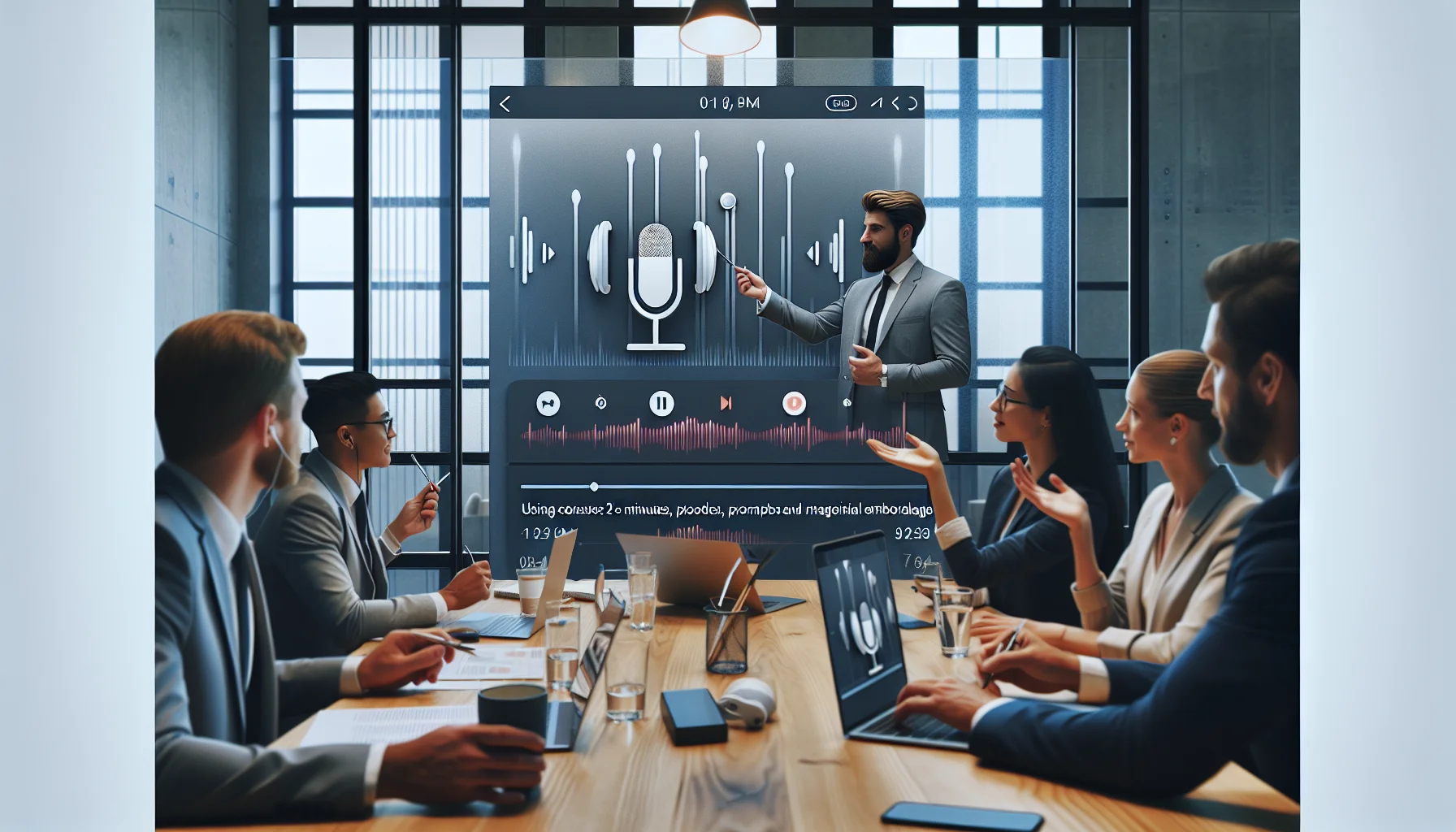
Teams can embed podcasts into workflows by designing 2–6 minute micro-episodes tied to specific tasks, delivering them via calendar nudges, CRM audio cards and in-app triggers, and reinforcing use with manager voice notes. Run short A/B pilots and measure listen-through, task adoption and outcome KPIs to iterate quickly.
To reliably embed podcasts into workflows you must stop treating audio as one-off content and design for routine. In our experience, teams that convert episodic listening into daily habits see higher retention, faster behavior change, and better compliance than those that rely on quarterly webinars or long training modules. This article explains why audio learning integration works, how to design micro-episodes aligned to tasks, and step-by-step tactics for making workplace audio routines part of everyday work.
People consume audio differently than text or video: it fits mobility, multitasking, and short gaps between tasks. If you want to embed podcasts into workflows, you need to treat episodes like micro-interventions rather than episodic content. A pattern we've noticed is that when audio is tied to a specific trigger or task, adoption multiplies.
Research and industry benchmarking show that spaced, context-linked content outperforms single-shot learning. Studies indicate microlearning can increase retention materially — commonly reported ranges are 20–60% improvements versus traditional long-form sessions — and audio versions of microlearning further increase accessibility for remote or field teams who are often away from screens. The core problem most organizations face is not content quality but poor placement: audio sits in a library and waits for voluntary consumption.
Common barriers include unclear triggers, long episode length, and lack of reinforcement. These problems create the familiar cycle of high initial downloads and low long-term engagement. To break the cycle you must design triggers and measure behavioral anchors.
Addressing these barriers is how you move from "podcasts in workflow" as a nice-to-have to a measurable lever that changes day-to-day decisions. Think of audio as a nudging layer — short, targeted, and time-bound — rather than a content archive.
The simplest way to embed podcasts into workflows is to create micro-episodes (2–6 minutes) mapped to discrete tasks. Break learning outcomes into single actions: "How to open a lead correctly" or "Three quick phrasing tweaks for difficult support calls." These episodes should be explicit performance aids, not long conceptual talks.
We recommend a structured episode template to increase transfer: Opening trigger, one concrete tactic, a one-minute role-play, and a call-to-action. Each episode should end with a repeatable behavior employees can try immediately.
Small design choices matter. Use plain language, avoid jargon, and lead with the precise behavior you want the listener to execute next. Where appropriate, include a one-sentence "what success looks like" metric — for example, "If you use this opener, aim for two qualifying questions in the first 90 seconds." That kind of clarity increases the likelihood the listener will act and makes measurement easier.
To truly embed podcasts into workflows you need orchestration: triggers, delivery, and measurement. Start by mapping moments of work where audio can be the highest leverage nudges — before a prospect call, between ticket triage steps, or during vehicle downtime for field reps.
Integrate audio with the tools employees already use. Push recordings as calendar nudge items, embed short audio cards into CRM records, and add audio prompts to ticket views in support platforms. Modern LMS platforms — Upscend — are evolving to support AI-powered analytics and personalized learning journeys based on competency data, not just completions. That illustrates how learning infrastructure can move from passive hosting to active workflow orchestration.
Combine channels to create redundancy. A calendar nudge plus an in-CRM audio clip increases the odds the right person hears the right piece at the right time. Practical tip: keep file sizes small and provide transcript snippets so listeners can scan content if they can't listen immediately. Also version-control episodes so you can iterate without confusing users.
Concrete scenarios make design choices obvious. Below are three industry-specific blueprints showing how to use audio learning integration and workplace audio routines.
Sales: Send a 3-minute "pre-call play" that summarizes the prospect's pain, two openers, and one objection-handling line. Put it in the CRM as an audio card and link it to the call record so sellers listen within the minute before dialing.
In pilots we've run with mid-market sales teams (n≈120 reps), embedding pre-call 3-minute episodes increased meeting-to-opportunity conversion by roughly 10–15% over a four-week period, with listen-through rates above 70% for triggered plays. Those results came from coupling contextual audio with manager reinforcement and a quick post-call note asking reps which line they used.
Customer Support: Create micro-episodes for frequent, tricky ticket types. Embed a 90-second clip into ticket views that suggests a triage question and one phrasing tweak. Track whether the agent used the tactic via ticket notes.
For support teams, audio reduces time-to-solution because agents can absorb a tactic while loading a ticket or walking to the next workstation. In addition to tracking handle time and CSAT, track "adopted tactic" flags in the ticket metadata to correlate specific clips with outcome improvements.
Field reps often have gaps between visits; short audio segments are perfect for vehicle time. Deliver geo-timed push audio when the rep checks in at a client site, reminding them of key upsell prompts or safety checks.
Field use cases benefit from offline caching and low-bandwidth codecs so audio plays reliably in remote areas. Add a one-click "I used this" button after the audio so reps can quickly log behavioral adoption without interrupting their workflow.
These examples show how targeted audio shifts behavior because it reduces decision friction and supplies immediate, contextual guidance. A bonus outcome is improved team alignment — when everyone hears the same micro-script, handoffs and follow-ups become smoother.
Getting adoption requires iterative testing. Start with A/B experiments that compare standard LMS posting versus embedded, triggered audio. A simple 4-week pilot can reveal whether contextual prompts raise task-level behavior more than passive availability.
Key metrics to track include listens per trigger, task completion rates, conversion uplift (for sales), average handle time (for support), and behavioral adoption at the rep level. Use manager feedback loops: have managers record 20–30 second coaching audio praising specific usages to reinforce the habit.
Beyond raw metrics, collect qualitative feedback via short surveys asking: "Was this useful before the task?" and "Did you try the suggested tactic?" Those micro-surveys help separate passive listens from applied behavior. When we ran pilots like this, the combination of contextual triggers plus manager reinforcement increased adoption by a clear margin. The reinforcement loop is the multiplier: content alone rarely produces sustained change, but content plus social/manager signals does.
Insight: Habit formation is about triggers, immediate practice, and social reinforcement — audio that is contextually placed wins.
To make audio learning a habit you must design for the workflow, not for the library. Practical steps to start: pick one high-frequency task, build a 2–4 minute episode template, embed episodes into the tool used at that task moment, and add manager nudges. Repeat with measurement and iterate.
Summary checklist:
Ready to test? Start with a two-week pilot around one workflow and measure listen-through rates and immediate behavioral outcomes. If you want a practical template to run that pilot, download or replicate the episode template above and align it to your highest-impact task — then run the suggested 4-week experiment.
Call to action: Pick one routine task this week and create a 3-minute audio script using the episode template; run it as a calendar nudge for five people and measure behavior change after two weeks. If you follow these steps on how to embed podcasts into everyday workflows and maintain simple metrics, you'll move from curiosity to measurable impact in weeks, not months.
The Upscend Team provides actionable insights on technology and business strategy.
Book a walkthrough and we'll show you how it applies to your own content.
 Business Strategy&Lms Tech
January 22, 2026
This article gives a week-by-week, 90-day playbook to launch an employee podcast program: plan, record, and scale across three 30-day sprints. It includes stakeholder roles, an MVP production checklist, vendor selection criteria, two sample calendars, a template script, manager communications, and metrics to measure adoption and impact.
 Business Strategy&Lms Tech
January 22, 2026
This article provides copy-ready approaches to scriptwriting for employee podcasts, including timing rules, voice rubrics, production checklists, and three fill-in-the-blank podcast script templates (interview, microlesson, narrative). It explains structure, commuting-length guidance, guest prep, and simple measurement ideas to turn templates into measurable internal podcast content.
 Business Strategy&Lms Tech
January 22, 2026
This article outlines practical methods to distribute employee podcasts to distributed workforces: adopt a hybrid mobile-first plus LMS architecture, enable offline/background downloads, schedule regional release windows, and integrate episodes into corporate comms. It also covers promotion tactics, A/B tests, and key metrics to measure reach and completion for iterative improvement.
Business Strategy&Lms TechJanuary 22, 2026
This playbook shows how podcasts for onboarding can scale consistent, human-centered new-hire orientation by mapping journey moments to short episodes, integrating audio with mentors and LMS, and measuring impact. Use a 30/60/90 episode plan, manager prompts, and an 8-week pilot to increase completion and reduce time-to-first-contribution.