

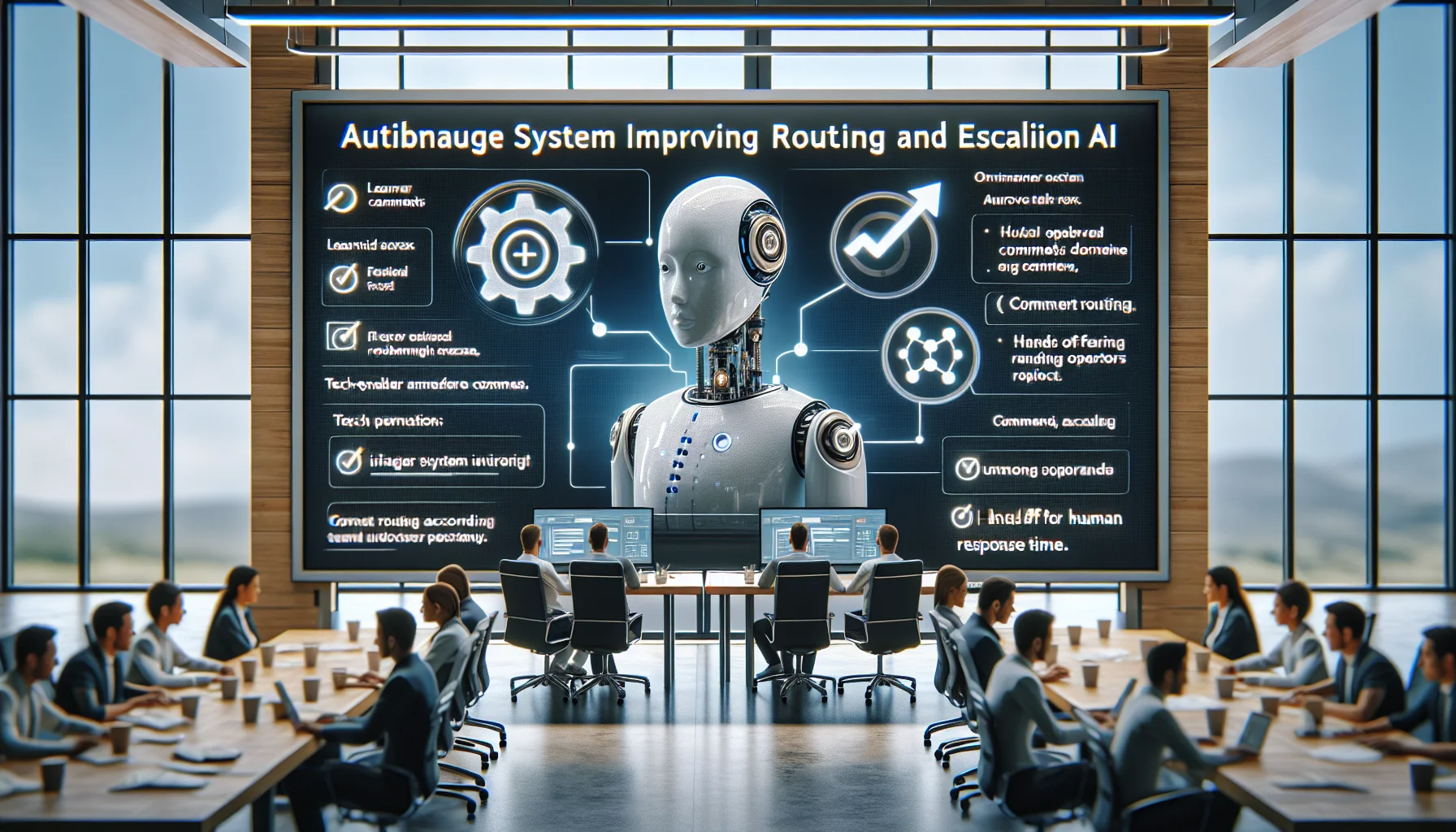
This article explains how to design an automated triage system for learner comments using modular architecture, intent and urgency models, and prioritized rulesets. It covers escalation policies, human-in-the-loop workflows, implementation steps, and KPIs to measure impact, plus a short case study and sample rules to run a 4-6 week pilot.
Feedback triage AI is the backbone of any scalable learner support model: it classifies, prioritizes, and routes comments so instructors and support teams respond where they add the most value. In our experience, a practical design balances fast, reliable automation with clear escalation pathways and measurable KPIs. This article walks through architecture, decision logic, rule examples, escalation templates, and a short case study so you can create AI triage for educational feedback routing with confidence.
Designing an automated triage system starts with a clear modular architecture. Break the stack into ingestion, preprocessing, intent + entity extraction, urgency/impact scoring, routing, and monitoring. Each module should be independently testable so you can improve classifiers without disrupting routing logic.
A common pattern is to separate the lightweight edge logic from a more powerful, centralized decision engine: the edge handles format normalization and basic intent filters; the central engine hosts the Feedback triage AI models and orchestration rules. This reduces latency for obvious cases while keeping complex decisions consistent.
Key components to include are real-time ingestion (webhooks/API), a preprocessing pipeline, an intent model, an urgency scorer, the routing rules engine, and a human-in-the-loop interface for escalations and corrections.
Decision logic is where automation turns into useful action. The core is a combined intent + urgency model that converts free-text comments into structured signals. In our deployments we use ensembles: a fast intent classifier plus a calibrated urgency regressor for risk-sensitive routing.
Start with a concise intent taxonomy aligned to operational teams: content question, grading dispute, technical issue, accessibility need, emotional / wellbeing flag, and general feedback. Each intent maps to a routing target and a default SLA. A short, well-tested taxonomy reduces misclassification.
Intent mapping should be continuously updated using human feedback loops—every human-handled ticket should feed back to retrain the model and update rule exceptions.
Below is a text description of the recommended flow diagram; describe it to stakeholders and use it to design integrations:
Implement the decision layer as a prioritized ruleset combined with probabilistic model outputs. Use both deterministic and ML-based rules to manage edge cases and compliance requirements.
Example sample ruleset (ordered priority):
Escalation is where most systems fail: missed urgent issues and misclassification cause student harm and reputational risk. Build clear, auditable escalation policies and test them with simulated urgent cases.
Use a layered escalation policy combining urgency scoring, rule overrides, and human review. For example:
To mitigate misclassification, implement a "safe fallback" that prioritizes human review for low-confidence or conflicting signals. Instrument every handoff so you can trace why a comment was auto-routed.
To create AI triage for educational feedback routing at scale, plan a phased rollout: pilot, expand, optimize. Start with a single course or cohort, measure outcomes, then incrementally add intents and channels.
We’ve found that integrating with LMS webhooks and a central ticketing system reduces duplication and latency. In one case, we've seen organizations reduce admin time by over 60% using integrated systems like Upscend, freeing up trainers to focus on content.
Implementation checklist:
Define KPIs before you launch. Focus on both automation performance and operational impact: precision/recall for critical intents, false negative rate for urgent issues, average time-to-first-response, and % of comments resolved without human touch.
Suggested KPIs:
Common pitfalls include overfitting the intent model to a narrow dataset, failing to monitor drift, and not having a rapid human override path. We’ve found a retraining cadence (monthly for active courses) and QA sampling (5% random human audits) dramatically reduce misclassification.
Case study (short): A mid-sized university piloted an automated triage with a 4-intent taxonomy and urgency scoring. After 3 months they saw:
Designing an effective Feedback triage AI requires attention to modular architecture, clear decision logic, robust escalation policies, and continuous measurement. In our experience, the combination of deterministic rules for safety-critical paths and ML models for nuanced classification produces the best balance of coverage and reliability.
Start with a narrow pilot, instrument every decision, and iterate based on KPIs. Use the sample rulesets and escalation templates above to draft your first production runbook and ensure human-in-the-loop checks for safety and quality.
Next step: build a 4–6 week pilot plan that includes data collection, a baseline KPI report, and a retraining schedule; measure time-to-first-response and urgent false negatives as primary success metrics.
Call to action: If you’re designing an automated triage system for learner comments, download or create a pilot checklist now and schedule a 2-week data capture period to validate intents and urgency thresholds.
The Upscend Team provides actionable insights on technology and business strategy.
Book a walkthrough and we'll show you how it applies to your own content.
 Ai
AiDecember 28, 2025
Automated feedback loops combine deterministic auto-scoring, ML evaluation, and human-in-the-loop routing to shorten time-to-certification, increase assessor throughput, and improve grading consistency. This article maps the technology stack, operational workflows, ROI drivers, governance controls, and a practical pilot-to-scale roadmap for AI-driven grading in technical certification programs.
 ESG & Sustainability Training
January 5, 2026
ESG training feedback should be treated as continuous data—baseline, immediate post, and 30–90 day follow-ups—to measure knowledge, intent and behavior. Use mixed survey types, sampling strategies and bias-control techniques, then prioritize role-based fixes and micro-lessons. A 90–180 day improvement cadence closes the loop and demonstrates measurable adoption gains.
 Psychology & Behavioral Science
January 12, 2026
AI-driven recommendations ingest interactions, assessments, and contextual signals to rank next-best learning actions and retrain via continuous feedback. Versus static curricula, they scale individualized pacing, reduce decision points for learners, and improve measurable outcomes (e.g., 22% faster time-to-mastery, 18% higher 30-day retention) when paired with strong data hygiene and governance.
 Lms&Ai
February 5, 2026
This article provides a sprint-based 90-day plan to build an AI feedback pipeline for online courses. It outlines discovery, data preparation, proof-of-concept, pilot, and rollout phases, plus technical tasks, a labeling template, KPIs, roles/RACI, and a go/no-go checklist to validate impact quickly.