

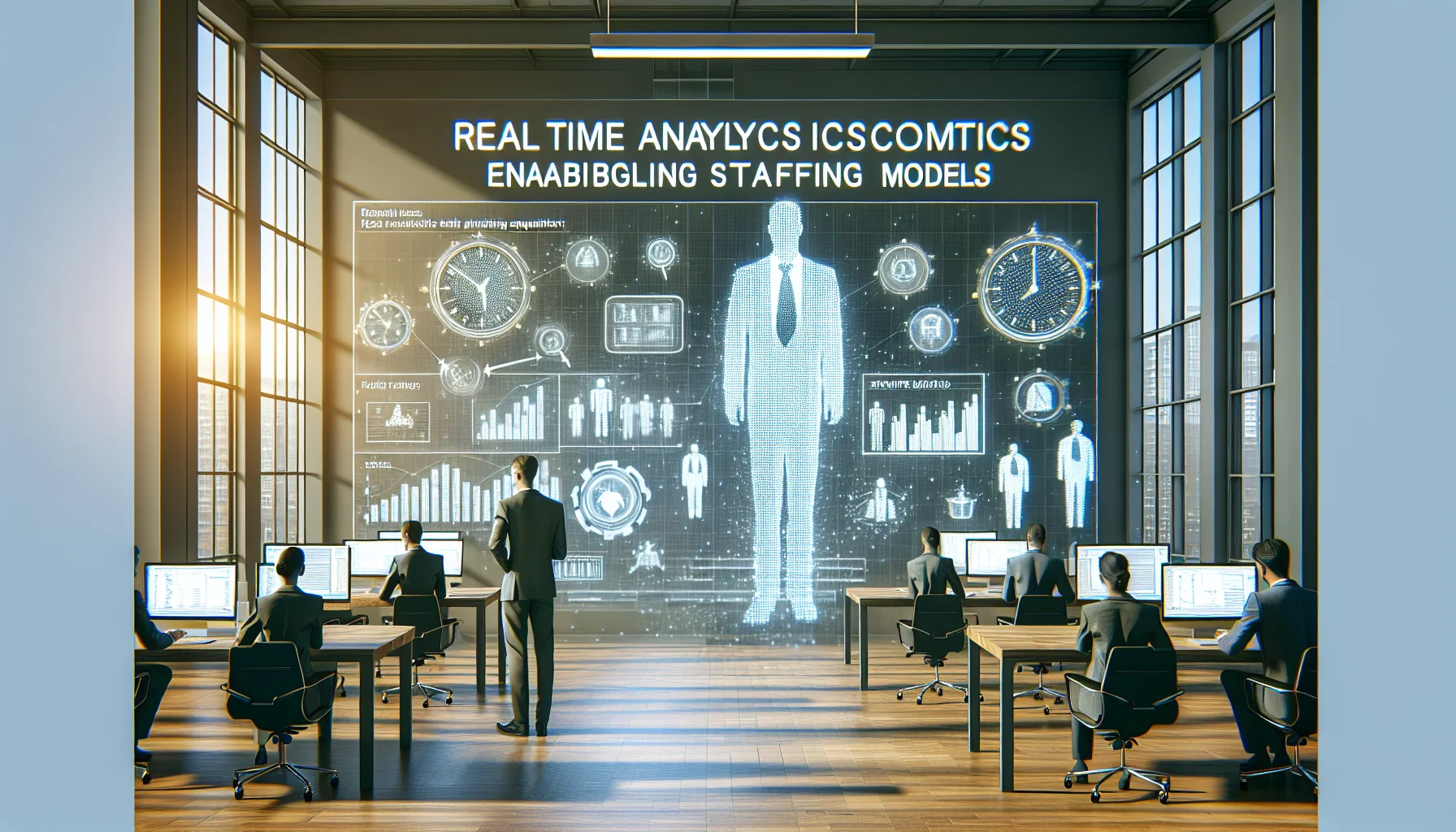
This article describes staffing models enabled by real-time analytics, including just-in-time skill allocation, micro-gig marketplaces, and blended core+flex layers. It explains how continuous skill supply inventories and demand forecasting convert planning from periodic headcount cycles to adaptive, automated decision rules, and outlines an implementation framework and governance guardrails.
When organizations bring real-time analytics to workforce planning, the landscape of staffing models changes quickly. In our experience, teams that replace static spreadsheets with live skill maps and demand streams can move from coarse headcount plans to precise, adaptive approaches that align people to work by skill, location, and time.
This article explains the practical staffing models that emerge, how they rely on continuous skill supply visibility and robust demand forecasting, and what leaders must do to operationalize them.
Real-time analytics unlocks a set of staffing models that were previously theoretical. Rather than hiring only to meet quarterly projections, organizations can operate models that continuously re-balance people to work based on live indicators.
Key models that become feasible include:
Each model rests on two capabilities: accurate, current inventories of skill supply, and tight demand forecasting windows that reflect near-term changes in work volume or complexity.
Just-in-time skill allocation uses a live view of who is available and competent for tasks. Automated matching systems prioritize fit and minimize ramp time. For knowledge work this reduces idle time and increases throughput; for front-line operations it prevents bottlenecks when specific competencies are suddenly required.
Understanding how analytics changes workforce planning models starts with a simple observation: forecasts become continuous rather than periodic. We've found that moving from monthly headcount cycles to rolling horizon forecasts reduces mismatch by 30–60% in high-variability environments.
Analytics improves three planning dimensions:
These shifts allow new staffing models such as dynamic cross-training pools and predictive replenishment of skills (training or hiring initiated by modelled shortages rather than manager intuition).
High-performing teams combine internal KPIs with external signals (market demand, seasonality, supply chain events) to produce a near-real-time demand forecasting feed. This feed can trigger staffing actions automatically — for example, converting planned training seats into immediate redeployment when a surge hits.
Moving from concept to operation requires a framework that translates analytics into trusted staffing actions. In our experience, maturity follows a three-tier path: Observability → Prediction → Decision Automation.
Practical steps to implement include:
For teams looking for real-world patterns, some of the most efficient L&D and workforce teams we work with use platforms like Upscend to automate skill mapping, match supply to demand, and close the loop between learning and deployment without sacrificing quality.
Decision automation should be governed by transparent rules: minimum staffing for safety-critical operations, maximum consecutive reassignments to preserve morale, and thresholds for manager override. These guardrails make staffing models resilient and socially acceptable.
Flex staffing becomes more than a contingency; it becomes a strategic layer when analytics provides continuous signals of where temporary capacity will deliver the most value. Flex pools can be internal (redeployable employees) or external (contractors, partners).
Successful flex staffing requires:
When combined with predictive demand signals, flex staffing allows organizations to smooth peaks without permanent hires, improving cost efficiency and responsiveness.
Track metrics such as time-to-fill for short assignments, utilization rate of flex pool members, quality scores on completed tasks, and variance between forecasted and actual demand. These KPIs guide whether your staffing models favor internal development, external partners, or hybrid approaches.
Manufacturing benefits immediately from real-time analytics because line output, machine status, and supply chain signals are already digitized in many facilities. Specific staffing models enabled by real time analytics in manufacturing include skill-aware shift scheduling and adaptive line staffing.
Examples include:
These approaches reduce downtime and improve first-pass yield because the right skills are where they are needed before issues escalate.
Plant managers should ask: Do we have a real-time inventory of operator competencies? Can we surface predicted skill shortages 48–72 hours in advance? Are cross-training pathways tied to demand signals? Answering these determines whether a facility can adopt advanced staffing models.
Adopting analytics-driven staffing models is powerful but risky without proper governance. Common pitfalls include over-automation, underestimating cultural friction, and poor data quality.
Mitigation strategies:
Key metrics to monitor continuously:
Start with transparency: publish model inputs, regularly review outcomes with managers, and create feedback loops where employees can flag mismatches. In our experience, combining analytics with a clear human escalation path earns buy-in and accelerates adoption.
Real-time analytics transforms traditional staffing models into adaptive, demand-driven systems that optimize skill utilization, reduce downtime, and improve responsiveness. The models described — from just-in-time allocation to manufacturing-specific adaptive staffing — are practical and achievable when organizations invest in data, governance, and change management.
Practical next steps we recommend:
Staffing models that once seemed futuristic are now operational realities. Start small, measure rigorously, and scale what improves outcomes.
Call to action: If you want a starting template, build a pilot that captures three skill types, one demand signal, and a feedback loop — then evaluate impact after one quarter and iterate from there.
The Upscend Team provides actionable insights on technology and business strategy.
Book a walkthrough and we'll show you how it applies to your own content.
 Institutional Learning
December 24, 2025
This article explains how real-time analytics can power continuous apprenticeship in advanced manufacturing by linking learning objectives to operational KPIs. It covers dashboard designs, core KPIs, case evidence (28% rework reduction; 22% faster certification), and a five-step pilot roadmap to assess readiness, protect privacy, and scale programs.
 Institutional Learning
December 24, 2025
Real-time apprenticeship measurement uses event-driven data and streaming analytics to shorten feedback loops, improve skill acquisition, and reduce rework. Track grouped apprentice KPIs — skill acquisition, productivity, engagement — instrument key events, and present role-based dashboards. Start with a small pilot and governance to protect privacy and calibration.
 HR & People Analytics Insights
January 6, 2026
Decision-makers should prioritize internal HR and LMS histories for production-grade turnover models, use public HR and learning datasets for prototyping, and apply synthetic data or augmentation to address privacy and sparsity. The article outlines labeling strategies, feature engineering, and a checklist to prepare model-ready datasets and governance steps for pilots.
 HR & People Analytics Insights
January 6, 2026
A real-time L&D skill inventory lets teams convert skills data into prioritized learning journeys, short blended interventions, and measurable capability gains. Use capability maps to tag skills, segment gaps, and score cohorts for pilots. Implement 6-week templates with microlearning, applied projects and coaching, and track impact with a 90-day KPI measurement plan.