

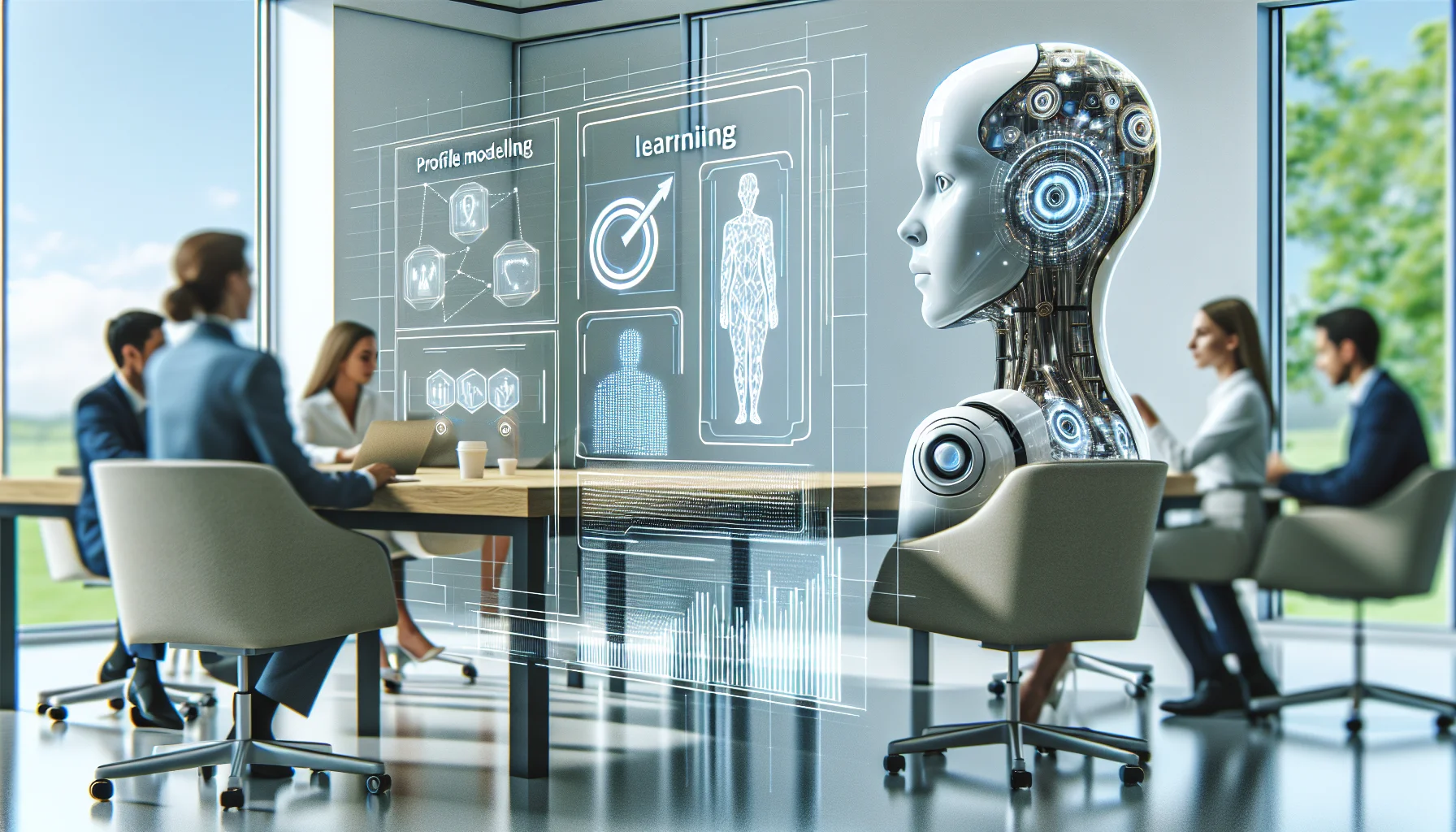
This article explains how AI agents personalize learning by combining profile modeling, dynamic sequencing, and continuous assessment. It outlines key data inputs, algorithms (Bayesian tracing, RL, collaborative filtering), an end-to-end pathway example, integration points with HRIS/LMS, and a checklist to reduce data quality, bias and adoption risks.
AI agents personalize learning by synthesizing learner signals, role requirements and competency models to generate adaptive, time‑boxed pathways. In our experience, effective systems don't just recommend content — they translate performance gaps into a sequence of targeted micro‑activities, assessments and remediations that evolve as the learner progresses.
This article explains the algorithms and data inputs that power personalization, gives an end‑to‑end example from skills assessment to remediation, and lists concrete integration points and rules teams can deploy. We'll address common pain points such as data quality, bias and learner acceptance, and provide a practical checklist teams can use to pilot adaptive learning agents.
At a high level, AI agents personalize learning by combining three capabilities: (1) profile modeling, (2) dynamic sequencing, and (3) continuous assessment. These agents operate as decision engines that turn raw signals into prioritized learning actions and schedule them to maximize retention and transfer.
We've found that teams that treat the agent as an orchestration layer — not just a content recommender — get the most value. The agent's outputs include adaptive assessments, recommended micro‑learning, and remediation triggers. Key outputs are mapped to competency benchmarks so progress is measurable.
Successful agents need rich, structured inputs: skills profiles, performance signals, and contextual metadata such as job roles. These inputs are combined to compute a learner's current competency vector and identify the smallest instructional move that closes the largest gap.
To make the agent reliable, start with a canonical learner model. In our experience, this includes three layers: a persistent skills registry, transient behavioral signals, and organizational constraints. AI agents personalize learning more effectively when the model links content items to competencies and observable outcomes.
Signal engineering matters: timestamps, decay functions and confidence scores convert raw events into usable predictors. For example, a failed real‑world task logged in an HRIS should have a higher remediation priority than an old quiz failure because its recency and impact are greater.
Blend self‑assessments and manager observations with objective metrics using weighted scoring. We've found that a simple three‑component score (self, manager, system) with adjustable weights reduces volatility while preserving sensitivity to change. That score feeds the sequencing engine to decide whether a learner needs a micro‑lesson, a simulation, or on‑the‑job coaching.
Below is a concise, practical walkthrough of how AI agents personalize learning in an enterprise setting. This is a reproducible pattern you can pilot in an LMS integrated with competency frameworks.
During implementation, the turning point for most teams isn’t just creating more content — it’s removing friction. Tools that make analytics and personalization part of the operational workflow improve adoption; for example, Upscend helps by surfacing the right metrics and automations so those remediation loops become repeatable.
Day‑to‑day the learner sees a short queue: a 7‑minute micro‑lesson, a 5‑minute practice, and a 10‑minute simulation on alternate days. The agent adapts the queue daily based on pass/fail and time‑on‑task, preserving momentum and preventing overload.
Under the hood, agents combine classic and modern methods: collaborative filtering for content discovery, Bayesian knowledge tracing or item response theory for mastery estimation, and reinforcement learning for sequencing policies. The sequencing objective balances retention, efficiency and business impact.
When we design agents we define explicit business constraints (e.g., compliance windows) and pedagogical rules (e.g., no more than two heavy simulations per week). The agent evaluates candidate paths against those rules and selects the highest‑scoring plan.
Use Bayesian knowledge tracing for micro‑skill mastery, supervised ranking for content relevance, and policy‑learning (RL) when you can simulate long‑term outcomes. Hybrid pipelines — where a rule‑based filter preselects content and a learned model ranks it — often outperform pure black‑box approaches, especially when transparency is required for compliance.
Practical deployment requires integrating the agent with core systems: HRIS, LMS, and an authoritative competency framework. These integrations allow the agent to access role definitions, update learning records, and consume real‑time performance signals.
We've found that three integration patterns unlock most value: push/pull sync for profiles, event streams for performance signals, and SCORM/LRS endpoints for activity records. With these in place, the agent can automate enrollment, trigger manager nudges, and update proficiency badges.
Deploying agents often hits three predictable pain points. First, data quality: inconsistent skills tags and stale HR records produce noisy recommendations. Second, algorithmic bias: models trained on skewed past data can perpetuate inequities. Third, learner acceptance: if recommendations feel opaque or irrelevant, adoption collapses.
Address these with governance: canonical taxonomies, periodic data validation, and explainability layers. We've found that exposing the rationale for each recommended step (showing competency gap, evidence and expected time) increases trust and engagement.
AI agents personalize learning by turning diverse data inputs into measurable, adaptive journeys. In our experience, the highest ROI comes from focusing first on clean inputs (skills profiles, performance signals, role maps), then iterating sequencing logic with real learners. Start small: pilot one role with a tight competency model, instrument outcomes, and iterate.
To get started, define three pilot objectives (measurement, adoption, business impact), integrate your HRIS and LMS, and apply the personalization rules listed above. If you want a practical next move, assemble a two‑week sprint to map competencies and configure one end‑to‑end pathway; measure lift with pre/post competency scores and completion rates.
Call to action: Identify one role to pilot, export its competency map from your HRIS, and run a two‑week assessment to generate the first adaptive pathway — use the checklist here to keep the pilot focused and measurable.
The Upscend Team provides actionable insights on technology and business strategy.
Book a walkthrough and we'll show you how it applies to your own content.
 Ai
AiDecember 28, 2025
This article explains the architecture and algorithms behind AI tutoring platforms, covering data ingestion, student modeling (IRT/BKT/hybrids), personalization engines, conversational NLP, and operational concerns like latency and observability. Readers will learn how platforms analyze answers, recommend content, and mitigate integration and explainability challenges.
 Learning System
December 28, 2025
This article maps model families to L&D use cases—collaborative and hybrid recommenders for ranking, sequence models (RNNs/Transformers) for next-step prediction, RL for long-horizon optimization, and GNNs for prerequisite-aware paths. It gives data requirements, starter hyperparameters, a decision matrix and practical governance tips for piloting models.
 Learning System
December 28, 2025
This article lists prioritized learning data sources and the learner signals needed to build AI-driven personalization. It explains instrumenting event tracking (xAPI), LRS data normalization, labeling strategies, privacy and consent controls, and an ETL blueprint to convert fragmented systems into model-ready feature stores. Includes a practical checklist for pilots.
 Business Strategy&Lms Tech
January 25, 2026
This article shows how advanced AI personalized learning combines NLP-driven content embeddings, reinforcement learning sequencing, and knowledge graph personalization into scalable, explainable L&D systems. It covers pipelines, architecture, implementation trade-offs, monitoring metrics, and a staged roadmap: deploy semantic search first, add graphs for constraints and explainability, then pilot RL policies with conservative exploration.