

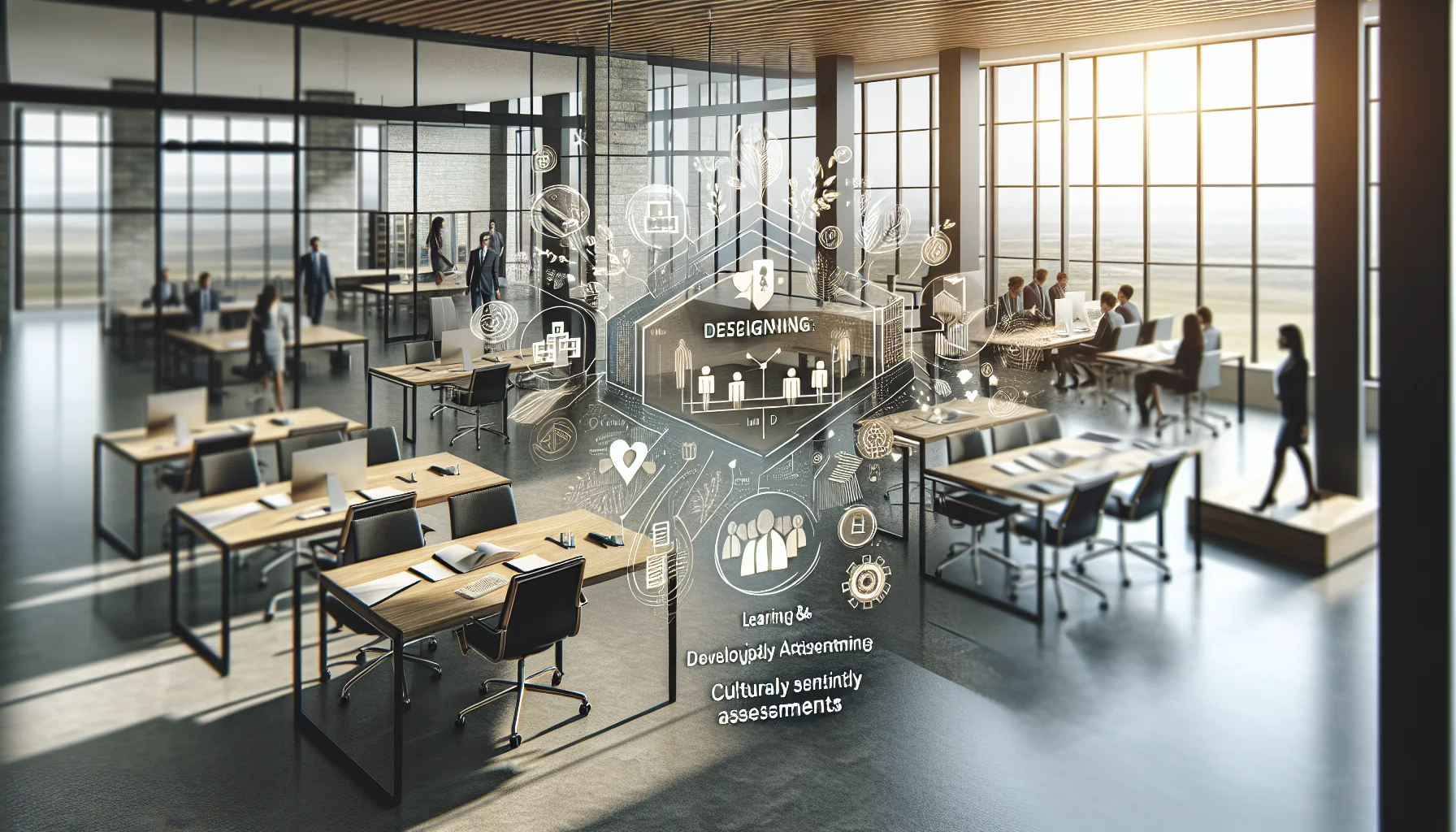
Practical steps for L&D teams to design culturally sensitive assessments in multi-tenant LMSes: map competencies, tag item banks for culture and language, run localized pilots with SMEs, and use DIF analytics. Combine modular content and branching adaptive learning paths so tenants receive localized remediation while preserving global mastery thresholds.
culturally sensitive assessments are essential when learning programs scale across countries, languages and business units. In our experience, organizations that embed culture into assessment design reduce bias, improve completion rates and get more actionable competency data. This article gives practical steps for L&D teams building culturally sensitive assessments, mapping competencies, and deploying adaptive learning paths across a multi-tenant personalization context.
Start with a tight checklist to prevent biased items and to make assessment localization straightforward. The checklist below balances psychometric validity with cultural relevance so your culturally sensitive assessments are defensible and scalable.
Practical tip: include a visible culture tag on each item (e.g., neutral, region-specific, language-dependent) so tenants can opt items on/off during multi-tenant personalization.
An assessment is culturally sensitive when it measures the intended competency rather than cultural familiarity. We've found that clear behavioral anchors, video or work-sample tasks, and localized scoring rubrics dramatically improve validity. Use rubrics that emphasize observable actions, not culturally bound behaviors.
Concrete examples help designers avoid abstract guidance. Below are short, localized scenario templates you can adapt quickly for technical, compliance, and soft-skill assessments.
Scenario: "A server in Region X shows intermittent packet loss. You have command-line access and limited permissions." Use a hands-on lab or simulated sandbox. For assessment localization, change region-specific tech stack names, measurement units, and regulatory references while keeping the core problem identical across tenants.
Scenario: "An employee receives a gift from a vendor during a local festival." Offer multiple-choice and short-essay prompts that vary by legal/regulatory context. When designing culturally sensitive assessments for Middle East learners, for example, adjust cultural norms and legal considerations while preserving the ethical principle being tested.
Scenario: "You lead a project team with cross-cultural members; two members disagree publicly in a meeting." Use role-play or recorded responses and rubric-based scoring. Soft skills are especially susceptible to cultural interpretation, so include local SMEs in rubric calibration.
Quality assurance is a continuous cycle: draft, local SME review, pilot, psychometric analysis, revise. This ensures culturally sensitive assessments remain fair across tenants and languages.
Analytics should flag items with disparate impact. A pattern we've noticed: items referencing local practices often show lower completion or higher variance; those should either be localized further or replaced with neutral alternatives.
Use a combination of descriptive and inferential tests. Compare item difficulty across tenant groups, run DIF, and review open responses via qualitative coding. Visual dashboards that slice by tenant, language, and role reduce reporting fragmentation and help redesign teams act fast.
Designing adaptive learning paths inside a multi-tenant LMS requires both content modularity and tenant-level rules. Personalization should respect local learning preferences while maintaining global competency outcomes.
Start with a core competency map that defines mastery thresholds. Then build modular assessment gates: when a learner misses a competency in a tenant-specific context, the system routes them to a localized remediation path. This is where personalized learning paths in multitenant LMS become powerful: the same assessment engine can serve different content blocks per tenant based on culture tags.
Some of the most efficient L&D teams we work with use platforms like Upscend to automate this entire workflow without sacrificing quality. Their teams configure tenant rules, run localized pilots, and generate DIF reports from a single console—an approach that demonstrates how operational controls and analytics combine to scale culturally aware programs.
A typical implementation uses tenant profiles: preferred language, cultural norms, role taxonomies, compliance rules, and completion incentives. The LMS applies these preferences to choose which items, videos, or role-plays appear. Keep remediation short and culturally relevant to combat low completion rates.
Implementing at scale requires a project plan that connects competency mapping to item libraries and analytics. Follow a phased rollout to limit reporting fragmentation and ensure fairness.
Common pitfalls to avoid: relying on translation alone, using culturally loaded imagery or names, and centralizing reporting that doesn't allow tenant-level slicing. These lead to biased questions, low completion rates, and reporting fragmentation.
Maintain a governance rhythm: quarterly SME reviews, automated DIF alerts, and a documented appeals process for learners who contest an item. Keep item statistics transparent to each tenant and provide remediation at the individual level to support equitable outcomes.
Track these KPIs per tenant: completion rate, post-assessment performance lift, item-level DIF, time-to-certification, and learner satisfaction. Combining psychometrics with engagement metrics uncovers whether a high pass rate is due to learning or to culturally biased items.
Designing culturally sensitive assessments in a multi-tenant environment is a repeatable engineering and design problem: define competencies, build a tagged item bank, localize with SMEs, run pilots, and automate analytics to detect bias. Use assessment localization plus branching adaptive learning paths to keep remediation relevant and completion rates high.
Start small: pick one competency, create a neutral and a localized item set, pilot across three tenants, and run DIF. That single cycle will reveal your biggest gaps: biased questions, low completion segments, and fragmented reporting. Repeat, scale, and govern.
Ready to operationalize culturally sensitive assessments? Begin by mapping one core competency to three tenant roles, then run a pilot with local SMEs and psychometric analysis. This pragmatic approach yields faster wins and cleaner reporting across your multitenant LMS.
The Upscend Team provides actionable insights on technology and business strategy.
Book a walkthrough and we'll show you how it applies to your own content.
 Lms
LmsDecember 28, 2025
This article explains why cultural sensitivity mental health training is essential for global LMS deployments, and outlines localization strategies across language, imagery and scenarios. It provides stakeholder engagement steps, legal pitfalls to avoid, two regional examples and a practical checklist to measure engagement and safety during rollout.
 Workplace Culture&Soft Skills
January 5, 2026
Hybrid teams magnify cultural differences — especially around directness, hierarchy and time orientation — because digital channels strip nonverbal cues. Use the Cultural Mismatch Risk Score to audit scenarios, prioritize high-risk interactions, and implement localized norms, multilingual templates and targeted tooling to reduce miscommunication within 30/60/90 days.
 Workplace Culture&Soft Skills
January 5, 2026
The article explains how integrating psychological safety in hybrid teams reduces digital misunderstandings by combining leadership modeling, HR systems, and short measurement cycles. It gives a repeatable six-week pilot, sample pulse questions, and metrics to track behavioral and outcome improvements.
 Psychology & Behavioral Science
January 12, 2026
This article identifies LMS features neurodiversity teams should prioritize—customizable UI, native text-to-speech, captions, variable playback, modular navigation, bookmarking, xAPI analytics and notification controls. It provides a 10-point evaluation checklist, vendor shortlist criteria, two vendor comparisons, and an IT integration checklist to move from pilot to implementation with measurable accommodation outcomes.