

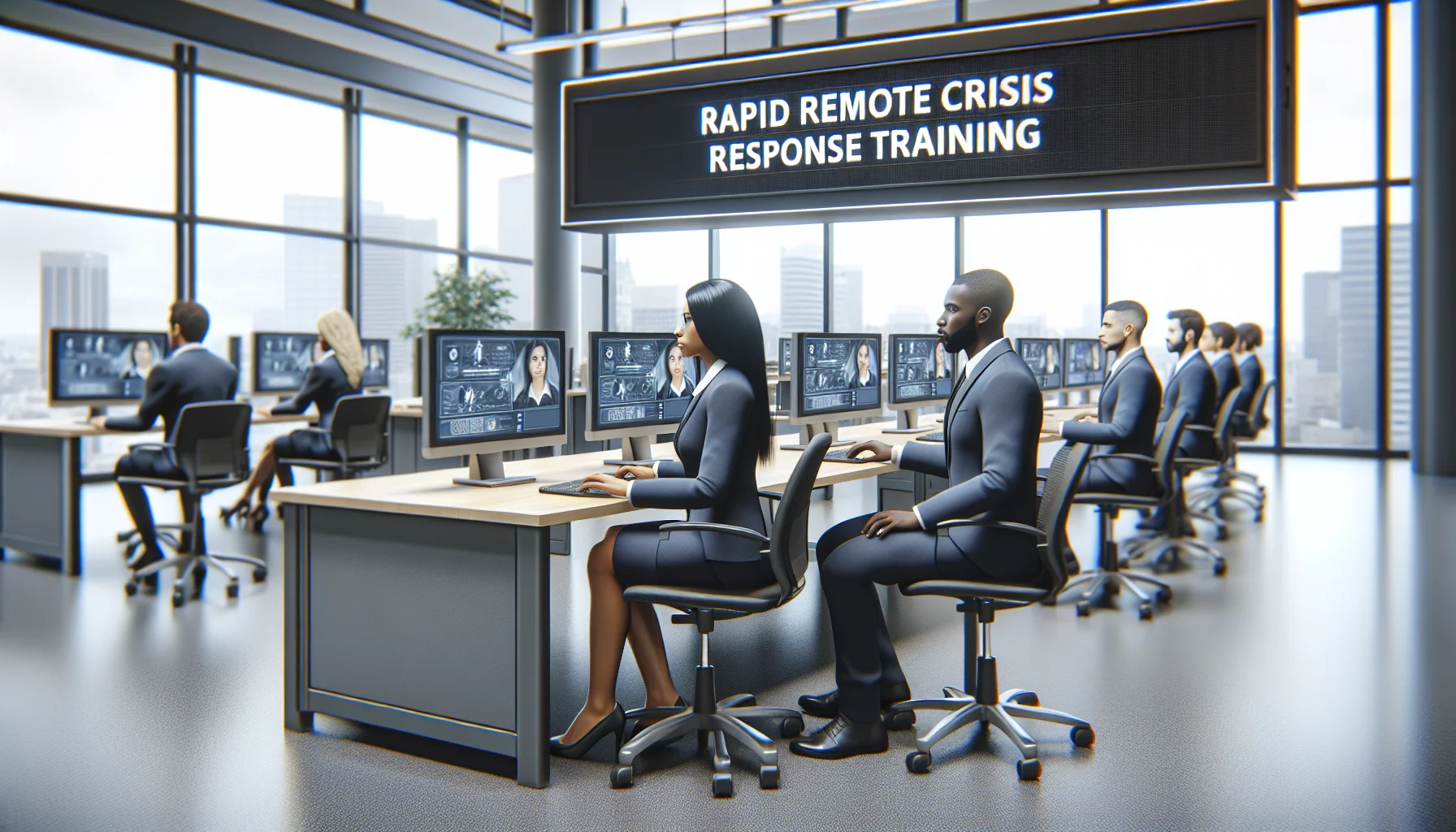
This article outlines a tactical playbook for rapid remote crisis response training. It recommends short synchronous micro-sims, asynchronous decision exercises, timezone cohorts, and virtual coaching, with a sample 4-week readiness sprint and low-bandwidth tech stack. Measurement focuses on behavioral metrics like time-to-escalate, decision accuracy, and AAR-driven improvement.
remote crisis response training must be fast, practical, and repeatable to protect people, reputation, and operations when a global event occurs. In our experience, programs that blend high-impact synchronous practice with measured asynchronous decision-making produce the best outcomes for distributed workforces. This article provides a tactical playbook—design principles, a sample 4-week remote readiness program, a recommended tech stack, and two anonymized examples—to help learning leaders scale remote crisis response training across time zones and bandwidth constraints.
To train remote and hybrid teams quickly you need a palette of high-frequency, low-friction interventions. The essential mix is: synchronous micro-sims, asynchronous decision exercises, timezone-friendly cohorts, and virtual coaching. Each addresses a key pain point—engagement, coordination, or bandwidth limits—while contributing to overall distributed team readiness.
Design each tactic to be measurable. Use short behavioral objectives (e.g., “notify chain initiated in <90s”), and run after-action reviews (AARs) that capture decisions and debriefs. Studies show that scenario-based practice with rapid feedback improves transfer to real incidents; the same holds remotely when exercises are short, repeated, and focused.
Synchronous micro-sims are 10–30 minute live simulations that require active decisions, role play, and immediate feedback. They boost muscle memory for critical procedures and create shared situational awareness across sites. Keep groups small (6–12 people), rotate roles, and capture timestamps to measure adherence.
Asynchronous decision exercises are scenario prompts delivered by email, LMS, or messaging that participants answer on their schedule. They are ideal for low-bandwidth contexts and for stretching critical thinking between live sessions. Use branching logic or short video clips to increase realism without requiring a live connection.
Effective remote crisis response training requires a clear cadence and escalating complexity. Below is a practical 4-week program that balances synchronous and asynchronous elements and anticipates limited bandwidth and coordination challenges.
The program mixes micro-sims, decision exercises, easy-access job aids, and coaching touchpoints to build confidence rapidly.
Each touchpoint includes a calibration metric (time-to-escalate, accuracy of decision, communication clarity). We’ve found that reporting these metrics weekly keeps stakeholders aligned and improves participation rates for future sessions.
Choose tools that are resilient under constrained conditions and that support rapid iteration. For remote crisis response training, prioritize these capabilities: offline access, lightweight branching, simple recording, and analytics for engagement and decision quality.
Recommended stack components:
Operational tip: keep a parallel low-bandwidth path—SMS or compressed audio summaries—so field staff remain included. This reduces exclusion and accelerates adoption.
Practical platforms now provide integrated feedback loops (available in platforms like Upscend) that let L&D teams spot disengagement patterns, adjust scenario difficulty, and correlate performance with role and region. Use these insights to tweak cadence and content rather than increasing session length.
Real-world application clarifies trade-offs. Below are two anonymized case studies that highlight how the tactics scale across function and risk profile.
A multinational sales organization needed fast training during a sudden regulatory event. They deployed a week-long sprint of asynchronous decision prompts followed by role-specific micro-sims that focused on compliance communication and customer triage. Results: faster escalation, 40% reduction in misrouted inquiries, and high participation driven by short, role-focused exercises.
A distributed IT ops team faced a cloud outage scenario. They used low-bandwidth text-based simulations and 15-minute micro-sims to practice failover procedures. Leaders ran virtual coaching sessions after each sim to address technical gaps; engineers appreciated the short, context-rich exercises. Outcomes: mean time-to-restoration improved and documented runbook adherence increased.
Measurement should focus on behavior, not just completion. Track a mix of process and outcome metrics: time-to-escalate, decision accuracy, communication clarity (peer-rated), and system recovery time. These measures are more meaningful than raw attendance and drive continuous improvement.
Common pitfalls to avoid:
To scale, convert core scenarios into modular assets that can be recombined for role or region. Empower local facilitators with a facilitator kit and scheduled coach office hours. We’ve found that a train-the-trainer approach combined with centrally curated scenario libraries reduces run-time creation by 70% and improves consistency.
Rapid, effective remote crisis response training is achievable with a disciplined mix of short live practice, asynchronous decision work, timezone-aware cohorts, virtual coaching, and low-bandwidth fallbacks. Begin with a pilot cohort, measure a small set of behavioral metrics, and iterate. Prioritize brevity and repetition over length—short, frequent exposures create durable readiness.
Start with this simple checklist:
Take action: launch a four-week pilot with a mixed cohort this quarter, collect the three core metrics for continuous improvement, and schedule the first refresh within 90 days. Quick pilots reduce organizational friction and make sustained remote crisis response training practical for any distributed team.
The Upscend Team provides actionable insights on technology and business strategy.
Book a walkthrough and we'll show you how it applies to your own content.
 L&D
L&DDecember 14, 2025
This article explains how to evaluate and deploy remote learning solutions by aligning learning objectives with platform capabilities, pedagogy, and realistic cost models. It recommends pilots, weighted vendor scorecards, and measurable KPIs to select virtual training platforms that scale. Practical adoption tactics and ROI estimation methods are included.
 Lms
LmsDecember 23, 2025
Remote employee training works best as a repeatable playbook that balances synchronous and asynchronous methods. Use a 60/40 baseline to assign foundational microlearning to asynchronous paths and practice, feedback and social learning to live sessions. Pair an LMS, video tools, and analytics with facilitator training and accessibility to scale across time zones.
 ESG & Sustainability Training
January 5, 2026
This article compares virtual, in-person and blended crisis training across speed, realism, reach, cost and assessment fidelity, and concludes blended crisis training is the pragmatic default when speed and fidelity matter. It includes a decision matrix, role-based mixes, sample schedules, cost/time trade-offs, and a 6–8 week pilot checklist with metrics.
 ESG & Sustainability Training
January 5, 2026
Metaverse safety simulations let distributed teams rehearse high-risk scenarios with lower physical risk and higher retention than video-only methods. The article explains four deployment patterns, technical baselines, outage contingencies, and consistent assessment rubrics to make remote team metaverse training measurable and compliant. Run a pilot with mixed connectivity to validate outcomes.