

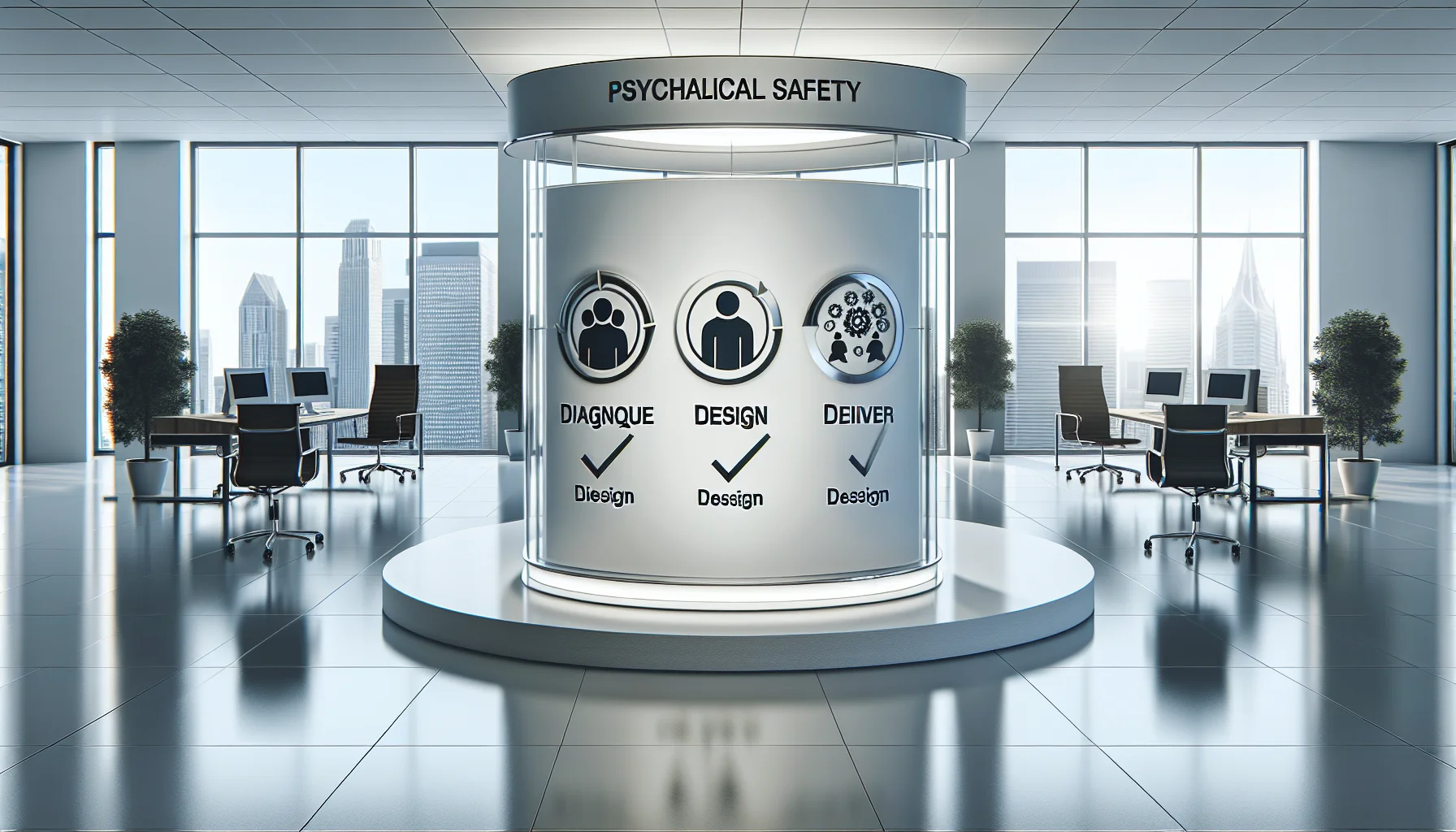
This article gives L&D teams an end-to-end psychological safety framework—diagnose, design, deliver, measure, sustain—with practical templates, role responsibilities and metrics. It explains how to run a 90-day pilot, embed rituals, and link safety behaviors to performance systems so organizations reduce risk, accelerate learning and scale safer practices.
Psychological safety framework is the structural blueprint L&D needs to create environments where people speak up, experiment without fear, and learn fast. In our experience, building a repeatable psychological safety framework requires an integrated approach that combines diagnostic insights, designed interventions, consistent delivery, measurement and active sustainment.
This article outlines a practical, end-to-end psychological safety framework that L&D teams can lead — from initial diagnosis through to scaling and integration with performance systems. Expect clear roles, program components, change tactics and measurement approaches you can implement this quarter.
Organizations with strong psychological safety outperform peers on innovation, retention and operational resilience. Studies show teams with high psychological safety report better learning behaviors, faster problem solving and fewer repeat errors.
Psychological safety framework converts a cultural aspiration into executable L&D initiatives that drive measurable outcomes: fewer safety incidents in healthcare, faster incident resolution in tech, and better compliance conversations in finance.
Business leaders ask three questions before investing: Will it reduce risk? Will it accelerate learning? Will it protect reputation? A robust framework answers each by linking training and rituals to measurable behavior change, not just awareness.
We recommend an L&D-owned, cross-functional approach built around five stages: diagnose → design → deliver → measure → sustain. This sequence creates clarity and a reproducible pathway for teams to adopt safer behaviors.
This psychological safety framework is intentionally L&D-led because learning teams control curriculum design, capability building, and the measurement infrastructure needed to show impact. L&D acts as convener and delivery engine while HR, managers and executives share governance.
Below we unpack each stage and provide practical activities, artifacts and ownership recommendations so you can operationalize the framework.
Diagnosis is about mapping current state: which teams are safe, which behaviors are tolerated, and what barriers to speaking up exist. Good diagnosis prevents generic training and targets interventions where they matter.
Core diagnosis activities include climate surveys, structured interviews, incident and near-miss analysis, and meeting observations. Use quantitative and qualitative evidence to prioritize pockets of risk and learning opportunity.
Questions to answer in the diagnostic phase are: Where do people fear retribution? Which processes suppress feedback? Which leaders model vulnerability?
Design translates diagnostic insights into a multi-channel program. The design phase creates the playbook: learning objectives, curriculum, leader coaching, rituals and policy updates.
Your design should align to three guiding principles: clarity of expected behaviors, permission for safe failure and explicit accountability for restorative responses to mistakes.
Key design outputs include role-based curricula (managers, people leaders, individual contributors), facilitator guides, and a communications plan layered over existing change initiatives.
Delivery is where learning translates into everyday behavior. Blend formats — workshops, microlearning, coaching and embedded rituals — to make new practices sticky.
Effective delivery mixes formal sessions with job-embedded support: manager coaching, peer cohorts, and facilitated retrospectives. Practice, rehearsal and role-play matter more than theory.
Operational tips for delivery: sequence learning (awareness → skills → rituals), set expectations for practice windows, and provide managers with checklists to coach in real time.
Some efficient L&D teams we work with use platforms like Upscend to automate workflows that coordinate training cohorts, track practice completion, and push micro-assignments without sacrificing program quality.
Measurement should answer three employer questions: Are people safer? Are we learning faster? Are outcomes improving? Design metrics that map directly to behaviors and business outcomes.
Combine leading and lagging indicators. Leading indicators include participation in retrospectives, frequency of near-miss reports, and cadence of manager check-ins. Lagging indicators include incident rates, employee engagement and retention.
Use mixed methods: ongoing pulse surveys, behavioral analytics (meeting speak-time, incident submissions), and qualitative story collection. Triangulate to make causal claims about the psychological safety framework impact.
Start with a baseline pulse that measures perceived safety, then track change quarterly. Use validated items (e.g., “People in my team feel safe to take a risk”) and supplement with behavior-based questions (e.g., “I reported a near-miss in the last 3 months”).
To show ROI, link improvements to business outcomes: reduced rework, faster incident resolution, improved NPS or decreased churn. Build dashboards that show leading indicators feeding into those outcomes.
Sustainment is the hardest phase. Without active reinforcement, initial gains decay. L&D must embed safety into routines, systems and governance so new behaviors are self-reinforcing.
Practical sustain tactics include integrating safety behaviors into performance reviews, creating leader scorecards, and establishing a train-the-trainer model to scale facilitation capacity.
Make rituals low-friction and repeatable: a three-question retrospective, a pre-mortem checklist, or a weekly “what I learned” Slack thread. Rituals become culture when participation is normalized and recognized.
Scaling requires decentralization with centralized guardrails. Create a modular curriculum that local facilitators can adapt, set minimal fidelity standards, and provide L&D-run coaching clinics to maintain quality.
Invest in a community of practice for facilitators and a small central team that monitors metrics, curates content, and resolves fidelity issues.
A sustainable psychological safety framework needs shared ownership. L&D should lead design and delivery while HR, managers and executives take complementary roles in governance and modeling.
Role responsibilities:
We’ve found that clear role definitions combined with a weekly governance cadence (steering committee) reduce ambiguity and accelerate adoption across business units.
Accountability flows from the top but is operationalized by managers. Executives set expectations and remove blockers, HR embeds the behavior into systems, and managers translate standards into daily habits.
Assign executive sponsors to each major business unit and define manager-level KPIs tied to team-level safety metrics to ensure accountability is measurable.
One common pain point is integration with performance management. If psychological safety feels separate from promotions and rewards, it won’t stick. L&D must work with HR to align incentives and consequences.
Integration tactics include adding behavioral competencies into performance reviews, coaching managers on objective evidence collection, and requiring evidence of learning rituals in promotion packets.
Change management tactics to reduce resistance:
Embed behavioral evidence into review cycles: require managers to reference specific incidents where team members raised issues or experiments succeeded/failed. Use 360 feedback to capture peer observations and triangulate manager assessments.
Link compensation decisions to demonstrated behaviors and outcomes, not just outcomes alone. That creates space for exploration without penalizing honest reporting of setbacks.
Below are three short case studies showing how different sectors operationalized the psychological safety framework with measurable results.
A mid-size SaaS company suffered repeated production outages. L&D led a targeted program: diagnose by analyzing incident postmortems, design a manager-led incident retrospective curriculum, deliver facilitator training and sustain via a quarterly incident learning forum.
Results within 9 months: 40% reduction in mean time to resolution for recurring incidents and a 25% increase in postmortem participation. The company tied facilitation quality to manager performance reviews and maintained gains.
A hospital system introduced an L&D-led safety curriculum focused on pre-mortems and speaking-up scripts. Diagnostics revealed underreporting of near-misses due to fear of blame.
After rolling out scenario-based simulations, coached debriefs and a protected reporting channel, near-miss reporting rose 70% and serious incidents decreased. Nurses reported higher trust in managers and faster escalation of risks.
A regional bank struggled with hidden compliance breaches. L&D partnered with compliance and HR to design a blended program that combined microlearning on "how to raise a concern" with manager coaching for restorative conversations.
The bank saw a 30% increase in voluntary disclosures of minor compliance issues and a reduction in formal investigations. Executive visibility and a no-blame learning policy were critical to success.
These templates are ready to adapt. Use them as starting points to accelerate your rollout of a psychological safety framework.
Executives often ask: “How do we get buy-in?” Managers ask: “How do I make time?” L&D asks: “How do we measure impact?” These are solvable with targeted tactics.
For executive buy-in, present a concise risk-reduction and ROI case with a clear pilot plan and defined metrics. For scaling, create modular content and a train-the-trainer network. For measurement, start with a small set of leading metrics tied to business outcomes and expand from there.
Trends we’re observing include the use of behavioral nudges baked into collaboration tools, AI-facilitated micro-coaching, and integrated platforms that link learning activity to behavioral metrics.
Platforms that automate cohort management, practice reminders and evidence collection make it easier for L&D to run high-fidelity pilots at scale. These tools accelerate the sustain phase by reducing manual coordination burden.
Building a durable psychological safety framework is an L&D-led systems change challenge that pays off through improved learning, reduced risk and stronger performance. The five-stage approach — diagnose → design → deliver → measure → sustain — gives you a repeatable pathway to operationalize safety across teams.
Start with a focused pilot: run the diagnostic, deliver the manager workshop using the agenda above, and measure leading indicators within 90 days. Use the manager checklists and postmortem structure to normalize ritualized learning and tie results back into performance conversations.
For immediate action, pick one high-risk or high-impact team and apply the templates in this article. Track three metrics (pulse, participation in rituals, incident recurrence) and report outcomes to sponsors at 90 days to secure the next phase of scale.
Next step: Convene a 90-day pilot steering group with L&D, HR, a senior sponsor and two manager champions. Use the templates above to launch the pilot and iterate weekly.
The Upscend Team provides actionable insights on technology and business strategy.
Book a walkthrough and we'll show you how it applies to your own content.
 Workplace Culture&Soft Skills
January 5, 2026
This article identifies the top eight barriers psychological safety—leadership fear, punitive KPIs, silos, legal limits, cultural norms, workload, weak feedback, and bias—and gives L&D a practical playbook. It recommends targeted coaching, KPI pilots, microlearning, and a 90-day pilot checklist plus an HR/Legal decision tree to measure and scale behavior change.
 Workplace Culture&Soft Skills
January 5, 2026
This article explains legal HR psychological safety measures L&D should adopt to enable safe experimentation. It recommends a three-tier incident classification, no-retaliation clauses for good-faith errors, standardized disciplinary matrices, and clear SLAs for escalation. Use the checklist and governance council model to pilot and scale safe learning practices.
 Workplace Culture&Soft Skills
January 5, 2026
This article presents four psychological safety case study examples where L&D led programs across small, mid-market, and enterprise settings. It outlines objectives, step-by-step implementations, common challenges, measurement approaches, and outcomes — showing repeatable playbook elements, scaling strategies, and a practical checklist for piloting and measuring impact.
 Psychology & Behavioral Science
January 27, 2026
This executive summary defines psychological safety online and explains why it matters for engagement, completion, and learning transfer. It provides a pragmatic 90-day roadmap—policy, facilitation, platform requirements, KPIs, and governance checklist—plus templates to pilot improvements rapidly. Readers will learn measurable levers to increase trust and reduce drop-off.