

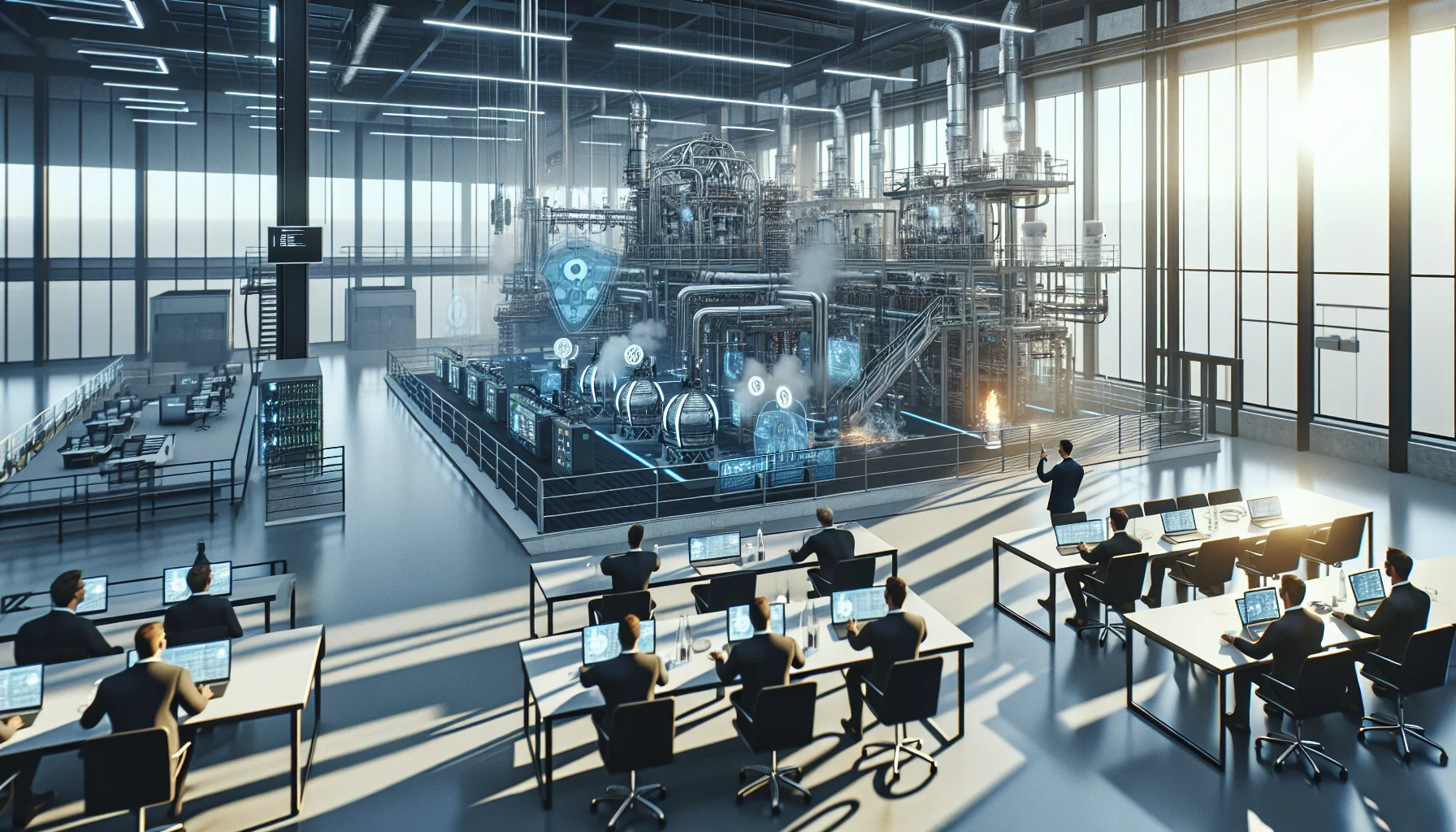
Digital twins training combines detailed asset simulations, VR/AR immersion, and learning operations to accelerate safe competence in high-risk technical roles. The article covers technology layers, pedagogy, use cases, ROI modeling, vendor/integration advice, and a stepwise pilot-to-scale checklist L&D and operations teams can apply.
digital twins training is transforming how organizations prepare workers for dangerous, complex roles by combining high-fidelity simulation with immersive learning methods. In this overview we define the technology, compare VR and AR approaches, and map practical, measurable paths to deploy immersive learning for high-risk jobs.
This article targets learning leaders, safety engineers, and operations managers seeking a rigorous, evidence-driven framework to plan pilots, prove ROI, and scale technical training safely and efficiently.
digital twins training combines a virtual replica of equipment, processes, or environments with immersive learning modalities to accelerate competence in high-risk jobs where mistakes are costly. Organizations use it to improve safety, cut downtime, and raise retention of procedural knowledge.
In our experience, the most successful programs treat the digital twin as a living asset: it supports scenario-based training, performance measurement, and continuous improvement. This article provides a practical blueprint—technology stack, pedagogy, outcomes, ROI, vendor guidance, and a clear pilot checklist—for teams ready to move from concept to sustained adoption.
At its core, digital twins training requires three integrated layers: a data-driven model of the real asset, an immersion layer for learners (VR or AR), and a learning operations layer for content, assessments, and analytics.
Below are the dominant components and how they interact to create credible, repeatable training experiences.
The asset model is the seed of a digital twin: 3D geometry, behavioral models, control logic, and live or historical telemetry. Simulation fidelity matters for transfer to the real world: physics engines, thermal/electrical models, and process dynamics are common inclusions.
digital twins training relies on accurate simulation of failure modes, startup/shutdown sequences, and human-machine interfaces to teach decision-making under stress.
Choosing between VR and AR depends on learning goals. VR offers full immersion and safe rehearsal of catastrophic failures; AR overlays guidance during on-the-job tasks. Both are valid for immersive learning and are often used together in blended programs.
For many high-risk jobs, VR is used for scenario rehearsal and competency assessment, while AR provides procedural support and remote expert assistance during live maintenance.
The learning operations layer houses courseware, scenario libraries, scoring rubrics, and dashboards. It connects simulations to LMS, HR systems, and maintenance records so performance data becomes operational insight.
digital twins training becomes scalable only when data pipelines, version control, and authoring tools empower L&D teams to iterate fast and measure learning impact.
Effective immersive learning programs blend cognitive, psychomotor, and affective learning to produce durable competence. digital twins training supports deliberate practice by enabling repeated, measurable practice in realistic contexts.
Key pedagogical principles below guide design choices and assessment strategies.
Scenarios replicate high-consequence events (e.g., gas leak, turbine overspeed) and are designed with learning objectives, measurable checkpoints, and adaptive difficulty. Spaced repetition across scenarios improves long-term retention.
We’ve found that learners retain procedures 30–60% better when immersion-based scenarios are scheduled with spaced practice and immediate feedback.
Immersive modules should break complex tasks into subskills (isolation, verification, corrective action) and set clear proficiency criteria. Automated scoring—time to action, sequence accuracy, safety violations—supports objective pass/fail decisions.
digital twins training allows skill decay monitoring and targeted microlearning to refresh weak areas.
Transfer is improved when virtual tasks mirror operational constraints (tools, communications, fatigue). Debrief and reflection sessions bridge virtual experience to field practice, and AR-enabled checklists reinforce correct steps on the job.
Combine simulated stressors with peer-led debriefs to convert experience into procedural memory and judgement.
This section answers "what is digital twin training for high-risk jobs" by mapping common applications across industries. Use cases show where immersive learning offers the most measured impact.
Below are prioritized examples where safety and uptime justify investment.
In upstream and downstream operations, digital twins training replicates blowout scenarios, shut-in procedures, and complex process start-ups. Teams practice coordination across roles without risking personnel or assets.
Benefits include lower incident rates and faster ramp-up after maintenance outages.
For power plants and nuclear facilities, digital twins support strict procedural training, control room simulations, and rare-event rehearsals. Immersive training reduces human error and improves crew-to-machine coordination.
Regulatory compliance and audit trails are easier to demonstrate with detailed simulation logs.
Aerospace uses digital twins training for line maintenance, avionics troubleshooting, and emergency cabin procedures. Simulations capture complex system interdependencies that are costly to replicate physically.
Technicians achieve higher first-time fix rates and safer interventions after immersive practice.
Factory floor teams train on digital replicas of production lines to reduce changeover time, avoid near-misses, and practice lockout-tagout procedures. Virtual commissioning shortens time-to-quality during new line rollouts.
Immersive learning reduces unplanned downtime and improves process knowledge across shifts.
Leaders ask: what returns justify the cost of digital twins training? Expected outcomes include safety improvements, lower downtime, faster onboarding, and measurable skill retention. An ROI framework ties these to financial and risk metrics.
Below is a pragmatic model to quantify impact and build a business case.
Estimate baseline costs (incidents, downtime, training) and expected percentage improvements from pilot data. Multiply improved uptime and fewer incidents by unit value to produce annualized benefit. Subtract implementation and operating costs to compute payback and NPV.
We recommend three-year ROI horizons because digital twins improve over time as models and scenario libraries expand.
Industry research shows immersive training can cut error rates and speed learning by 30–60% depending on task complexity. When combined with data-driven scenario selection, digital twins training produces consistent, auditable skill records that stakeholders accept in compliance reviews.
Use pilot metrics to validate assumptions before scaling and iterate on fidelity only where it materially improves transfer.
Launching digital twins training is a staged process: define scope, build a focused pilot, measure impact, and scale with governance. A failure mode we've seen is trying to digitize everything at once instead of proving value on a critical use case.
Below is a stepwise approach to reduce risk and accelerate adoption.
Identify a single, high-value scenario (e.g., emergency shutdown) with cross-functional sponsors: operations, safety, IT, and L&D. Define success metrics and the minimum viable fidelity required for transfer.
Clarify data needs and integration points early to avoid scope creep.
Create a compact, measurable pilot: one scenario, three learner cohorts, and a data collection plan. Include pre/post assessments, physiological or stress metrics if possible, and field validation through supervised practicals.
Use rapid authoring tools and modular assets so iterations are fast.
Analyze pilot data against safety and productivity KPIs. Iterate on scenario complexity, feedback mechanisms, and scoring. If outcomes meet thresholds, build a scale plan that prioritizes needs and technical prerequisites.
Governance should define model versioning, content ownership, and continuous improvement cadence.
To scale, standardize deployment patterns, create reusable asset libraries, and integrate with LMS and maintenance systems for longitudinal tracking. Train internal subject-matter experts to author and update scenarios.
Plan for hardware refresh and a clear support model to keep immersive environments reliable.
Procurement choices determine long-term flexibility. Choose vendors that support open standards, modular APIs, and clear SLAs for model fidelity and data ownership. In our experience, locked ecosystems increase long-term costs and slow iteration.
Below are practical selection criteria and integration steps to reduce supplier risk.
Start with read-only telemetry feeds for scenario generation, then progress to two-way integrations for live training that simulates real-time control. Establish a canonical data model so simulation logic maps to real instrumentation consistently.
We’ve found that involving OT and IT teams early prevents late-stage integration delays and reduces compliance risk.
Some of the most efficient L&D teams we work with use platforms like Upscend to automate this entire workflow without sacrificing quality. This insider approach demonstrates how orchestration layers can connect scenario authoring, learner management, and analytics into a single operational pipeline.
Adoption of immersive digital twins training brings technical, organizational, and human risks. Anticipating these risks and planning mitigations is essential to maintain momentum and realize benefits.
Below are the common pitfalls and pragmatic mitigations based on field experience.
Higher initial costs for modeling and hardware can stall projects. Mitigation: pilot with a narrow scope tied to quantifiable KPIs (e.g., MTTR reduction, incident avoidance) and use conservative benefit estimates.
Prove value with a 6–12 month pilot before committing capital for scale.
Complex OT integrations delay rollouts. Mitigation: begin with synthetic or historical telemetry and simulate control logic, then phase in live data when governance and security are in place.
Use middleware or API gateways to decouple simulation assets from production systems.
Technicians may distrust virtual practice or fear automated assessment. Mitigation: involve frontline workers in scenario design, keep assessments transparent, and use blended validation where virtual practice is tied to supervised field tasks.
Emphasize that the goal is skill amplification, not replacement.
Digital twins require updates as assets change. Mitigation: assign clear ownership for model maintenance, schedule regular audits, and invest in tools that make content updates efficient for subject-matter experts.
Track model accuracy metrics and tie them to training outcomes so model upkeep is prioritized.
Real-world examples illustrate how digital twins training produces measurable safety and performance gains. Below are three concise case studies with outcomes and lessons learned.
Each example focuses on problem, solution, metrics, and key takeaways.
Problem: A platform experienced frequent shutdowns during emergency isolation due to inconsistent crew responses. The business faced high cost per shutdown and elevated safety risk.
Solution: A digital twin of the platform's process control and safety systems was built and used in VR scenarios replicating leak detection and emergency isolation. Crews practiced coordinated shutdowns under time pressure and low-visibility conditions.
Outcomes: Incident response times improved by 40%, near-miss reports dropped 25%, and the client reported a one-year payback from reduced lost production. Lesson: align scenario fidelity to decision points, not cosmetic detail.
Problem: Line changeovers caused quality defects and excessive downtime during new model launches. Technicians had limited exposure to rare changeover failures.
Solution: A modular digital twin of the assembly line enabled technicians to rehearse changeovers in VR and use AR-guided checklists during live changeovers. The training emphasized interlock checks and sequence timing.
Outcomes: Changeover time dropped 18%, first-pass yield improved 12%, and maintenance calls during launches decreased 30%. Lesson: pair virtual rehearsal with AR job aids to lock procedures into daily practice.
Problem: Avionics troubleshooting required high expertise and specialists were scarce, causing long aircraft ground times.
Solution: A validated digital twin of avionics systems supported immersive troubleshooting training and remote AR-assisted diagnostics. Less-experienced technicians could practice fault isolation before touching the aircraft.
Outcomes: Mean time to fix fell by 25%, maintenance backlog decreased, and the airline reduced contract specialist hours. Lesson: immersive practice increases confidence and reduces risky exploratory work on live systems.
This checklist captures the minimum requirements to run a defensible pilot for digital twins training. Use it as a governance artifact and attach pilot metrics to the business case.
Save and adapt this checklist for stakeholder briefings and procurement. It ensures pilots are measurable and aligned to operational value.
digital twins training is a strategic investment for organizations that operate high-risk technical environments. When designed with clear learning objectives, realistic scenarios, and measurable KPIs, immersive learning reduces incidents, shortens onboarding, and protects critical assets.
Start small: choose a high-impact scenario, measure conservatively, and scale with governance. Use cross-functional teams to maintain model fidelity and align learning outcomes to operational KPIs. Over time, a mature digital twin program becomes a continuous improvement engine that drives measurable safety and productivity gains.
Next steps: run the pilot checklist, pick one decisive use case, and define a three-month measurable pilot with predefined acceptance criteria. If you need a pragmatic framework to manage authorship, orchestration, and analytics across simulation and learning systems, consider operational patterns used by advanced L&D teams to accelerate adoption.
Call to action: Use the pilot checklist above to scope a 90-day proof-of-value pilot tied to a single high-risk scenario, collect pre/post metrics, and schedule a governance review to decide on scaling based on measured safety and operational improvements.
The Upscend Team provides actionable insights on technology and business strategy.
Book a walkthrough and we'll show you how it applies to your own content.
 General
December 31, 2025
This article maps funding digital twin training options—government grants, industry funds, corporate capital and vendor financing—to program scale. It includes where to find grants, a one-page business-case template, sample grant language, ROI payback scenarios, and a grant-prep checklist to align funding cycles and speed approvals.
 General
December 31, 2025
This article explains practical methods to optimize digital twin UX and human factors in training programs. It covers ergonomic interface design, techniques to reduce cognitive load, onboarding and accessibility best practices, and evaluation metrics (completion rate, time-to-proficiency, simulation sickness). Use the provided heuristics and testing protocol to iterate toward measurable learner improvements.
 General
December 31, 2025
This article explains why embedding digital apprenticeships into a remote 70-20-10 strategy accelerates skill development, builds a predictable talent pipeline and improves retention. It provides templates, competency maps, role RACI, success metrics, legal considerations and a case study with cost-benefit figures to guide HR and L&D teams.
 General
December 31, 2025
This article explains how ai digital twin, predictive analytics training, and simulation intelligence will transform training over five years by enabling adaptive scenarios, risk-weighted prioritization, and automated feedback. It outlines a phased roadmap (discovery, augmentation, autonomy), governance and validation controls, and recommended pilot experiments with measurable KPIs.