

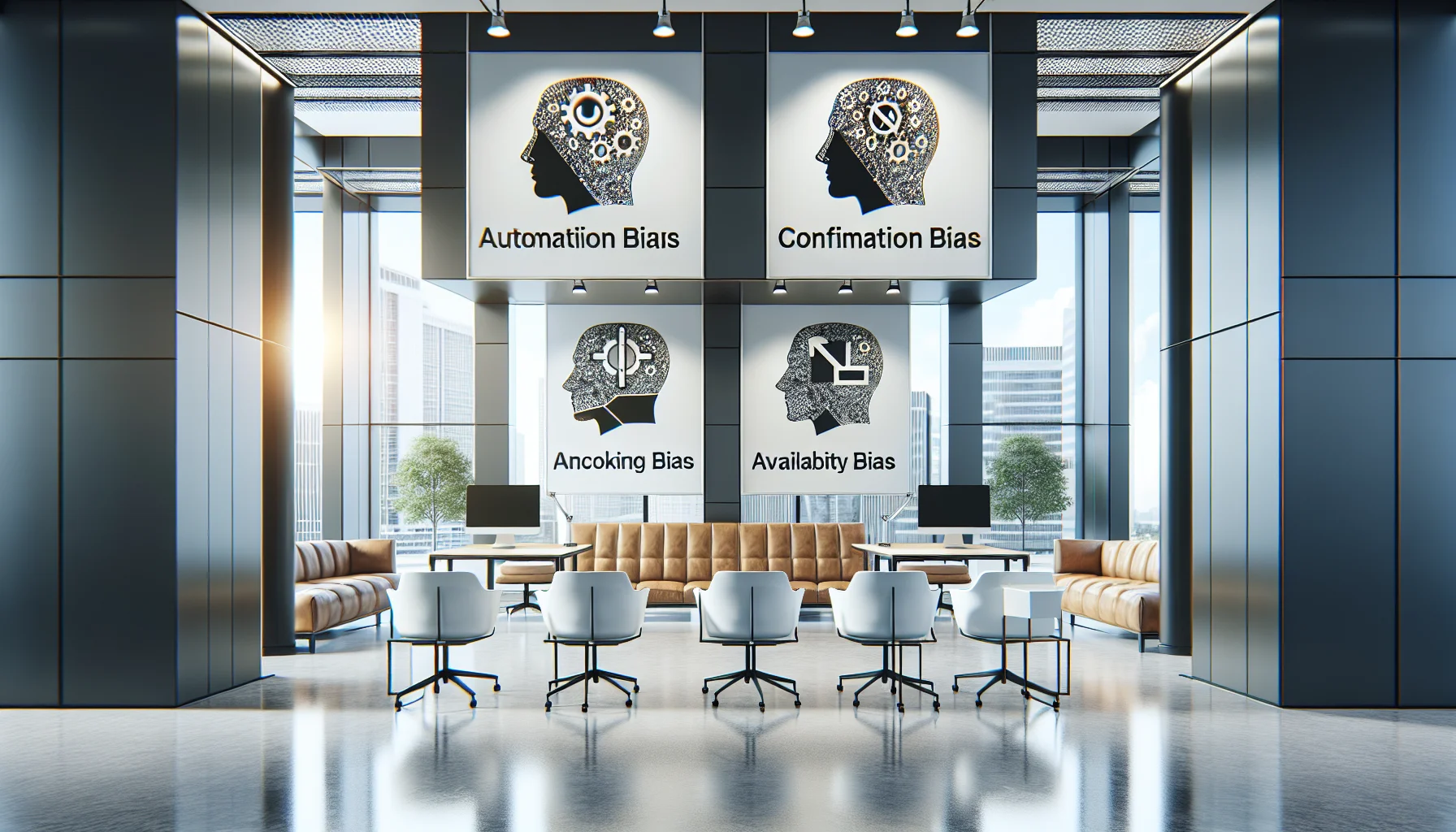
The article identifies automation bias, confirmation bias, anchoring, and availability bias as common distortions in human verification of AI outputs. It presents training and process controls—debiasing checklists, blind reviews, pre-mortems, and red-team exercises—that reduced false-accepts from 12% to 4% in a case study and improved detection speed and inter‑rater reliability.
In our experience, cognitive biases AI regularly distort human verification of model outputs: reviewers become overconfident, miss edge-case errors, and lean on intuition rather than traceable checks. This article breaks down the top biases that interfere with verification, shows concrete AI examples, and presents practical bias mitigation training techniques teams can apply right away.
We focus on actionable guidance—checklists, pre-mortems, red-team exercises—and a short case study that shows measurable error reduction after training. If you manage reviewers, auditing teams, or product owners, you'll find ready-to-run exercises and policies here.
When humans verify AI output under time pressure, a handful of predictable decision patterns recur. Understanding the patterns is the first step to reliable verification.
Below are the most frequent issues we see in audits and operational reviews:
Each of these produces a different failure mode in verification: automation bias yields false negatives (missed errors), confirmation bias produces one-sided audits, anchoring prevents course corrections, and availability bias distorts risk perception.
Examining real-world scenarios clarifies why these biases matter. Below are short, concrete examples tied to common verification tasks.
Automation bias: a content-moderation reviewer skips flagged posts because the classifier's score is "low risk," even though the post contains policy-violating language. The model's confidence becomes a shortcut.
Confirmation bias: an analyst expects the model to be superior on a new dataset and selectively highlights cases where the model is correct while ignoring systematic label drift.
Anchoring: a quality engineer sees an initial accuracy metric of 92% and interprets subsequent ambiguous cases in light of that anchor, downplaying signs of degradation.
Availability: after a high-profile hallucination makes headlines, the team irrationally assumes the model is unreliable across all tasks, causing unnecessary rollbacks.
To connect practice and terminology: teams need to ask "how cognitive biases AI affect AI output verification" in their retrospectives to make these failure modes explicit and measurable.
Training to reduce automation bias in employees must be intentional: simple awareness sessions are rarely sufficient. Effective programs combine education with procedural changes.
Key components we recommend:
In practice, training that mixes scenario practice, quiz-based checks, and enforced two-stage signoffs reduces automation bias more than lectures alone. This is where tools that provide dynamic sequencing and role-based learning paths can help operationalize training: while traditional LMS require manual setup, some modern tools (like Upscend) are built with dynamic, role-based sequencing in mind, making it easier to push context-specific exercises to the right reviewers at the right time.
As a focused question, "how cognitive biases AI affect AI output verification" helps teams design assessment metrics. We track three quantifiable signals:
When these metrics worsen after rollout, it's often a sign that automation bias or confirmation bias has crept into the workflow.
Effective training is a blend of cognitive reframing and process controls. Below are techniques we've implemented with measurable success.
Debiasing checklists: short, task-specific checklists that reviewers must complete before approving an output. Checklists create friction and force alternative hypothesis checks.
Pre-mortem sessions: teams imagine a future failure and list reasons it happened; this reduces overconfidence and surfaces hidden assumptions.
Combine these with bias mitigation training that includes role-playing and scenario-based assessments. We've found that forcing independent evidence before a final decision decreases automation bias and improves overall decision quality.
Below are practical exercises you can run in 30–90 minutes. Each is designed to reveal a specific bias and teach a corrective habit.
Split reviewers into two groups: one sees model outputs with confidence scores, the other sees outputs without scores. Compare acceptance rates and error detection. Discuss differences and require the group that saw scores to rerun 10 decisions without scores.
Gather stakeholders and ask: "The project failed six months from now. What single reason caused the failure?" Write reasons, cluster them, and assign owners to mitigation actions. This primes teams to consider alternative failure modes rather than anchoring on success metrics.
These exercises help surface unconscious bias and improve decision-making under pressure by converting fuzzy intuition into documented risk control steps.
We worked with a mid-size content platform that faced repeated moderation misses. Reviewers were quick to accept AI suggestions, leading to a 12% false-accept rate on policy violations.
Intervention: a 6-week program combining a debiasing checklist, blind review rounds, monthly pre-mortems, and mandatory red-team sessions. Trainers measured three KPIs before and after: false-accept rate, time-to-detect, and inter-rater reliability.
Results after 10 weeks:
Key lessons: enforced friction (checklists and blind reviews) coupled with scenario practice (pre-mortems and red teams) creates durable change. Management support to make these practices mandatory was critical to adoption.
Cognitive biases AI are predictable and addressable. By naming the biases—automation bias, confirmation bias, anchoring, and availability—and deploying focused bias mitigation training, teams can shift verification from gut-driven to evidence-driven decisions.
Immediate actions to implement this week:
If you want a reproducible starter kit, begin with the checklist + blind review combo and scale with red-team exercises. These small, targeted interventions reduce decision bias under pressure and build trust in your verification process.
Call to action: Try the blind review exercise this week, capture the KPI baselines, and schedule a 45-minute pre-mortem—then compare results after one month to see measurable improvement.
The Upscend Team provides actionable insights on technology and business strategy.
Book a walkthrough and we'll show you how it applies to your own content.
 Lms
LmsDecember 23, 2025
AI adaptive learning uses algorithms, recommendation engines, adaptive testing and NLP to tailor training to role, skill gaps, and behavior. This article explains vendor use cases, integration and privacy needs, presents a three-step pilot plan, and provides an ROI checklist to help L&D teams test, measure, and scale personalized training.
 Ai
AiDecember 28, 2025
This article outlines an implementable AI ethics HR framework to keep automated training recommendations fair and accountable. It covers fairness metrics, data governance, model mitigation, explainability, audits, vendor due diligence, and a phased roadmap with templates. Use the checklist and dashboards to measure and reduce bias in production.
 Psychology & Behavioral Science
January 12, 2026
AI-driven recommendations ingest interactions, assessments, and contextual signals to rank next-best learning actions and retrain via continuous feedback. Versus static curricula, they scale individualized pacing, reduce decision points for learners, and improve measurable outcomes (e.g., 22% faster time-to-mastery, 18% higher 30-day retention) when paired with strong data hygiene and governance.