

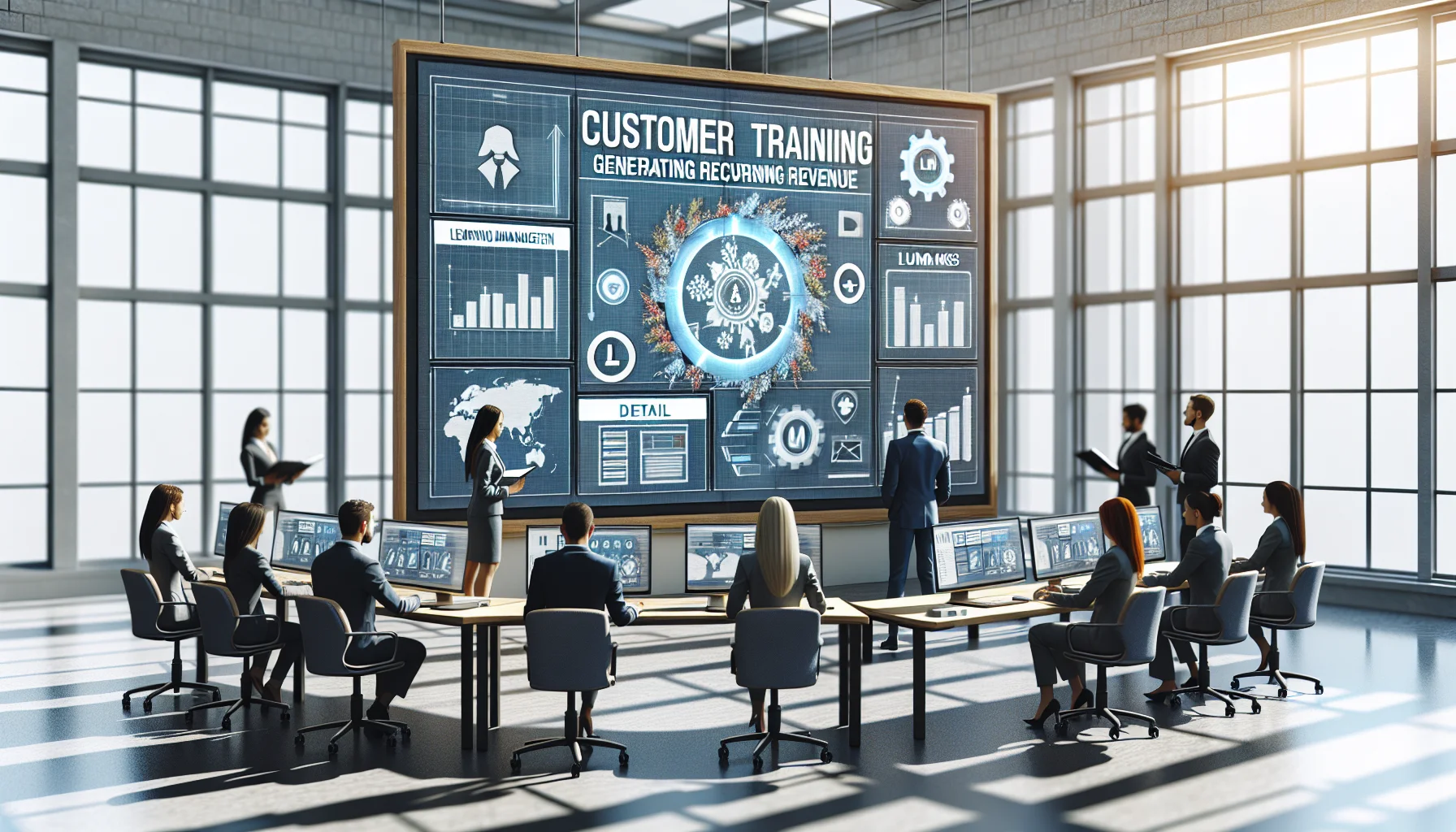
This article explains how to build recurring revenue from a customer training LMS by designing outcome-driven courses, selecting one-time or subscription pricing, and packaging certifications and bundles. It covers promotion tactics (email and in-product prompts), integration with billing/CRM, and measurement methods to attribute retention and upsell impact.
customer training LMS programs turn product knowledge into predictable income when designed with strategy, pricing discipline, and clear measurement. In our experience, the highest-performing customer education programs start with a learning-first mindset and end with commercial rigor: layered learning paths, tiered access, and promotional hooks that convert free adopters into paid learners. This article walks through course design, pricing models, packaging, promotion, integration, and measurement so you can build recurring revenue training inside your platform.
Start by mapping the post-sale journey and identifying moments where training reduces time-to-value. A good customer training LMS focuses on outcome-based modules: onboarding modules that get customers to "first success," adoption modules that drive feature usage, and optimization modules for power users.
Use this three-tier course structure:
Design each module with clear objectives, measurable outcomes, and built-in assessments. We’ve found that micro-assessments increase completion rates and improve perceived value — which is critical when you move from free resources to paid training courses inside your platform.
Build modular tracks that can be consumed independently or as part of a bundle. For example, a "Starter Track" (onboarding + key features) and an "Expert Track" (advanced mastery + certification prep). Label time-to-completion and expected outcomes to reduce buyer friction.
Price deliberately. There are three common pricing levers that work for a customer training LMS: one-time fees, recurring subscriptions, and bundles that mix product and learning. Which to choose depends on customer lifetime value (LTV), the frequency of content updates, and competitive positioning.
One-time fees work for discrete, high-value credentials (e.g., certification exams). Subscriptions are ideal for ongoing enablement or communities where content is refreshed and learners re-engage. Bundles are effective when training is an adjunct to product purchase: include a learning tier in professional support plans.
When determining price:
Sample price architecture (illustrative): Basic $99 one-time, Plus $29/month, Premium $499 one-time + $49/month for certification maintenance.
Packaging converts interest into purchase. A customer training LMS should offer clear value ladders: free trials or intro modules, paid certifications, and enterprise seats with reporting. Certifications are a high-conversion anchor because they provide external validation and internal ROI justification.
Packaging tactics that work:
Two example course catalogs to illustrate packaging:
Even the best customer training LMS fails without demand generation. Treat training like a product: define acquisition channels, messaging, and sales enablement. Use behavioral triggers from product usage to personalize outreach.
High-impact promotion tactics:
Example campaign flow:
Measurement distinguishes training that pays from training that costs. Track these core KPIs in your customer training LMS: course completion rate, certification conversion, training-induced revenue, and training churn uplift (reduction in customer churn attributable to training).
We recommend a simple attribution model: baseline cohort behavior vs. trained cohort behavior over 90–180 days. Benchmarks from industry data suggest trained customers can show 10–30% higher retention and 15–40% higher upsell rates depending on program quality and alignment.
Automation and billing integration matter here. We've seen organizations reduce admin time by over 60% using integrated systems like Upscend, freeing learning teams to focus on course quality and analytics rather than manual invoicing and seat management.
Prioritize metrics that connect training to revenue: conversion to paid course, renewal rates for certified customers, and net revenue per trained account.
Sample pricing matrix that maps offerings to outcomes:
| Offering | Delivery | Price | Primary KPI |
|---|---|---|---|
| Starter Onboard | Self-paced | $0 / Free | Activation rate |
| Power User Bundle | Self-paced + Workshop | $199 one-time | Feature adoption |
| Certified Admin | Cohort + Exam | $499 + $59/yr | Renewal & Upsell |
Execution matters more than clever ideas. Below is a checklist we use to launch commercial training in an LMS and avoid the common traps:
Common pitfalls:
Two operational examples that work:
Building recurring revenue with customer education requires a sequence: design outcome-driven content, price based on buyer value, package for renewal, promote with behavioral triggers, and measure impact against revenue KPIs. A customer training LMS is the platform; your strategy is the engine that converts education into ARR.
Start small: launch a clear, single-path paid offering, instrument results, then iterate pricing and packaging based on real cohort data. With disciplined measurement and automation, training moves from cost center to predictable revenue stream.
Next step: audit your current training catalog against the checklist above and run a 90-day pricing experiment for one paid offering — measure conversion, retention lift, and incremental revenue to validate the model.
The Upscend Team provides actionable insights on technology and business strategy.
Book a walkthrough and we'll show you how it applies to your own content.
 General
December 22, 2025
This article outlines evidence-based strategies to build a continuous learning culture using an LMS. It covers leadership sponsorship, career-aligned learning pathways, manager enablement, social learning, recognition, and a 12-week pilot blueprint with measurement tips. Follow the checklist to increase LMS engagement, retention, and internal mobility.
 Lms
LmsDecember 23, 2025
This article explains how to design and scale continuous learning LMS programs that drive measurable outcomes. It covers skills mapping, microlearning sequencing, manager enablement, platform features, KPIs, and governance. Readers will learn pilot approaches, engagement mechanics, and operational steps to convert an LMS into a career development platform.
 Lms
LmsDecember 24, 2025
This article explains how training providers can treat an LMS as a profit center by productizing courses, using white-label LMS deployments, and choosing business models (resale, licensing, subscription, per-seat). It outlines tech, legal, pricing, and KPI frameworks plus a decision checklist and ROI template to pilot corporate course sales.
 Business Strategy&Lms Tech
January 28, 2026
This guide explains why a customer education LMS drives retention and expansion, which features to prioritize (onboarding journeys, certifications, analytics), and how to design persona-based curricula. It includes a 90-day implementation sprint, measurement KPIs, vendor evaluation criteria, and a 12-month rollout template for practical adoption.