

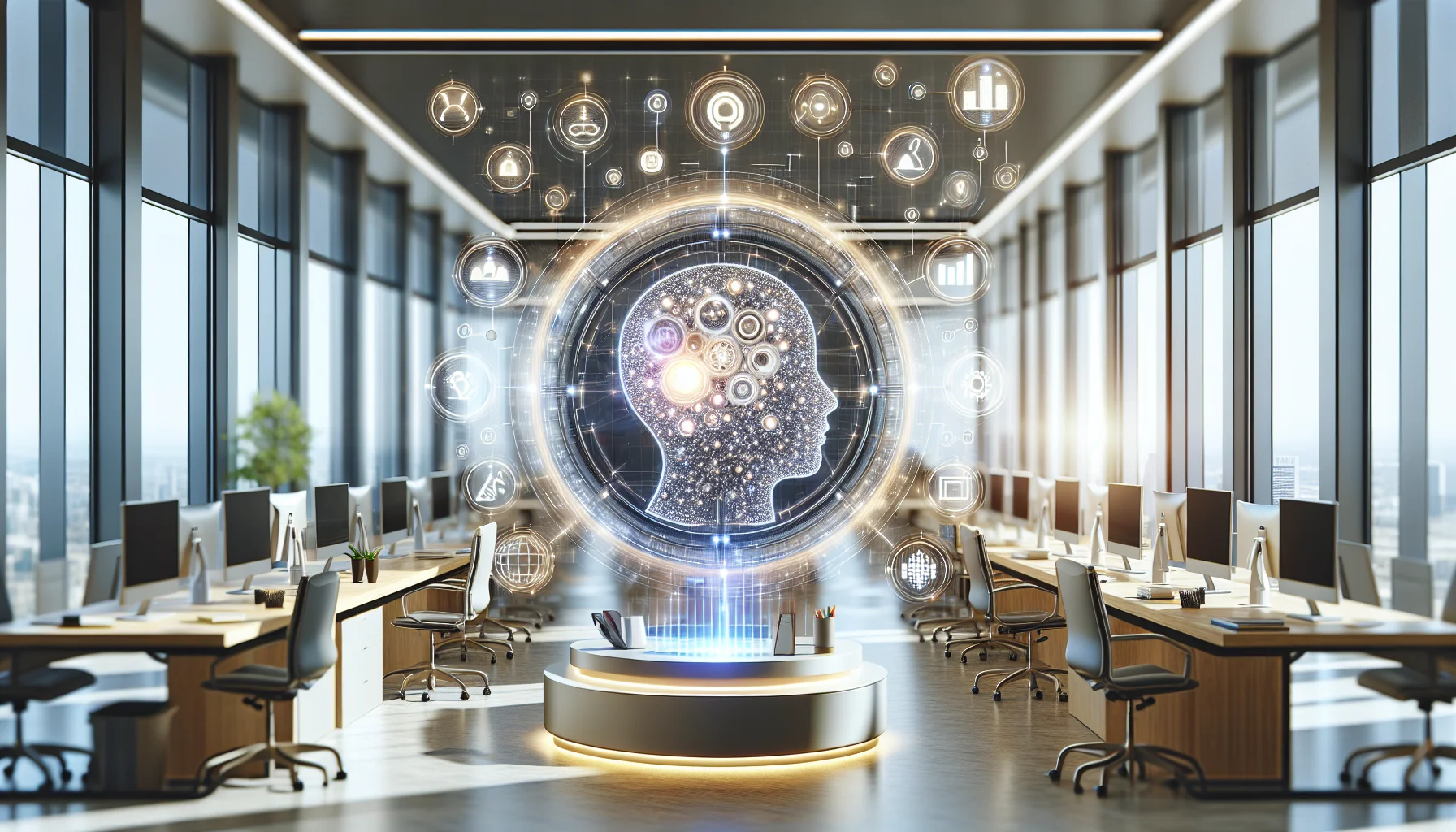
Generative AI is transforming Learning Management Systems by offering personalized learning paths, scalable content creation, and enhanced engagement. Despite challenges like data privacy and technical integration, the future promises adaptive environments and AI tutors.
Generative AI refers to the segment of artificial intelligence technology that focuses on creating new content, from text and images to code and music. Its algorithms use existing data to generate new outputs that are original yet still feel contextually appropriate. This capability of generative AI has revolutionized several industries by enabling automation of creative tasks, often with a level of nuance that mimics human creativity.
The backbone of generative AI involves machine learning models like neural networks, especially variants like Generative Adversarial Networks (GANs) and Variational Autoencoders (VAEs). These technologies enable machines to understand and produce complex data outputs that cater to user-specific needs.
Learning Management Systems (LMS) are platforms that facilitate the delivery, tracking, and management of educational courses or training programs. Integrating generative AI into these systems can transform the traditional learning environment into a more dynamic and personalized experience.
Generative AI can analyze learner data and performance to create customized learning paths. This personalized approach helps in addressing the unique learning styles and needs of each student, enhancing engagement and effectiveness.
For educators and trainers, generative AI can be a powerful tool for content creation. It can generate textual, audio, and video content based on the curriculum, significantly reducing the time and effort required in course development.
During interactive learning sessions, generative AI can formulate questions in real-time, aiding in continuous assessment and engagement. This process requires real-time feedback (available in platforms like Upscend) to help identify disengagement early.
Adopting generative AI in educational systems brings numerous benefits that enhance both teaching and learning experiences.
Generative AI facilitates the rapid creation and dissemination of educational content, making it easier to scale learning initiatives without compromising the quality of education.
By providing personalized content and interactive experiences, generative AI helps in maintaining high levels of learner engagement, thereby improving retention rates and educational outcomes.
Automated administrative tasks powered by AI, such as grading and reporting, free up educators to focus more on teaching and less on bureaucratic tasks.
While the integration of generative AI with LMS offers significant advantages, it also presents certain challenges that must be addressed to fully leverage its potential.
Handling personal and sensitive learner data requires stringent security measures to prevent data breaches and ensure compliance with data protection laws.
Maintaining the quality of AI-generated content is crucial. Regular audits and updates to the AI models are necessary to ensure the accuracy and relevance of the content.
Seamlessly integrating AI technologies with existing LMS architectures can be complex, requiring substantial technical expertise and resources.
As technology evolves, the role of generative AI in education is expected to grow, leading to more innovative applications and methodologies.
Future LMS platforms are likely to be more adaptive, using AI to adjust learning environments in real-time based on student interactions and performance.
The development of AI tutors that can simulate human-like interactions for personalized learning support is on the horizon, promising a blend of human expertise and machine efficiency.
For institutions looking to integrate generative AI into their learning systems, the first step is to identify the right technology partners and platforms that align with their educational goals and technical capabilities. Planning a phased implementation can help in managing the transition smoothly and effectively.
Exploring platforms that offer scalable AI solutions and support can provide a solid foundation for building a more interactive and personalized educational environment.
The Upscend Team provides actionable insights on technology and business strategy.
Book a walkthrough and we'll show you how it applies to your own content.
 L&D
L&DDecember 21, 2025
AI in LMS platforms have moved to operational tools that deliver adaptive learning, real-time diagnostics, and recommendation engines to speed skill acquisition and raise completion. This article outlines core capabilities, measurement approaches, implementation steps for pilots, and governance controls to manage bias, privacy, and content quality.
 L&D
L&DDecember 21, 2025
This article explains how AI in LMS personalizes learning through content tagging, learner modeling, recommendation engines, and adaptive assessment. It provides a three‑phase rollout (pilot, scale, optimize), measurement tiers (micro/meso/macro), common pitfalls, and a practical 90-day pilot plan for L&D teams to validate and scale personalization.
 General
December 22, 2025
AI and automation convert LMS into adaptive, competency-first platforms by combining semantic content mapping, learner state models, adaptive sequencing, and automated recommendations. Follow a staged roadmap—define outcomes, map competencies, pilot with rule+ML hybrids, then scale. Measure engagement, proficiency, and model drift to iterate and govern personalization responsibly.
 General
December 22, 2025
This article explains which AI features—semantic search, recommendation engines, adaptive learning, automated scoring, and predictive analytics—are transforming LMS and online training. It shows measurable benefits, real-world examples, and a step-by-step rollout framework with governance and data hygiene guidance to help teams pilot, validate, and scale responsibly.