

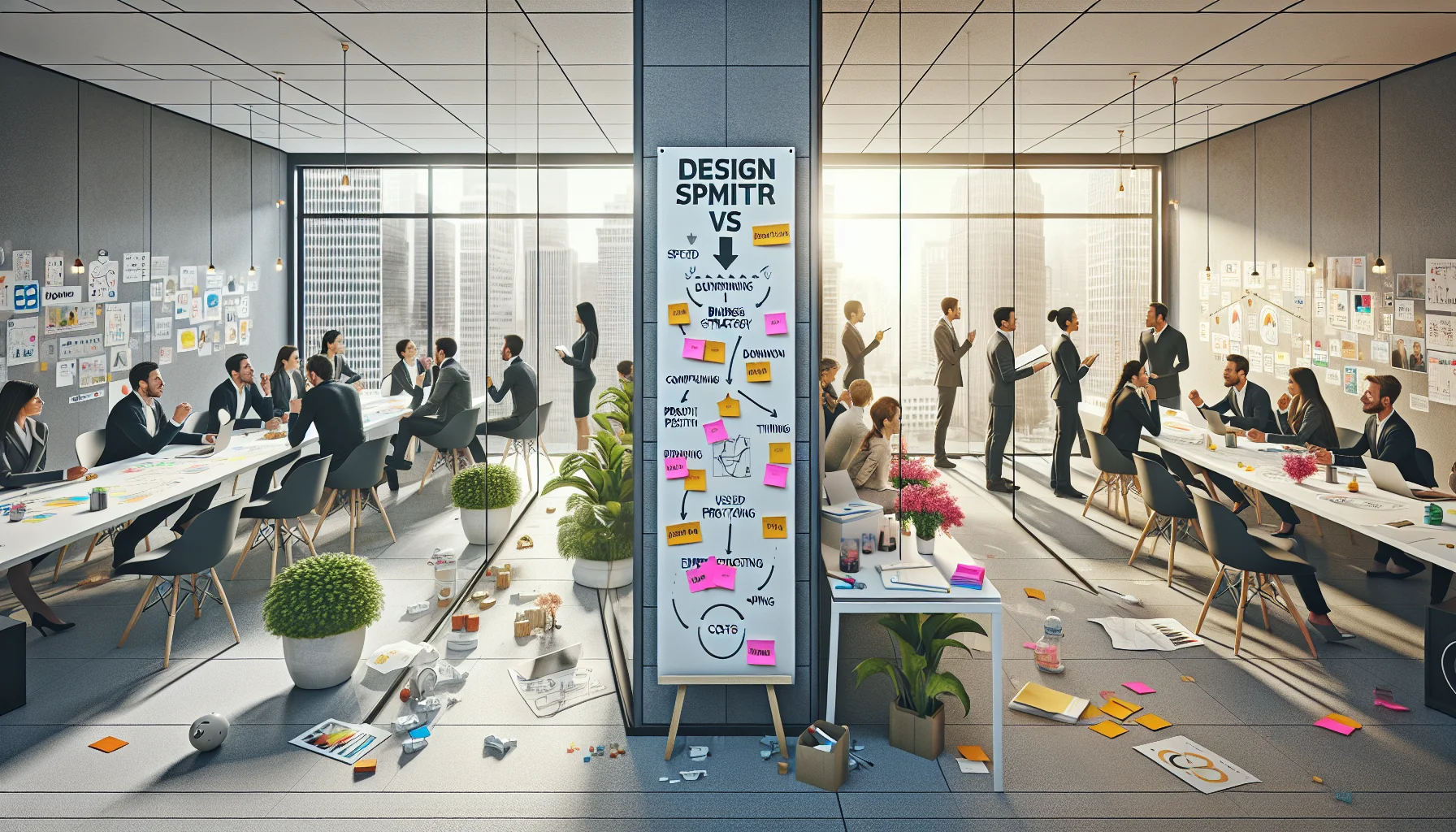
This article compares design sprints and design thinking to help product teams choose the faster path to validated outcomes. It covers definitions, timelines, team makeup, cost and risk, decision flowchart, case comparisons and KPIs. Use a sprint for rapid validation and design thinking for deeper discovery and strategic fit.
design sprint vs design thinking is the central debate when product leaders need to choose between structured, time-boxed problem solving and longer-form, exploratory innovation. In our experience, teams ask the same business question: which approach reliably moves ideas to validated outcomes faster? This article compares the two on definitions, timelines, typical outcomes, team composition, cost estimates, risk profiles and measurable KPIs to help you pick the right method for your situation.
A quick definition removes ambiguity. A design sprint is a focused, five-day (often compressed) protocol that uses facilitated workshops, rapid prototyping and structured testing to answer a critical business question. Design thinking is a human-centered, iterative framework encompassing empathy, problem definition, ideation, prototyping and testing over variable timelines.
Both share roots in user-centered innovation but differ in cadence and scope. A design sprint prioritizes speed and decision-making; design thinking prioritizes exploration and depth. Below are concise summaries.
Comparing timelines clarifies expected outcomes. A standard design sprint runs 3–7 days and produces a clickable prototype and user feedback. Design thinking projects can span 4–24 weeks or longer and yield validated product directions, strategy changes, and organizational learning.
In practice, the outcome differences affect stakeholder expectations: sprints answer a specific risk or assumption quickly; design thinking reduces uncertainty across a broader problem space.
For teams under time pressure, a design sprint will deliver initial validation in days. When product strategy or user needs are fuzzy, design thinking provides richer insights but takes longer. Use rapid prototyping and targeted usability tests to shorten design thinking cycles without losing depth.
A clear team model reduces friction. Typical sprint teams include a facilitator, PM, lead designer, engineer, and a decision-maker. Large design thinking initiatives require researchers, multiple designers, product owners and stakeholder workshops across departments.
Cost approximations depend on hourly rates and opportunity cost. A one-week sprint with 5 people costs roughly 5 person-weeks plus prototype tooling. A three-month design thinking engagement often equates to 12–20 person-weeks, research incentives and broader stakeholder time.
| Dimension | Design Sprint | Design Thinking |
|---|---|---|
| Typical duration | 3–7 days | 4–24+ weeks |
| Core team | 5–7 cross-functional | 8–15+ including researchers |
| Primary outcome | Tested prototype, quick validation | Validated problem definition, strategic options |
| Risk profile | Higher risk of surface-level solutions | Lower risk for deep, systemic change |
In our experience, sprints fail when the problem statement is vague or when stakeholders are absent from decision points. Design thinking projects fail when they lack clear milestones or when organizational constraints prevent iteration. Mitigation: set explicit success criteria and gating reviews.
Use the flowchart below to make an objective choice based on speed vs exploration. This is a lightweight decision aid product teams can apply in planning meetings.
| Step | Decision Node | Recommended Path |
|---|---|---|
| 1 | Is there a single, testable hypothesis that could de-risk a major bet within a week? | Yes → Design Sprint |
| 2 | Is the problem space broad, requiring research across user segments? | Yes → Design Thinking |
| 3 | Are stakeholders aligned on a time-boxed decision? | Yes → Design Sprint; No → Design Thinking |
Tip: If you need to balance speed and discovery, run a sprint as a discovery trigger and follow with focused design thinking cycles.
Short comparative cases show practical tradeoffs. Below are three condensed client scenarios we've observed and led.
These cases highlight that design sprint vs design thinking is not binary; they are complementary when sequenced strategically. A sprint can validate feasibility, then a design thinking program can optimize adoption and scale.
Practical tooling and platforms speed both methods. For example, early usability detection and participant management (available on platforms like Upscend) reduce recruitment friction and improve test quality.
Define measurable goals before starting. Sprints should have short, specific KPIs; design thinking should map to both short-term and strategic KPIs.
Use a mix of qualitative metrics (user quotes, observed behavior) and quantitative metrics (drop-off rates, time-on-task). Regular checkpoints and pre-registered success criteria reduce bias.
“We needed a rapid answer to whether customers would use the new flow — the sprint gave us a quick yes and saved months of development.” — Product Lead, Fintech
Choosing between design sprint vs design thinking depends on your objective: need immediate validation and alignment, or deep discovery and strategic clarity? In our experience, high-performing teams hedge risk by combining both: run a sprint to validate the riskiest assumption, then invest in a design thinking track to optimize and scale.
Quick checklist to decide:
Key takeaway: The two approaches should be viewed as complementary tools in your innovation toolkit. Use a sprint to accelerate certainty and design thinking to deepen product-market fit.
Call to action: If you want a practical plan tailored to your product calendar, schedule a readiness review with your core stakeholders to map which risks to de-risk via a sprint and which require longer design thinking investment.
The Upscend Team provides actionable insights on technology and business strategy.
Book a walkthrough and we'll show you how it applies to your own content.
 General
December 14, 2025
This article outlines a practical framework for candidate experience improvements across job ads, applications, interviews and offers. It covers application process optimization, structured interviews, offer tactics to raise offer acceptance rate, and a measurement checklist. Use the phased implementation checklist to pilot changes, measure effects, and scale improvements.
 Creative&User Experience
December 23, 2025
Structured creative decision making pairs lightweight frameworks, systematic ideation, and disciplined testing to accelerate campaigns and raise ROI. The article explains RICE, OODA, ideation methods, an operational playbook and KPIs so teams can run powered tests, reduce rework, and institutionalize learning with weekly decision forums.
 General
December 23, 2025
Comparing RACI, DACI, ICE, RICE, and OKR-linked decision gates, this article explains when to use each for cross-functional marketing, product, development, and L&D teams. Learn step-by-step templates (campaigns, curriculum, vendor selection), a one-page meeting cheat sheet, and a 30-minute pilot to reduce approval delays and clarify ownership.
 Business Strategy&Lms Tech
January 22, 2026
This article gives a tactical blueprint to design a 4-day training sprint that produces measurable performance change. It covers pre-work, timeboxed practice loops, assessment rubrics, facilitator roles, and manager follow-up. Use the provided agenda, competency map, and templates to pilot and measure results across 30/60/90-day checkpoints.