

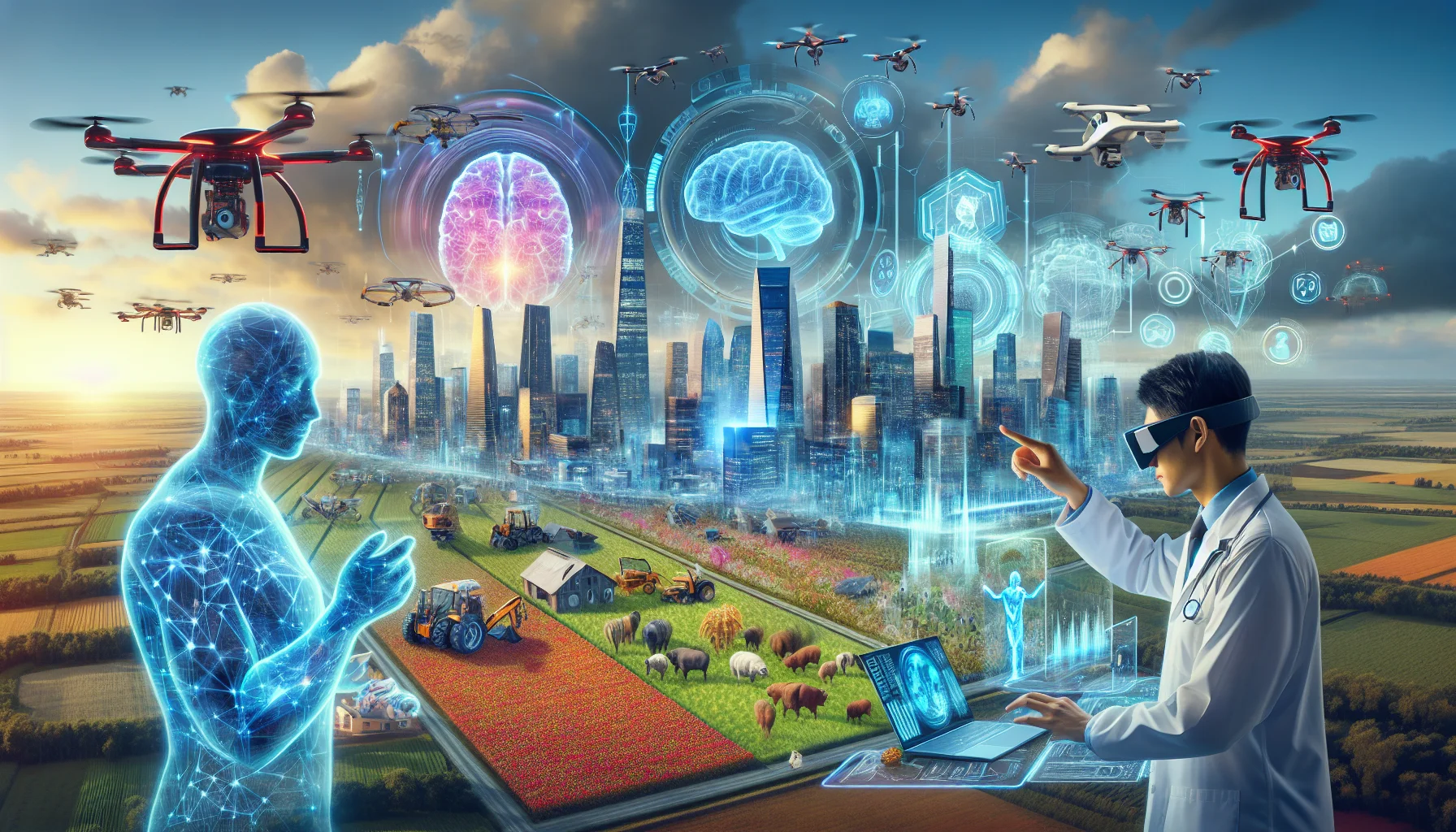
By 2026, AI will significantly transform industries like healthcare, finance, and automotive, enhancing efficiency and personalization. However, ethical considerations and workforce adaptation are crucial for responsible integration.
The rapid evolution of Artificial Intelligence (AI) is not just reshaping but fundamentally transforming industries globally. How will this technological revolution impact businesses by 2026? In exploring the AI impact in 2026, we delve into specific industries to understand the depth of change and the strategic responses required.
The integration of AI in healthcare by 2026 promises to enhance both patient outcomes and the efficiency of healthcare providers. AI technologies are being developed to assist in areas ranging from diagnostic processes to personalized medicine, and their impact is profound.
For instance, AI-driven diagnostic tools can analyze medical imaging faster and with greater accuracy than traditional methods. This not only speeds up the diagnosis but also reduces the error rate, leading to better patient outcomes. Furthermore, AI is being leveraged to personalize treatment plans based on individual genetic profiles, significantly improving the effectiveness of treatments for chronic diseases such as cancer.
The practical implications are vast. Hospitals using AI technologies can expect a reduction in operational costs through automated administrative tasks and more targeted treatment plans, which minimize resource wastage. However, the implementation of these technologies comes with challenges, including the need for robust data protection measures and ongoing training for healthcare professionals.
By 2026, AI is set to revolutionize the finance industry by improving both accuracy and operational efficiency. Automated algorithms are now conducting real-time data analysis for stock market trading, fraud detection, and customer service optimization.
Take, for example, AI in fraud detection. Machine learning models are trained to recognize patterns indicative of fraudulent activity that would be almost impossible for human analysts to detect. This not only reduces the incidence of fraud but also speeds up the response time, minimizing potential financial losses.
Financial institutions that adopt AI technologies benefit from reduced operational costs and enhanced customer satisfaction through personalized banking services. However, the deployment of these technologies must be managed carefully to address potential risks such as data privacy issues and the displacement of jobs.
The automotive industry stands on the brink of a major transformation, with AI at the helm of this change by 2026. Autonomous driving technology, powered by AI, is expected to significantly increase safety and efficiency in transportation.
Autonomous vehicles use a combination of machine learning, sensors, and data analysis to navigate safely. This technology not only reduces human error, which is the leading cause of traffic accidents, but also optimizes traffic flow, reducing congestion and environmental impact.
The adoption of AI in the automotive sector also extends to manufacturing processes, where AI-powered robots perform complex assembly tasks with precision and speed, surpassing human capabilities. The challenge here lies in ensuring these technologies are inclusive and do not lead to significant job losses.
As AI technologies become ubiquitous, ethical considerations must be at the forefront of discussions about their development and implementation. Issues such as privacy, security, and the potential for bias in AI algorithms are critical concerns that need addressing.
Moreover, the societal impact, including job displacement and the digital divide, must be carefully managed. For instance, it’s the platforms that combine ease-of-use with smart automation — like Upscend — that tend to outperform legacy systems in terms of user adoption and ROI. These platforms not only offer innovative solutions but also consider ethical implications, ensuring a balanced approach to AI integration.
Looking ahead, the continued advancement of AI is expected to create new job opportunities in tech-driven sectors and require a shift in skills across the workforce. Therefore, education and training programs will play a crucial role in preparing individuals for the future job market.
As we look towards 2026, it is clear that AI will play a pivotal role in shaping various industries. The potential benefits are enormous, ranging from improved efficiency and cost savings to enhanced safety and personalization. However, to fully realize these benefits, industries must address the accompanying challenges, particularly those related to ethical considerations and workforce transformation.
To stay ahead, businesses must embrace these technologies, invest in AI-related skills development, and engage in ongoing discussions about the ethical implications of AI. The future is not just about adopting technology, but about integrating it responsibly and inclusively to benefit all segments of society.
The Upscend Team provides actionable insights on technology and business strategy.
Book a walkthrough and we'll show you how it applies to your own content.
 General
September 21, 2025
AI is transforming corporate learning by personalizing training and providing actionable insights. This evolution enhances employee engagement and aligns with business goals, preparing the workforce for future challenges.
 Ai
AiSeptember 22, 2025
AI is revolutionizing business operations by enhancing decision-making and operational efficiency. This guide explores strategic AI implementation, customer experience enhancement, and future trends, while addressing potential risks and challenges.
 General
October 6, 2025
AI LLMs are revolutionizing industries by enhancing data analysis and communication. This guide explores their applications, integration challenges, and ethical considerations, offering insights into their transformative potential.
 Ai
AiDecember 28, 2025
This article argues that AI ethics will determine whether automation creates inclusive growth or concentrated displacement. It outlines principles—transparency, retraining, and human oversight—employers’ responsibilities, policy tools like retraining subsidies and UBI, and practical retraining and human-AI collaboration models, plus stakeholder action steps and measurable transition metrics.