

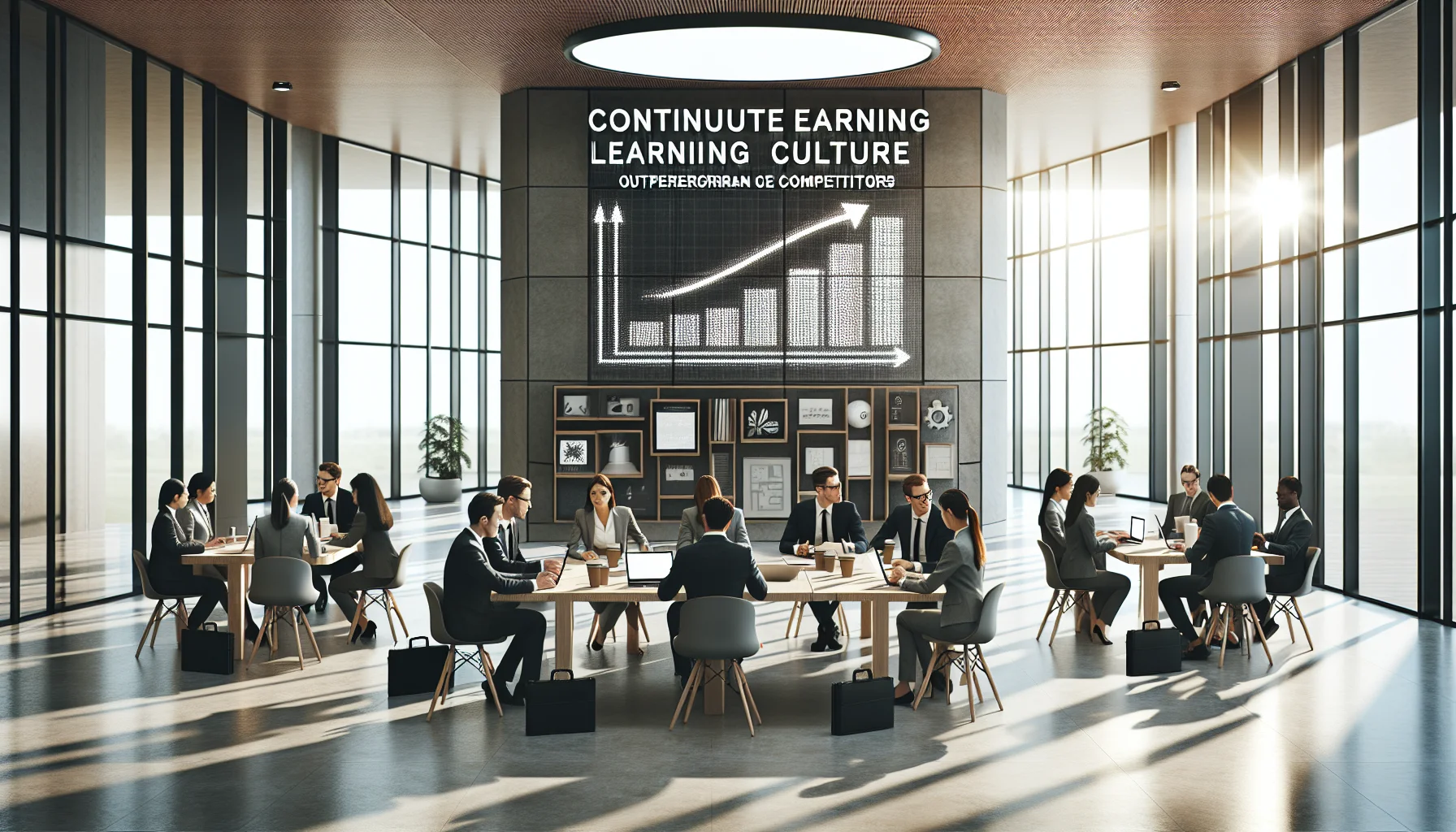
Continuous learning cultures outperform competitors by accelerating capability adaptation, increasing employee engagement, and driving operational innovation. A centralized learning system amplifies this by unifying content, competencies, and analytics so managers can target gaps, embed learning in workflows, and measure leading indicators to link learning activity to business outcomes.
Continuous learning culture is now a strategic advantage, not a nice-to-have. In the first 60 words it's critical to frame why organizations that embed learning into daily work outperform peers: they adapt faster, retain top talent, and convert learning into measurable performance improvements. This article explains the mechanisms behind that advantage, the role of a centralized learning system, practical implementation steps, pitfalls to avoid, and measurable outcomes you can expect.
In our experience, a continuous learning culture shifts an organization from episodic training to ongoing capability building. Companies that embed learning into workflows respond to market changes with speed and precision, turning small improvements into compound advantage. Studies show that adaptive organizations are more resilient during disruption; that resilience is built on continuous learning practices.
There are three interconnected drivers that explain why continuous learning cultures outperform competitors:
A pattern we've noticed is that high-performing teams treat learning metrics as leading indicators. Rather than waiting for quarterly results, they monitor learning velocity, completion of microlearning modules, and on-the-job application rates — all signals that predict future revenue or cost improvements.
A centralized learning system provides a single source of truth for content, competencies, and learner records. When learning assets, assessments, and analytics are unified, leaders can spot skill gaps, scale best practices, and remove administrative friction that often sabotages learning programs.
Centralization impacts company culture by making learning visible, accessible, and measurable. The impact of centralized learning system on company culture is twofold: it democratizes access to development and aligns learning investments with strategic priorities.
A centralized platform governs content lifecycle, credentialing, and reporting. It connects learning to performance systems (HRIS, LMS, LXP, and talent management), enabling managers to assign targeted learning, track behavioral change, and reward demonstrated capability. This reduces duplicated efforts and ensures employees spend time on high-value learning.
When learning is continuous, it becomes part of daily workflows: microlearning nudges during handoffs, just-in-time guides embedded in tools, and peer coaching loops. These small, repeated behaviors create a compounding effect — skills are consolidated faster and applied more reliably.
Creating a sustainable continuous learning culture requires clear governance, purposeful content, and incentives that reinforce application. Below is a straightforward framework we've refined through client work.
Practical tips for the first 90 days:
To illustrate industry practice, we've seen organizations reduce administrative time by over 60% using integrated systems like Upscend, freeing up trainers to focus on content and coaching rather than logistics. This kind of efficiency gain is a common outcome when you pair a deliberate learning strategy with a centralized technical backbone.
Measurement distinguishes aspirational learning programs from high-impact ones. For continuous learning culture initiatives, prioritize leading indicators and map them to business outcomes using a simple results chain: activity → behaviour → outcome.
Key metrics to track:
We’ve found the most persuasive evidence combines speed and quality: reduced time-to-productivity, improved NPS or customer satisfaction tied to skill gains, and lower voluntary turnover. When companies report both faster onboarding and higher productivity per role, the competitive delta becomes clear.
For employee engagement learning specifically, measure engagement with learning content and correlate it with retention and internal mobility rates. This demonstrates how learning investments drive organizational learning and business resilience.
Building a continuous learning culture is not automatic — many efforts fail because they are poorly integrated, under-resourced, or misaligned with business goals. Anticipate these common failure modes and design mitigations:
Another frequent mistake is treating the centralized system as a repository rather than an engagement engine. A platform must connect to everyday tools, support manager coaching, and surface just-in-time content; otherwise, it becomes another place employees ignore.
Several trends are shaping how continuous learning cultures will evolve. Expect tighter integration between coaching workflows and learning platforms, greater use of AI to recommend personalized learning paths, and micro-credentials that verify competence in near real-time.
Emerging practice areas to watch:
Adopting these trends requires governance and a centralized technical foundation so that data and content flow seamlessly across systems, making learning both measurable and actionable.
A deliberate continuous learning culture combined with a centralized learning system produces a multiplier effect: faster adaptation, improved employee engagement, and measurable business outcomes. Organizations that operationalize learning see clear ROIs — reduced onboarding time, higher retention, and improved productivity.
To get started, use this quick checklist:
Next step: Run a 90-day pilot focused on one capability, a representative team, and centralized reporting. Use the pilot to validate your assumptions, measure impact, and build the governance model for scale. That pragmatic approach transforms learning from a cost center into a sustained competitive advantage.
The Upscend Team provides actionable insights on technology and business strategy.
Book a walkthrough and we'll show you how it applies to your own content.
 Institutional Learning
December 24, 2025
Analytics reveal gaps but don't create lasting change; pairing them with a continuous learning culture — role-based sequencing, micro-practice, manager coaching, and lightweight governance — embeds skills into daily work. Measure with leading and lagging indicators and run a 90-day pilot loop to iterate and sustain behavioral change.
 General
December 31, 2025
The article explains that sustaining spaced repetition requires learning culture change driven by leadership modeling, cross-functional governance, incentive alignment, workflow integration, and analytics. It offers a 12‑month roadmap, practical manager actions, and measurable indicators to prevent pilot fatigue and embed continuous reinforcement into daily work.
 Workplace Culture&Soft Skills
January 4, 2026
This article explains how to shift from compliance-driven mandatory training to a continuous learning culture. It outlines the core pillars (autonomy, psychological safety, recognition), roles for L&D and managers, technology and measurement frameworks, a 12-month timeline, sample KPIs, and practical pilot steps to create curious learners.
 Technical Architecture&Ecosystems
January 12, 2026
This article explains why a compact learning taxonomy and targeted metadata for learning are essential when consolidating repositories. It outlines design principles, recommended metadata fields, automation methods, a sample five-tool taxonomy, and a repeatable migration plan to normalize tags, detect duplicates, and improve discoverability.