


Compares branching scenarios and roleplay for DEI empathy, weighing scalability, emotional authenticity, facilitator dependence, and measurement. Recommends starting with branching for safe, repeatable practice and using roleplay for high‑risk or leadership cohorts, with a hybrid path for most organizations. Includes a decision matrix, measurement best practices, and two case vignettes.
In our experience, deciding between branching vs roleplay hinges on clear learning objectives. This article directly compares branching vs roleplay for DEI empathy work, weighing scalability, emotional authenticity, facilitator dependence, and measurement. We provide a practical decision matrix, implementation tips, and two focused vignettes to show when each method is superior. Readers will gain an actionable framework to align method to context and risk level.
Branching scenarios vs roleplay operate on different pedagogic premises. Branching scenarios use interactive narrative trees where learner choices lead to consequences; roleplay relies on live interaction, improvisation, and facilitation to create learning tension.
Use branching when the aim is to practice decision-making in a repeatable, reflective environment. Use roleplay when the aim is to develop interpersonal skills that depend on tone, timing, and emotional responsiveness.
Branching scenarios excel at mapping decision paths and delivering consistent feedback loops. They make trade-offs explicit and allow learners to replay scenarios with low social risk.
Roleplay DEI training offers dynamic emotional practice, where learners experience immediacy and vulnerability that drives empathy in ways a screen often struggles to reproduce.
Empathy in DEI training is not just intellectual; it must be felt. The main test is whether participants move from perspective-taking to perspective-changing.
Roleplay DEI training often produces higher immediate emotional engagement. Live facilitators and peers create a field of social cues—tone, body language, micro-expressions—that heighten realism and produce honest affective responses. That emotional authenticity can catalyze sustained behavior change when debriefed effectively.
However, roleplay carries risks: participant discomfort can escalate into retraumatization if scenarios are not well-designed or facilitators are undertrained. A common pain point is inconsistent facilitator skill; poor debriefs can leave learners defensive rather than reflective.
Branching scenarios vs roleplay for empathy therefore becomes a question of controlled intensity: branching affords graduated exposure and built-in reflection prompts that mitigate risk while still prompting perspective shift.
For organizations balancing budget and reach, the contrast between branching vs roleplay maps clearly to operational constraints. Branching scenarios scale efficiently; once built, they can be deployed to thousands with predictable cost per learner.
Roleplay is labor-intensive. It requires skilled facilitators, scheduling, smaller cohorts, and sustained quality assurance. Facilitator training is a frequent bottleneck and a recurring cost that affects program fidelity.
Facilitator dependence is the fulcrum: when you have a cadre of trained facilitators, roleplay delivers high-impact outcomes. When you do not, branching scenarios provide a consistent baseline of learning with lower marginal cost.
Measurement separates opinion from evidence. When comparing branching vs roleplay, consider what you can reliably measure: choices and outcomes versus qualitative behavioral change.
Branching scenarios produce rich, trackable interaction data: decision points, time to decision, paths taken, and repeat attempts. These data enable A/B testing of scenario design and clear ROI models. In contrast, roleplay relies on observation rubrics, participant self-report, and facilitator ratings—valuable but less granular and harder to scale.
A pattern we've noticed is that hybrid programs combining branching analytics with targeted roleplay workshops yield the deepest insights: branching collects baseline behavior and flags learners who most need human-led practice.
While traditional systems require constant manual setup for learning paths, some modern tools are built with dynamic, role-based sequencing in mind. For example, Upscend demonstrates how platforms can automate learner progression and surface analytics that inform when a cohort should move from branching to facilitator-led roleplay.
Design metrics aligned to behavior: track decision fidelity, escalation patterns, and debrief reflection quality. Use mixed methods: quantitative logs from branching and qualitative coding from roleplay sessions for triangulation.
Use this practical matrix to decide between branching vs roleplay by context: organization size, budget, and risk level.
| Context | Recommended method | Rationale |
|---|---|---|
| Large workforce, low budget | Branching scenarios | Scales with predictable cost; safe baseline empathy practice. |
| High-risk public-facing roles | Roleplay DEI training | Requires authentic rehearsal under facilitator oversight. |
| Mixed cohorts, limited facilitator pool | Hybrid | Branching for baseline; roleplay for flagged learners. |
| Executive leadership | Roleplay | Tailored, high-impact, models organizational norms. |
Checklist to guide selection:
Vignette A — Roleplay outperforms: A mid-size legal firm faced recurring microaggressions in client rooms. We ran a branching module to map decision options, then a week-long intensive roleplay with senior partners. The roleplay sessions exposed subtle power dynamics and allowed partners to practice immediate repair language. Post-intervention, incident reports dropped 45% over six months because live rehearsal changed enacted behavior in high-stakes settings. This shows roleplay's unique ability to convert insight into practiced habit when leaders must model change.
Vignette B — Branching scenarios superior: A global retail chain needed uniform DEI onboarding for 25,000 employees across languages. We deployed branching scenarios that simulated customer service microaggressions, tracked choices, and tailored remediation modules. Branching enabled A/B testing of phrasing and reduced repeat offenses by 28% within three months. Limited facilitator capacity made roleplay infeasible; branching provided consistent, measurable improvement at scale.
Facilitator training and participant discomfort are the two most cited pain points. To mitigate:
When comparing branching vs roleplay, there is no universal winner. Branching offers scalability, repeatability, and strong measurement. Roleplay delivers emotional authenticity and powerful behavioral rehearsal when supported by skilled facilitators. A hybrid, data-informed approach is often the most effective: use branching to identify needs and roleplay to remediate high-risk or high-impact learners.
Practical next steps:
If you want help designing a hybrid path that balances reach and emotional rigor, start by auditing facilitator capacity and piloting a branching module that produces measurable decision data — that dataset will tell you who most needs human-led practice.
Call to action: Begin by running a short branching pilot with clear decision metrics and use the results to prioritize roleplay cohorts; contact an internal L&D lead to schedule your pilot within the next 30 days.
The Upscend Team provides actionable insights on technology and business strategy.
Book a walkthrough and we'll show you how it applies to your own content.
 ESG & Sustainability Training
January 5, 2026
This article presents a practical decision matrix and heuristics to choose between branching scenarios and passive eLearning for DEI. It covers five criteria (complexity, emotional risk, audience scale, budget, assessment), offers sample scenarios and implementation steps, and provides a quick checklist to pilot and measure results before scaling.
 Business Strategy&Lms Tech
January 26, 2026
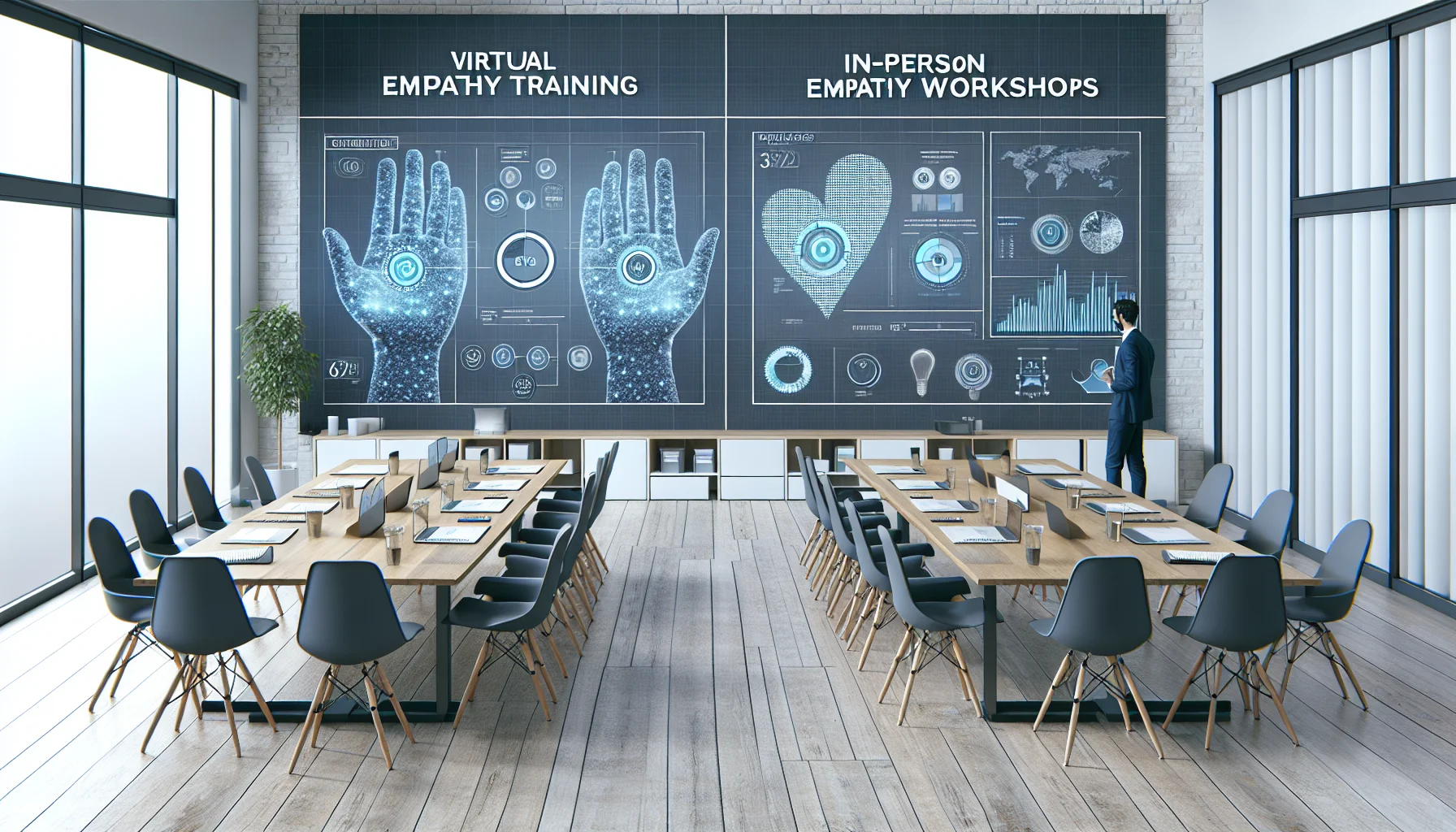
This article compares virtual empathy training and in‑person workshops across outcomes, evidence, cost, and design. Virtual programs scale and retain knowledge when they use spaced practice and micro-simulations; in-person delivers stronger affective shifts and role-play fidelity. For most organizations a hybrid model with mixed-method evaluation and facilitator training is recommended.