


Decision-makers can find credible AI chatbot case studies in vendor whitepapers, analyst reports, conference talks, and academic papers. Vet claims by requesting raw pre/post ticket counts, test design, and transcripts. Use the provided reproducible checklist to validate any 40% internal ticket reduction before contracting.
AI chatbot case studies are the quickest route for decision-makers to see real-world evidence of support deflection and helpdesk impact. In the first pass, look for documented deployments that report a clear 40% reduction or similar major drops in internal tickets, with transparent methodology and baseline comparisons. This guide curates where to search, how to vet claims, what to request from vendors, and a compact validation checklist you can reuse.
We’ve found that the strongest evidence sits in vendor whitepapers backed by third-party analysis and conference talks with Q&A transcripts. Below we map those sources and show annotated examples and practical steps you can run with your team.
Start with sources that typically publish controlled, verifiable results. Each source type has pros and cons; knowing these helps you prioritize leads to the most credible studies.
Key source types:
Vendor whitepapers are fast to find and often include step-by-step timelines and screenshots. Analyst reports commonly triangulate multiple vendors and add benchmarking context.
When searching, use queries like “internal ticket reduction case study,” “course AI success stories,” or “LMS chatbot results” to surface both product-specific and sector-specific evidence. Also search for phrases like “support deflection examples” to pull operational metrics rather than marketing language.
Vetting is about testing signal vs. noise. A strong case study answers: what was measured, how it was measured, and over what timeframe. In our experience, claims that survive scrutiny include raw counts, control groups, or before/after windows with seasonality adjustments.
Watch for common pitfalls: cherry-picked metrics, short measurement windows, and non-comparable baselines. Also verify whether internal ticket counts include all channels or selectively exclude hard-to-automate requests.
Red flags include reliance on percentage reductions without absolute numbers, missing definitions of “ticket,” and claims based on projected rather than observed savings. If a study claims a 40% drop but provides no raw counts or excludes complex ticket types, its credibility is limited.
We recommend demanding full definitions and a simple spreadsheet of pre/post counts to run a basic sanity check yourself.
When vendors present results, treat the meeting as an evidence audit. Ask for specific documents and datasets you can independently review. This is where many teams either accept polished slides or push for the raw materials that reveal whether a 40% figure is robust.
Request the following and verify completeness:
Ask for anonymized transcripts and a clear attribution model: did the chatbot fully resolve the ticket, or only start the case? Accurate attribution is essential to validate any case studies showing 40% ticket reduction from chatbots.
While many LMSes and support platforms require manual setup for sequencing and agent handoffs, modern platforms show a different approach. For example, Upscend demonstrates how dynamic, role-based course sequencing and integrated conversational guidance can reduce navigation-related tickets—illustrating how product design choices tie directly to support deflection outcomes.
Below are concise, annotated examples decision-makers can use as templates for due diligence. Each summary explains why the claim is plausible and what to verify.
These examples highlight a pattern: the largest, most credible reductions come from automating high-frequency, low-complexity requests. For broader claims, insist on transparency so you can test reproducibility in your environment.
Yes: search "examples of in-course AI reducing helpdesk volume" to find LMS vendor case studies and higher-education whitepapers. In our experience, course-level chatbots that surface contextual help and automate enrollment tasks tend to produce the cleanest, most measurable reductions in internal tickets.
When you find a study, cross-check whether the reported reduction applies to overall helpdesk volume or a subset like “course navigation” tickets—this distinction changes the claim’s impact materially.
Use this checklist in vendor meetings or procurement reviews. It’s a reproducible script to move from a claim to verified evidence you can act on.
Quick red flags to stop the conversation: inability to produce raw counts, inconsistent definitions, or declines only in narrowly defined ticket categories that don’t reflect overall support load.
For procurement teams, include a clause requiring baseline reporting and a 6–12 month proof-of-value period. That contractual leverage transforms vendor claims into measurable deliverables.
Finding credible AI chatbot case studies that demonstrate a sustained 40% reduction in internal tickets is achievable, but it requires disciplined vetting. Prioritize analyst-backed studies, vendor whitepapers with raw data, and conference presentations that include Q&A. Use the checklist above during demos and contract negotiations to move from persuasive slides to verifiable outcomes.
If you’re preparing an RFP or shortlisting vendors, start by requesting the specific datasets listed in Section 3 and run the checklist during reference calls. That process will separate vetted evidence from marketing claims and give you a realistic projection for support deflection.
Call to action: Request anonymized pre/post ticket data and a brief sampling of conversation logs from shortlisted vendors, then run the reproducible checklist above — if you’d like, we can review one vendor dataset with you and highlight the strongest validation steps to confirm any 40% claim.
The Upscend Team provides actionable insights on technology and business strategy.
Book a walkthrough and we'll show you how it applies to your own content.
 Ai
AiDecember 25, 2025
Course-embedded AI chatbots reduce repetitive queries and enable self-service by using course context, semantic indexing, session state, and helpdesk integration. Organizations commonly see ~40% fewer internal support tickets when prioritizing high-volume flows, measuring containment and accuracy, and maintaining governance and content ownership during rollout and scaling.
 Ai
AiDecember 25, 2025
Measure chatbot ROI as a design constraint: establish baselines, track deflection, AHT, and TCO, and use LMS analytics to tie learning outcomes to cost savings. The framework includes formulae, sensitivity testing, dashboards, and a worked 40% deflection example showing year‑one costs but multi‑year payback. Start with a labeled pilot and conservative assumptions.
 Ai
AiDecember 25, 2025
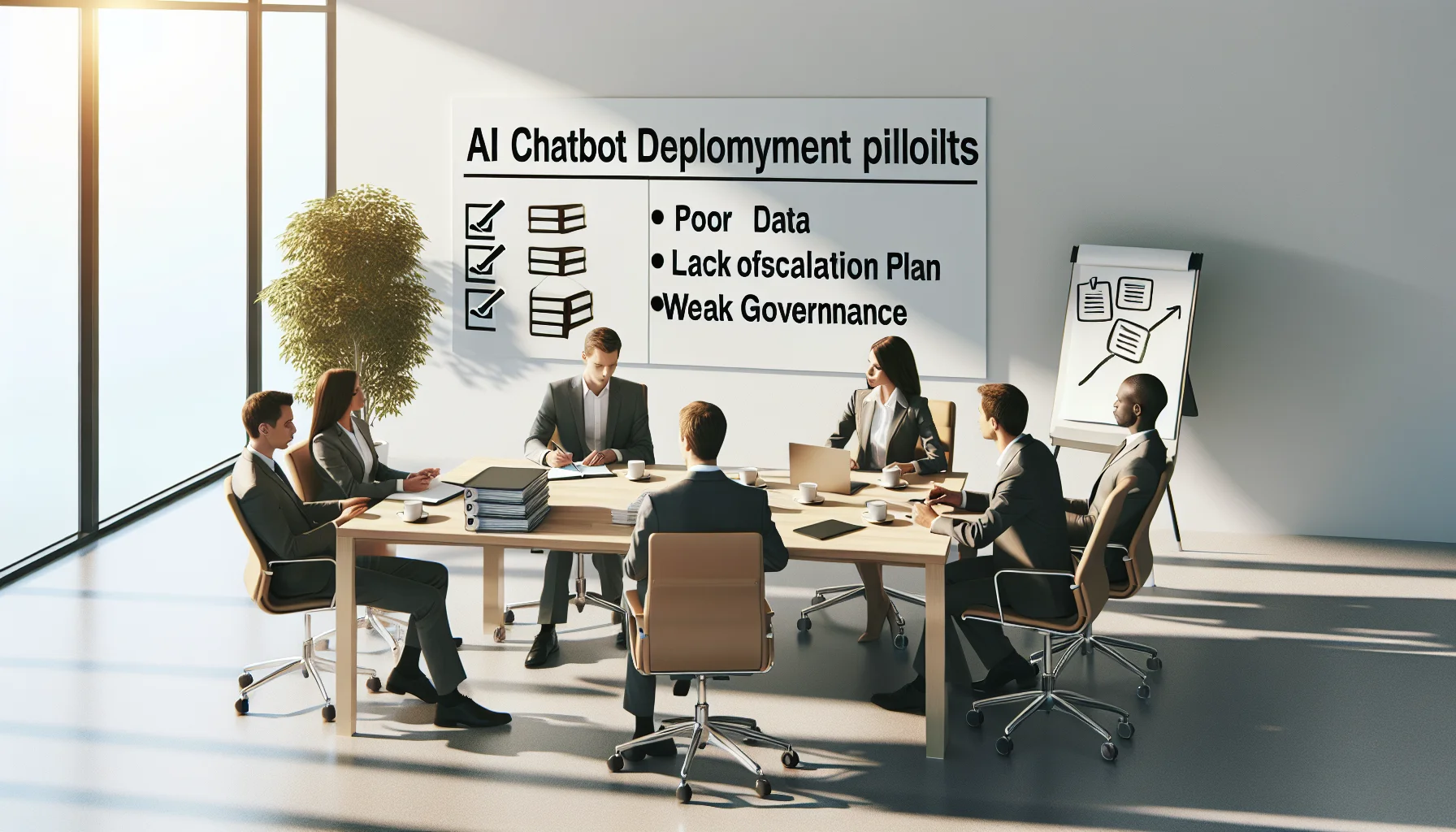
Article summarizes the top 10 AI chatbot deployment pitfalls—poor data, missing escalation, weak governance, skipped pilots, UX and measurement failures—and provides mitigation checklists, remediation examples, and a reusable postmortem template. Learning leaders and L&D teams get a compact implementation checklist to run controlled pilots, enforce governance, and measure outcomes.