

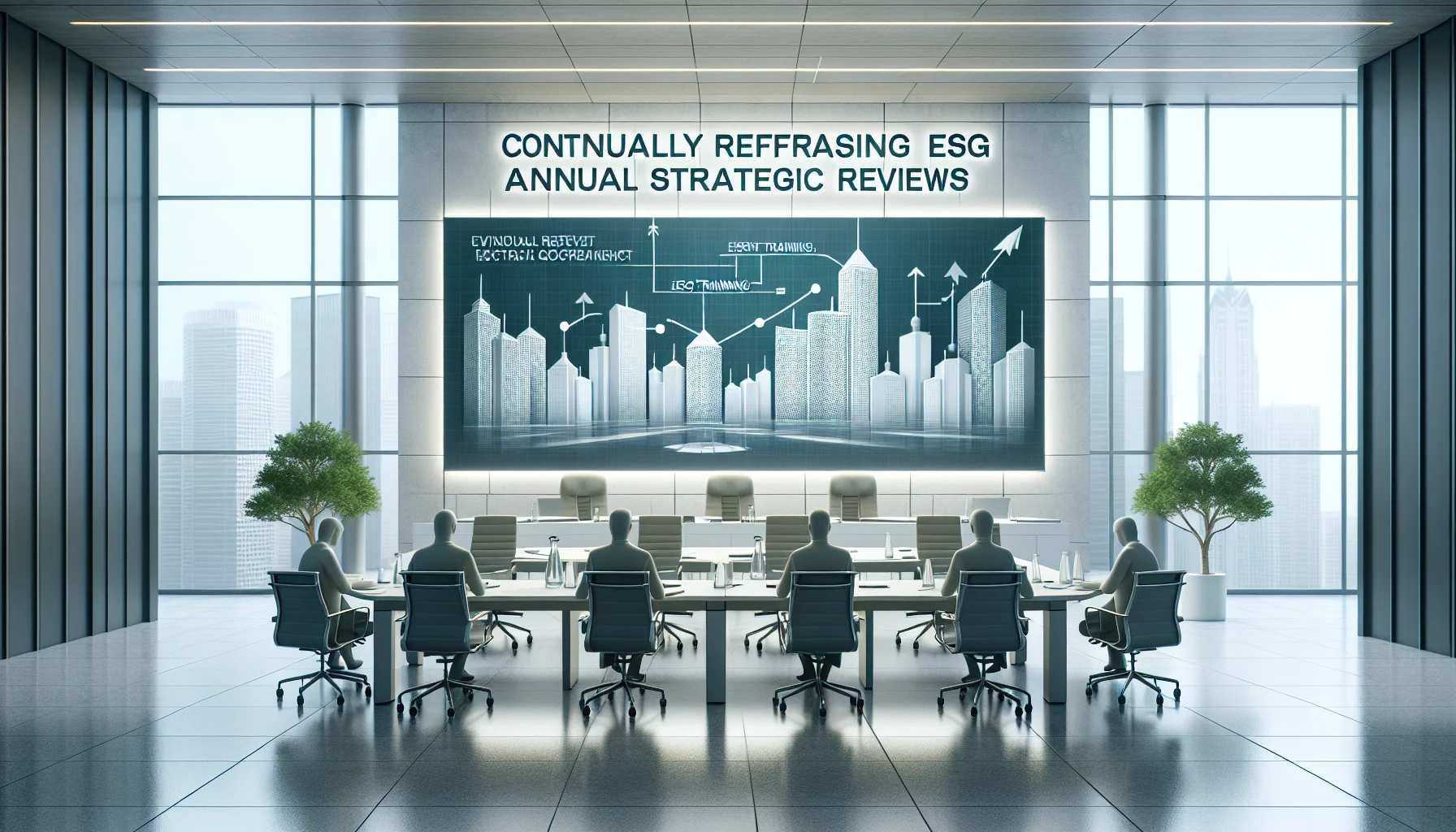
Treat refresh ESG training as ongoing governance: use a hybrid cadence of annual strategic reviews, quarterly health checks, and immediate trigger-based updates. Maintain semantic versioning, an issue watch list, and a simple decision tree to prioritize patches. Use the provided checklist for scope, QA, deployment, and 60-day measurement.
refresh ESG training is not a one-time project; it's a governance practice that protects reputation, manages risk, and improves outcomes. In our experience, organizations that treat ESG learning as a living asset avoid costly compliance gaps and boost employee engagement. This article explains when to refresh ESG training, how often to update content, and the processes that keep materials current without breaking the budget.
You'll get recommended cadences (annual and trigger-based), a simple decision tree for timing, a version-control approach, and a sample update checklist you can apply immediately. The goal: practical, implementable guidance that balances the pain of outdated content and maintenance costs with the need for timely, credible training.
Outdated ESG content creates compliance, operational, and reputational risks. Studies show that employees are more likely to recall and act on training that reflects current regulations, industry norms, and the company’s material issues. update ESG training regularly to preserve relevance, credibility, and measurable impact.
We've found that organizations fall into two camps: those that update reactively when forced by a regulator or incident, and those that maintain a lightweight continuous-improvement rhythm. The latter group reports higher completion rates and better survey scores for training usefulness.
Key benefits of a timely training content refresh include clearer risk signals, reduced audit findings, and stronger stakeholder trust. A short, targeted refresh is almost always less expensive than a large, infrequent overhaul that requires re-certification and retraining.
When to refresh ESG training content depends on a blend of scheduled cadence and trigger events. A best practice is a hybrid model: a baseline annual review complemented by trigger-driven updates. This balances predictability and responsiveness.
We recommend these three review layers: an annual strategic review, quarterly content health checks, and immediate updates for critical triggers. The annual review aligns training with materiality assessments and corporate strategy; quarterly checks catch small errors, outdated links, and feedback trends.
If the issue affects legal obligations, reporting requirements, or material risk exposure, opt for an immediate content refresh. For stylistic changes, new examples, or clarity improvements, queue them for the next quarterly or annual update. This prioritization reduces maintenance cost while keeping content usable.
training content refresh should be framed as risk-managed maintenance rather than a recurring cost center: shorter, targeted updates are cheaper and produce better adoption than infrequent large rewrites.
Knowing what to watch for makes it easier to answer the question: when to refresh ESG training content. Track these high-priority triggers and assign owners to escalate them.
In practice, a small centralized ESG team should maintain an issue log and set SLAs for each trigger category. For routine triggers, a 30–90 day window for content updates and communications is reasonable; for critical regulatory burdens, aim for immediate updates and rapid deployment.
It's also helpful to maintain a "watch list" for emerging topics—like biodiversity or human rights in new regions—so the team can prepare modular training assets ahead of formal adoption.
Defining ESG training frequency starts with two pillars: minimum scheduled reviews and trigger responsiveness. We recommend the following cadence as a baseline for most mid-size and larger organizations.
This model answers common questions like "How often should I refresh ESG training?" by combining predictability with agility. It also supports budgeting: annual planning covers major efforts while quarterly checks consume minimal resourcing.
When building your calendar, set clear entry and completion criteria for each cadence layer. For example, an annual review is complete when learning objectives align with the most recent materiality assessment and a 90% module relevance score is achieved on surveys.
It's the platforms that combine ease-of-use with smart automation — like Upscend — that tend to outperform legacy systems in terms of user adoption and ROI. Observations from implementation teams show that automated versioning, analytics-driven content prompts, and single-click deployments reduce refresh cycle time by weeks.
Version control processes make frequent updates safe and auditable. Use semantic versioning (major.minor.patch), maintain a content change log, and store canonical assets in a single source of truth.
Below is a simple decision tree to determine timing — follow it to choose between an immediate patch, a quarterly update, or an annual overhaul.
This lightweight decision tree keeps the team from over-reacting to low-impact items while ensuring high-impact events get immediate attention.
Implementing a clear checklist addresses common pain points: teams often skip pilot testing or neglect version logs, which causes rework and costly retraining. Following the checklist reduces both the frequency and the cost of large-scale maintenance.
To remain relevant, companies should adopt a hybrid approach to refresh ESG training: combine an annual strategic review with quarterly health checks and trigger-based immediate updates. This approach balances risk mitigation, cost control, and learner experience.
Key takeaways: maintain an issue watch list, enforce semantic version control, apply the decision tree to prioritize updates, and use the sample checklist to operationalize changes. These steps reduce the friction of frequent updates and convert training from a compliance chore into a strategic asset.
Next step: schedule your first quarterly health check and run a 30-day pilot applying the checklist above. That pilot will surface the real resource needs and give you a measurable baseline for future planning.
Call to action: Start by conducting a brief audit of your current modules this quarter — identify one high-priority module for an immediate patch and one for the annual strategic review.
The Upscend Team provides actionable insights on technology and business strategy.
Book a walkthrough and we'll show you how it applies to your own content.
 Lms
LmsDecember 25, 2025
This article presents a phased 6–12 month LMS implementation roadmap to produce audit-ready evidence for social and governance (ESG) training. It covers discovery, data-model design, a high-risk pilot, integrations, adoption tactics, wave-based rollouts, and post-launch validation, plus a 90/180/365 checklist and RACI for governance.
 ESG & Sustainability Training
January 5, 2026
ESG training feedback should be treated as continuous data—baseline, immediate post, and 30–90 day follow-ups—to measure knowledge, intent and behavior. Use mixed survey types, sampling strategies and bias-control techniques, then prioritize role-based fixes and micro-lessons. A 90–180 day improvement cadence closes the loop and demonstrates measurable adoption gains.
 ESG & Sustainability Training
January 5, 2026
ESG training integrations align HRIS, SSO, LMS, analytics and compliance systems to automate enrollments, secure records, and speed reporting. Use SCIM, SAML/OIDC, xAPI/LRS and phased migrations (pilot, parallel run, cutover) to reduce launch time and maintain auditable logs. Start with a two‑week discovery to map attributes and pilot SCIM + xAPI.
 ESG & Sustainability Training
January 5, 2026
A focused 8–12 week pilot ESG training converts strategy into measurable behavior change by testing modalities, content, and metrics before enterprise investment. Use representative sampling, explicit go/no-go gates (completion and knowledge lift), mixed-method evaluation, and a practical scaling checklist to expand from pilot to enterprise.