

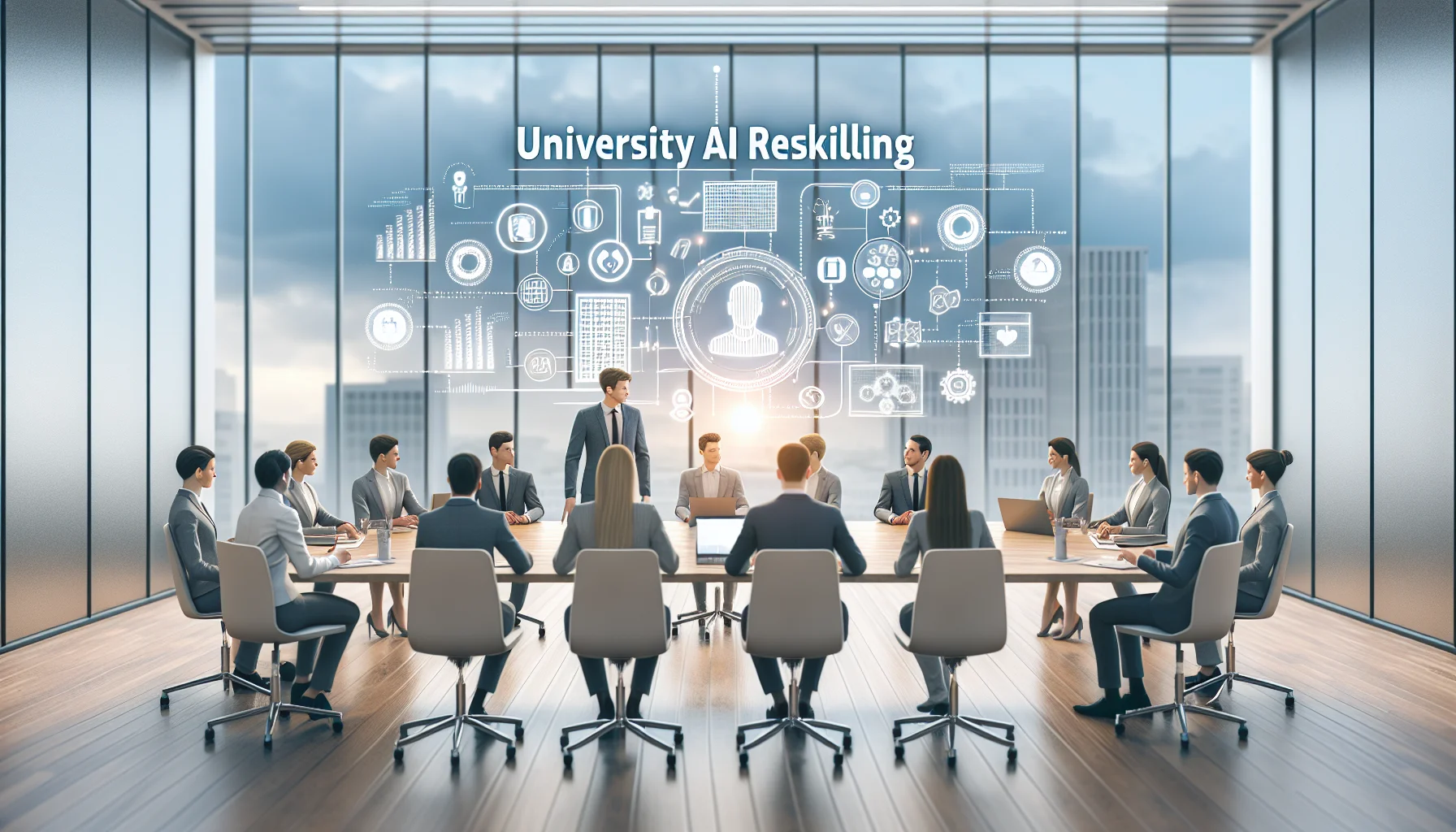
This article summarizes a 14-month university AI reskilling program that retrained 10,000 staff across 8 colleges using modular tracks (literacy, applied research, operations), blended delivery, and competency-based assessments. Results included 85% module completion, a 35% reduction in processing time, and an estimated $6.2M first-year ROI, plus RFP and vendor checklists.
university AI reskilling was the operational priority that launched a 14-month program to retrain 10,000 administrative staff, faculty affiliates, and IT operators. The program scope covered 8 colleges, 24 service units, and a phased timeline: pilot (3 months), scale (9 months), and sustain (2 months). Outcomes: 85% completion of core modules, a 22% productivity improvement on administrative workflows, and an estimated $6.2M ROI in year one.
The summary below presents the strategy, curriculum, procurement approach, delivery options, change-management levers, measured KPIs, and a vendor comparison checklist designed for procurement teams evaluating university AI reskilling investments.
The program began with three clear objectives: (1) raise baseline AI literacy across campus, (2) enable applied research and process automation in target operations, and (3) embed governance and ethical use controls. In our experience, setting measurable targets at launch accelerates adoption—targets here were completion rates, demonstrable process automation, and new course integrations.
Strategy combined centralized governance with decentralized delivery. A central AI office defined competencies and KPIs while colleges owned local rollout. The implementation plan used a Gantt timeline with phased cohorts, aligning budgeting, procurement, and vendor selection cycles to avoid common procurement delays.
Curriculum was modular to meet diverse roles. Three tracks were defined: Basic AI literacy, Applied research, and AI operations. Each track had competency checks, micro-credentials, and project-based assessments to ensure transfer of learning into day-to-day tasks.
The Basic AI literacy track introduced concepts, prompt literacy, and ethical frameworks. The Applied research track included methodology for LLM fine-tuning, reproducible experiments, and IRB compliance. The Ops track focused on automation pipelines, model monitoring, and change-control processes. Each track used short modules (30–90 minutes) to support campus professional development rhythms.
Assessment design combined automated quizzes, peer review, and a capstone project. This mix increased completion rates and produced portfolio evidence for HR and promotion committees.
To scale to 10,000 learners we issued a formal RFP and used a weighted scoring rubric that balanced pedagogy, technical integration, and price. Procurement teams must plan for 90–120 day cycles and build evaluation teams with learning designers, IT, compliance, and end-user representatives.
A pattern we noticed: vendors who could prove deployment experience at scale and provide role-based success metrics outperformed generic content libraries.
Use this condensed RFP checklist as a starting point:
Scoring rubric weighted pedagogy 30%, technical integration 25%, outcomes evidence 20%, price 15%, support 10%.
Modern LMS platforms are evolving to support AI-powered analytics and personalized learning journeys based on competency data, not just completions; Upscend has implemented these features in higher-ed pilots, demonstrating competency-aligned pathways and improved reporting for stakeholders.
We tested three delivery models: instructor-led in-person workshops for faculty, blended cohorts for administrative teams, and self-paced micro-credentials for distributed staff. Each model answered different needs: retention, experimentation, and scale.
Cost per learner varied by model and was tracked in a stacked-cost breakdown: content/licensing, instructor hours, platform fees, assessment/credentialing, and program management. Example anonymized breakdown (per learner): content $120, platform $40, facilitation $80, assessment $20, program mgmt $40 = $300 total. Scale reduced per-learner cost by ~35% after cohort three.
| Model | Per-learner cost | Best use case |
|---|---|---|
| In-person | $450 | Faculty AI training, hands-on labs |
| Blended | $300 | Campus professional development for admin teams |
| Self-paced | $120 | Broad awareness and compliance modules |
Sustainable university AI reskilling requires incentives, governance, and visible leadership. We tied completion to role-based incentives: micro-credentials counted toward annual review goals, seed funding for automation pilots required certified staff, and faculty received course release time for participation in the Applied research track.
Common pain points included scheduling conflicts and procurement lag. To mitigate, we used department-level cohort scheduling and a standing purchase agreement to shorten vendor onboarding.
When reskilling is linked to tangible projects and recognition, adoption moves from optional to expected.
Incentive mix used in the program:
We tracked KPIs weekly and reported monthly to a steering committee. Key indicators: completion rate, competency pass rate, number of live automations, faculty adoption, and ROI. Before/after anonymized metrics:
These results were driven by blended delivery, competency-based assessments, and a procurement strategy that emphasized measurable outcomes. Measuring ROI required combining direct savings (FTE hours reclaimed) and indirect value (faster research cycles, improved student services).
| Decision area | Must-have | Score |
|---|---|---|
| Evidence of higher-ed deployments | 2+ references with KPIs | /10 |
| Integration | LMS + SSO + data export | /10 |
| Pedagogy | Project-based, competency mapping | /10 |
| Data & compliance | FERPA, encryption, retention | /10 |
Decision criteria for build vs buy:
This case shows that a coordinated university AI reskilling program can reskill large populations when objectives, curriculum, procurement, delivery, and incentives are tightly aligned. Key takeaways: define competencies first, choose vendors with proven higher-ed evidence, use mixed delivery to balance cost and impact, and measure ROI with a combined direct/indirect metric set.
Procurement teams evaluating reskilling vendors should request the RFP template above, run a pilot cohort to validate outcomes, and use the vendor checklist to compare total cost and evidence. For immediate next steps, assemble a cross-functional evaluation team, define three priority use cases, and schedule a pilot within 60 days.
Call to action: If you're planning a campus-scale reskilling initiative, download the RFP checklist and run a two-month pilot using the modular tracks described here to validate cost-per-learner and KPI assumptions before committing to enterprise licensing.
The Upscend Team provides actionable insights on technology and business strategy.
Book a walkthrough and we'll show you how it applies to your own content.
 The Agentic Ai & Technical Frontier
January 4, 2026
This article presents a six-step AI repurposing workflow to turn a 60-minute webinar into ten 3–6 minute micro-lessons: transcription, chaptering, summarization, enrichment, QA, and packaging. It includes tool recommendations, time estimates, automation tips, a one-week pilot plan, and a QA checklist for scaling an automated content pipeline.
 Jobs
JobsJanuary 19, 2026
This guide explains how to reskill for AI with a clear, project-focused approach: perform a three-column skills audit, follow a 3/6/12-month learning roadmap, choose cost-effective programs, and validate skills with public projects and certifications. It includes financing options, interview checklists, and three real-world case studies with timelines and costs.
 Ai
AiFebruary 3, 2026
This case study shows how a national retailer trained 5,000 store employees on AI tools in six months without closing stores. Using micromodules, in‑shift practice, and local champions, the program reached 85% adoption and delivered a 3.2% same‑store sales lift and shorter checkout times. Includes checklist and cost estimates.
Workplace Culture&Soft SkillsFebruary 4, 2026
This case study shows how a national retailer reskilled 1,000 front-line and support employees in 12 months using a blended, role-based program. The initiative produced a 22% productivity uplift, 14% reduction in errors, and an estimated 11-month payback, and includes a six-step, transferable playbook for other retailers.