

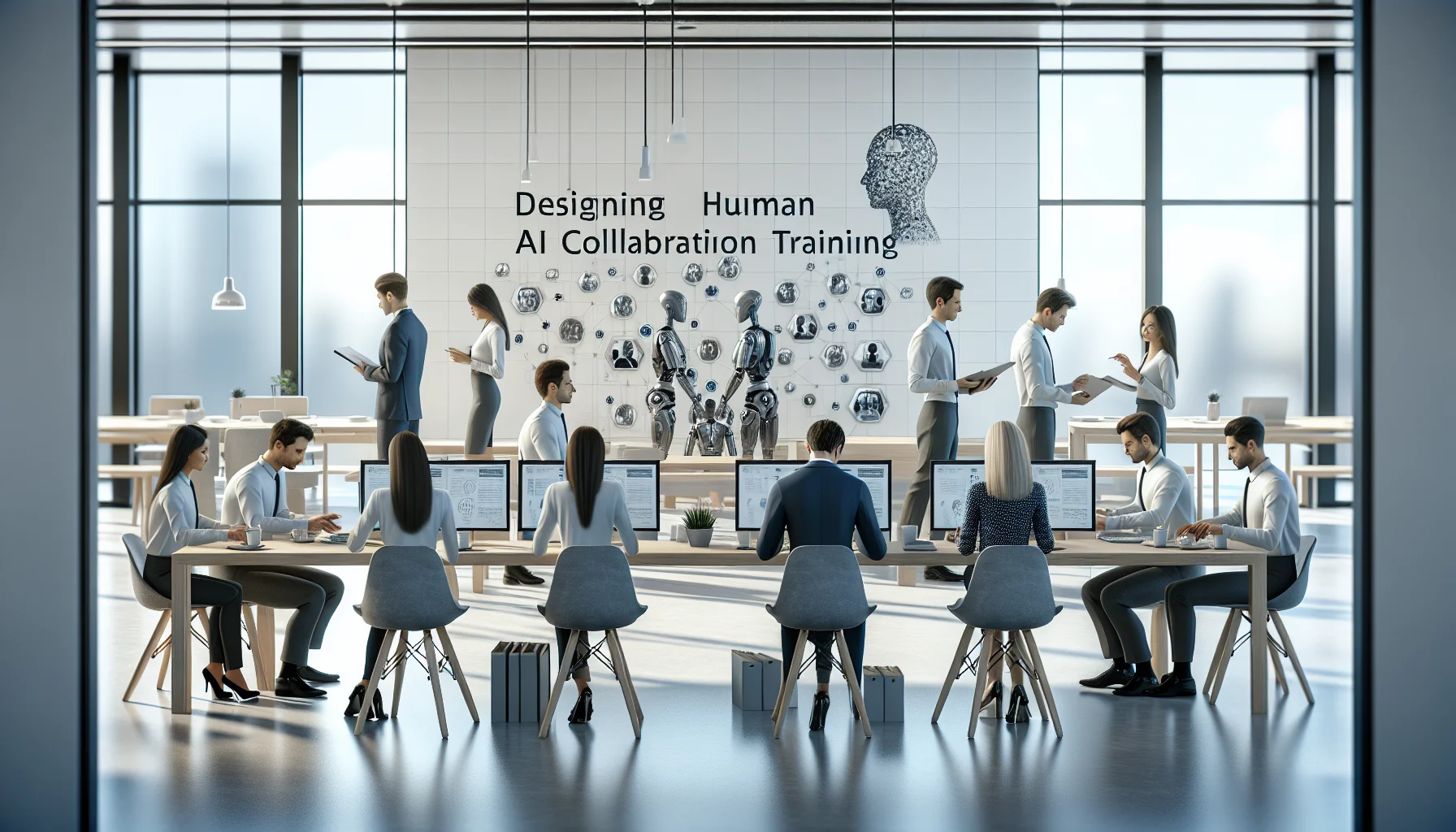
Step-by-step process to design human-AI collaboration training: assess needs, map personas, build role-specific competency maps, and deliver modular curricula with microlearning and simulations. Pilot, measure adoption and business KPIs, then scale via train-the-trainer and automated assessments. Includes templates and two case examples showing measurable impact.
Designing human-AI collaboration training is now a core competency for organizations adopting AI-driven workflows. In our experience, successful programs balance technical skills, decision design, and behavioral change so people and systems work as a team. This article walks through a practical, step-by-step design process — from needs assessment to evaluation — and provides ready-to-use lesson plans, templates, and examples from a mid-size retailer and a healthcare provider.
Start with a structured training needs assessment that links organizational goals to human-AI adoption targets. In our experience, clarity at this stage prevents wasted investment and creates measurable success criteria for human-AI collaboration training. Focus on use cases, current skill gaps, and process constraints.
A concise assessment has three parts: business objectives, task analysis, and learner readiness. Use the following steps:
Design a short, targeted survey (see template below). Ask about experience with AI tools, comfort with data-driven recommendations, frequency of relevant tasks, and barriers like time or device access. Include both quantitative ratings and open text to capture concerns. This creates the foundation for a focused training curriculum for AI.
Use a three-minute survey with Likert scales and one open question:
Persona mapping transforms a generic plan into role-specific pathways. We recommend creating 3–5 learning personas for most mid-size organizations: frontline operators, supervisors/managers, technical champions, business analysts, and executives. Each persona should have a competency map tied to real tasks.
Human-AI collaboration training must be role-specific: frontline staff need practical, short workflows, while managers need decision governance and change management skills.
A competency map lists observable behaviors, knowledge, and tools per persona. For example, a frontline persona might require “interpret model confidence,” “override safely,” and “escalate exceptions.” Use this format:
| Persona | Skill | Behavioral Indicator |
|---|---|---|
| Frontline staff | Interpret AI output | Explains recommendation and next step |
| Manager | Govern thresholds | Adjusts alert thresholds based on outcomes |
Curriculum design is where learning science meets operations. Build a modular training curriculum for AI with progressive layers: awareness, procedural fluency, and judgment. We’ve found that mixing microlearning with scenario-based practice yields the best transfer into daily work.
Core curriculum components should include:
Delivery modes must align with constraints: micro-modules for frontline, workshops for managers, and deep technical sessions for champions. Modern LMS platforms — such as Upscend — are evolving to support AI-powered analytics and personalized learning journeys based on competency data, not just completions. This trend helps scale tailored learning paths while tracking progress against job-level metrics.
Mix formats to match personas: brief video + job aid for frontline, cohort-based workshops for managers, and lab sessions for technical champions. Add asynchronous practice and quick assessments that feed into a competency dashboard.
Pilots validate assumptions quickly and cheaply. Design a pilot that tests three variables: curriculum effectiveness, tech integration friction, and change readiness. A tightly scoped pilot lasts 6–8 weeks and focuses on one site or team.
Human-AI collaboration training pilots should include clear criteria to move to scale, including adoption rate, error rates, and supervisor endorsement. Address common pain points like limited L&D budget and inconsistent manager buy-in by prioritizing high-impact cohorts and reusable assets.
Use a phased rollout: pilot → refine content → train-the-trainer for technical champions → regional deployment with monitoring. To manage budgets, reuse microlearning modules, automate assessments, and embed AI coach features into daily tools to reduce classroom time.
Evaluation should be continuous and tied to operational KPIs. A balanced measurement framework includes learning metrics (completion, competency attainment), behavioral metrics (adoption rate, override frequency), and business metrics (time saved, error reduction, revenue impact).
We recommend a simple success metrics spreadsheet that maps learning outcomes to business KPIs and sources of truth (system logs, audits, surveys). This makes ROI conversations evidence-based and defensible.
| Learning Outcome | Behavioral Metric | Business KPI | Data Source |
|---|---|---|---|
| Interpret recommendations | Correct decision rate | Error rate ↓ | QA audits |
| Escalate exceptions | Timely escalations | Resolution time ↓ | Ticketing system |
When direct business impact is slow to show, use leading indicators: task completion time, number of successful overrides, and sentiment changes in surveys. Combine quantitative logs with qualitative interviews to triangulate impact.
Below are compact lesson plans for three key personas and downloadable-style templates you can adapt. Each lesson follows a microlearning + practice model and is designed to be delivered in 45–90 minutes.
Include these practical templates in your program repository: a one-page training needs survey, a competency map template, and a success metrics spreadsheet. These artifacts reduce set-up time and are essential for replicable AI training programs across sites.
Designing effective human-AI collaboration training requires aligning learning to work, defining measurable outcomes, and iterating rapidly. In our experience, organizations that invest in role-based competency maps, short simulations, and clear governance see adoption accelerate and risks decline. Address budget constraints by prioritizing high-impact cohorts and using train-the-trainer models; address scaling by automating assessments and tracking competency-driven progress.
Two brief examples illustrate what’s possible: a mid-size retailer reduced order errors 35% after deploying a frontline microlearning program combined with manager governance training; a healthcare provider cut triage time 28% after pairing clinician simulations with a technical champion rotation that maintained models. These outcomes emerged because the training connected directly to daily workflows and had measurable KPIs.
Start with the templates provided: run a small pilot, measure the leading indicators, and expand with a train-the-trainer approach. If you’d like, we can share editable versions of the training needs survey, competency map, and success metrics spreadsheet to accelerate your first pilot. Choose a pilot team and schedule the first 6-week cycle — that step is often the hardest, but it unlocks practical learning and measurable ROI.
The Upscend Team provides actionable insights on technology and business strategy.
Book a walkthrough and we'll show you how it applies to your own content.
 Ai
AiJanuary 6, 2026
This article defines collaborative intelligence and explains why organizations should adopt human-AI collaboration. It provides a practical framework—skills matrix, role-based learning paths, governance steps—and a 12-month rollout with KPIs, sample curricula, and case studies. Readers will learn metrics, common pitfalls, and concrete steps to train humans to work with AI at scale.
 Ai
AiJanuary 6, 2026
This article presents a compact KPI framework for human-AI collaboration metrics across adoption, productivity, quality, trust and risk. It defines formulas, data sources, dashboard layouts, attribution approaches, and a 5-step implementation checklist, plus two short case studies showing measurable pre/post gains in productivity and quality.
 Ai
AiJanuary 6, 2026
This article compares human-AI training methods for collaboration skills, evaluating instructor-led, e‑learning/microlearning, experiential labs, and embedded on-the-job coaching. It provides cost and time-to-competency estimates, two concise pilot designs, and measurement tactics. Recommendation: use a blended stack—microlearning, VILT, labs, and embedded coaching—to maximize transfer and adoption.
 Business Strategy&Lms Tech
February 4, 2026
This article provides an actionable roadmap to build a human-AI partnership through readiness assessment, modular employee AI training, and lightweight governance. It recommends a 90-day pilot per role, KPIs to measure adoption and accuracy delta, and scaling patterns like role-based playbooks, hands-on labs, and executive dashboards.