


Budgeting for LMS ESG cost ROI requires accounting for licensing, integrations, content, change management and ongoing support. Typical first‑year TCO ranges from $15k for small orgs to $350k–$2M+ for enterprises. Use a line‑item ROI model (savings, avoided fines, productivity) and plan a 15–25% contingency to estimate payback and long‑term benefits.
LMS ESG cost ROI is one of the most common questions finance, compliance and sustainability teams ask when evaluating digital learning for sustainability and reporting. In our experience, realistic budgeting and a clear ROI model separate successful deployments from stalled projects. This article breaks down the cost of implementing LMS for ESG reporting, the total cost of ownership LMS considerations, and a practical model to calculate the ROI of LMS for sustainability reporting so you can make an evidence-based investment decision.
When estimating LMS ESG cost ROI, start with segmented cost ranges. We’ve found that pricing clusters around three profiles: small, mid-market and enterprise. Each profile has distinct drivers: number of learners, integration complexity, content needs, and regulatory reporting requirements. Below are realistic ranges and the components you'll almost always pay for.
The major line items that determine the cost of implementing LMS for ESG reporting include:
Below are typical total first-year cost ranges, including implementation and initial content. These are approximate and assume active reporting requirements and moderate customization.
Implementation nuances: If your ESG reporting requires certified training records, third-party audit trails, or deep integrations with sustainability platforms, add 15–40% to the ranges above. In our experience, the single biggest variable is integration complexity with existing HR systems and ESG data pipelines.
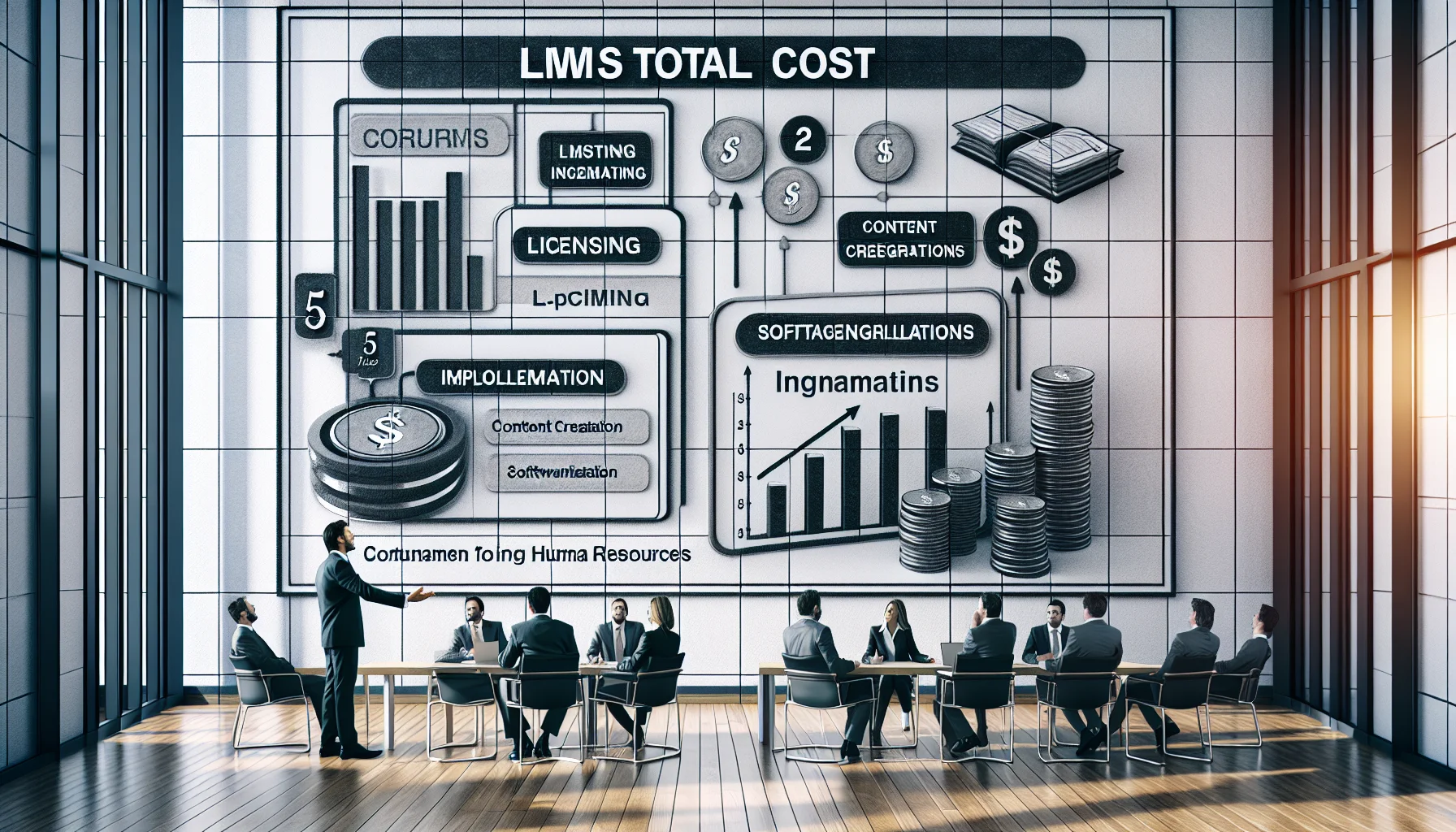
Underestimating total cost of ownership LMS is a frequent pitfall. The headline license price rarely tells the whole story. We’ve found these hidden costs cause budget overruns and implementation delays if not planned for.
To reduce surprises, set aside a contingency of 15–25% for the first year and plan for 8–12% of initial annual run rate for ongoing enhancements. Tracking these as recurring operational costs helps present a realistic LMS ESG cost ROI to stakeholders.
Calculating the ROI of LMS for sustainability reporting requires translating qualitative benefits into financial terms: risk reduction, audit cost savings, efficiency gains, and avoided fines. Below is a concise formula followed by a worked scenario.
Use this core formula:
Break down the savings line-by-line. Typical categories we recommend including in the model:
Scenario: 3,500 employees, mandatory ESG training, annual external ESG audit.
Assumptions:
Calculation:
This example shows a positive LMS ESG cost ROI in year two with payback occurring between 18–30 months depending on timing of benefits. You can increase ROI by negotiating license tiers, reusing existing content, and automating more manual tasks.
Operational best practice: make sure your LMS supports continuous monitoring and audit trails (this process requires real-time feedback (available in platforms like Upscend) to help identify disengagement early).
Stakeholders often want to know the payback period. Using the worked example above, we evaluate three scenarios: conservative, base, and aggressive. Each scenario alters the speed and scale of measurable benefits.
To shorten payback:
Negotiation and procurement strategy materially affect the LMS implementation cost and, by extension, your LMS ESG cost ROI. We recommend a three-pronged approach: scope control, commercial levers, and delivery guarantees.
Ask vendors for a clear statement of work with milestones and acceptance criteria. In our experience, including adoption targets (e.g., 80% of users complete mandatory modules in 90 days) and linking part of the implementation fee to those targets helps align incentives and improve ROI.
Before finalizing vendor selection, use this checklist to validate costs and assumptions. This will also populate your ROI model accurately and make stakeholder sign-off faster.
Downloadable ROI calculator template: copy the CSV table below into a spreadsheet and save as a file to use as your downloadable template. Populate your local numbers in the "Your Value" column to get instant ROI estimates.
| Line Item | Assumption | Your Value |
|---|---|---|
| First-year Licensing & Setup | Enter total | 0 |
| Annual Ongoing Costs | Enter total | 0 |
| Audit Cost Savings (annual) | Estimated annual savings | 0 |
| Productivity Gains (annual) | Estimated annual savings | 0 |
| Avoided Fines & Risk Reduction (annual) | Expected annual benefit | 0 |
| Total Annual Savings | Auto-sum | 0 |
| Annual Net Benefit | Total Annual Savings − Annual Ongoing Costs | 0 |
| ROI (%) | (Annual Net Benefit / Annual Ongoing Costs) × 100 | 0 |
Copy the table into Excel or Google Sheets, replace zeros with your estimates, and the formulas will compute ROI and payback automatically. This converts a qualitative business case into a finance-friendly submission for procurement and the CFO.
Estimating LMS ESG cost ROI requires disciplined scoping and a transparent TCO. In our experience, organizations that budget for integrations, change management, and content localization see shorter payback and higher long-term returns. Studies show that automated compliance workflows and audit evidence can reduce external audit time by 20–50%, a powerful lever to improve the ROI of LMS for sustainability reporting.
Key takeaways:
Next step: use the downloadable ROI template above and run a sensitivity analysis with conservative and aggressive scenarios to present to decision-makers. If you’d like, we can help adapt the template to your organization’s inputs and model a 3-year ROI and payback schedule.
The Upscend Team provides actionable insights on technology and business strategy.
Book a walkthrough and we'll show you how it applies to your own content.
 General
December 22, 2025
Itemize licensing, implementation, integrations, content and people costs to compute LMS total cost over five years. Model each year with ramp effects, inflation and user growth, run sensitivity analyses, and use a short pilot to validate admin hours and content assumptions to reduce hidden LMS costs and improve forecast accuracy.
 Lms
LmsDecember 23, 2025
Step-by-step framework to calculate LMS ROI over a 12–36 month horizon: tally total investment, quantify direct savings (licensing, travel, admin), and convert productivity and retention gains to dollars. Use HRIS, CRM, and LMS logs for inputs, run sensitivity scenarios, and validate assumptions with a 90-day pilot to produce defensible results.
 HR & People Analytics Insights
January 6, 2026
This article breaks down EIS implementation cost across platform, integration, analytics, training, and change management, with low/medium/high budget scenarios. It includes three-year TCO examples for 1,000 and 10,000 employees, drivers of cost, realistic EIS ROI timeline expectations, and vendor negotiation tips to reduce L&D measurement costs.
 Technical Architecture&Ecosystems
January 12, 2026
Breaks down LMS CRM cost into licensing, middleware, development, maintenance, and training, with realistic sample first-year budgets for small ($6k–$20k), mid-market ($40k–$120k) and enterprise ($150k–$700k+) projects. It includes a breakeven ROI method and recommends budgeting 20–40% of implementation annually for TCO.