

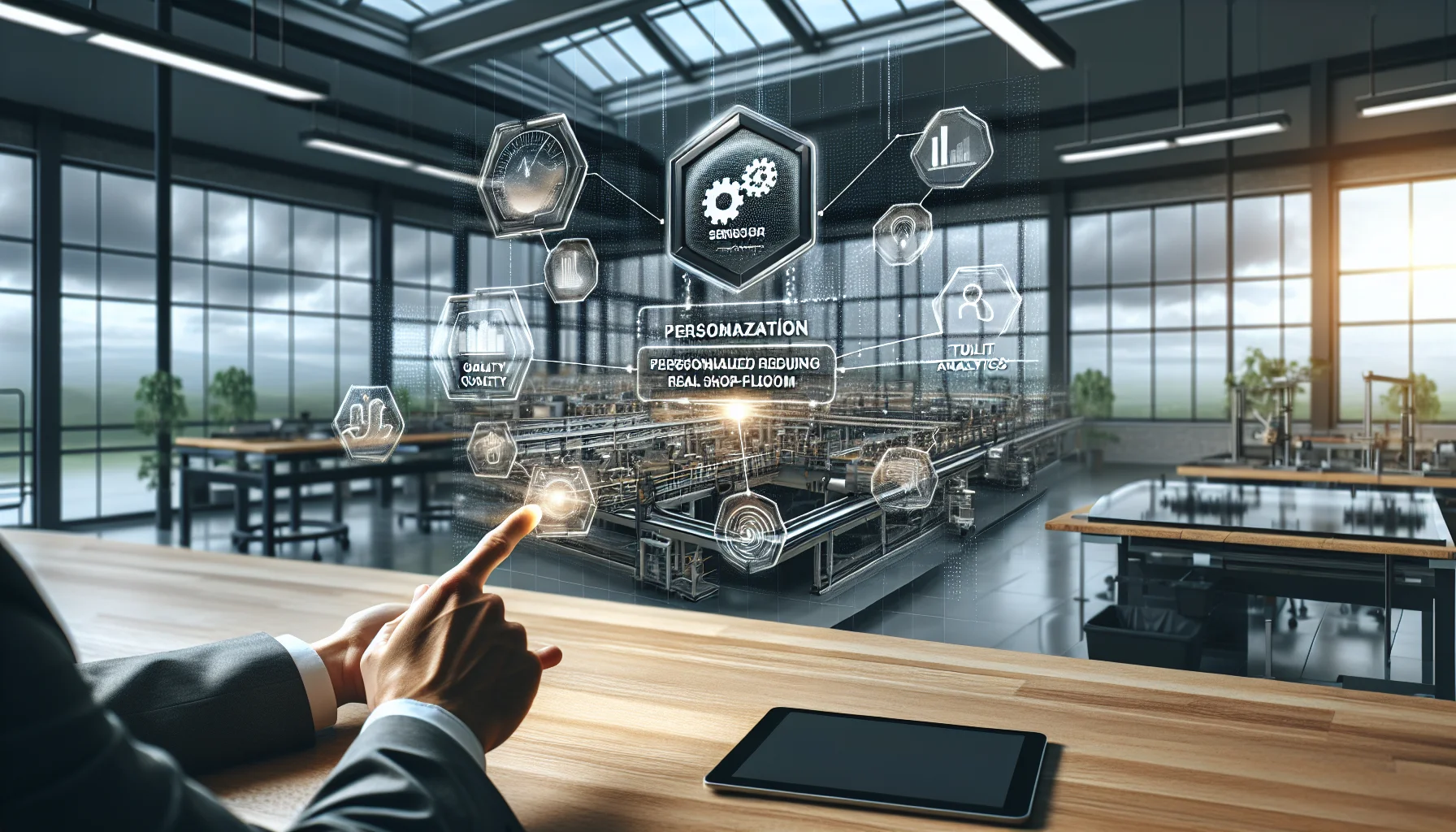
Real-time analytics enables personalized training on the shop floor by linking sensor, quality, and LMS data to trigger micro-lessons and supervisor nudges. Start with a focused 90-day pilot: map data, build simple triggers, deliver 1–3 minute remediation, and measure KPIs like first-pass yield and time-to-competency to prove ROI.
Personalized training powered by real-time analytics transforms how manufacturers close skill gaps on the shop floor. In our experience, moving from static curricula to data-driven, moment-of-need learning cuts error rates and accelerates competency. This article explains the mechanisms, implementation steps, and measurable outcomes of deploying personalized training that adapts to each worker's context.
We focus on practical frameworks, examples, and pitfalls so learning leaders and operations managers can adopt personalized training without long vendor selection cycles. Expect concrete checklists, pilot steps, and evaluation metrics grounded in industry practice.
Manufacturing environments are dynamic: machines drift, line mixes change, and new procedures roll out frequently. Static training fails because it assumes a fixed error profile and uniform learning pace. Real-time personalization responds to immediate evidence — sensor alerts, deviation logs, and operator inputs — to deliver targeted interventions.
We've found that manufacturers who adopt real-time personalization reduce rework by 20–40% in early pilots. The advantage is not just faster learning; it's contextual relevance. Workers receive the right micro-learning sequence exactly when they need it, improving retention and reducing cognitive load.
Adaptive learning tailors content sequencing based on performance signals and behavioral patterns. Unlike one-size-fits-all modules, adaptive systems reorder tasks, vary difficulty, and present remediation instantly. For shop floor use, adaptive learning must integrate with operations data to remain relevant.
Adaptive learning for factory workers prioritizes safety-critical tasks and aligns learning with production goals, making training measurable and tied to operational KPIs.
Analytics turn raw signals into actionable triggers. By combining sensor data, quality incidents, and LMS performance, you can create a decision layer that assigns learning content in real time. This is the core of personalized training applied on the floor: data-driven, timely, and measurable.
Key capabilities include anomaly detection, skill-gap inference, and micro-content delivery. When analytics identify a recurring torque error on a particular station, the system can surface a focused remediation sequence to anyone operating that station.
Effective personalized on the job training using analytics depends on integrating the right data streams. Typical inputs include:
KPIs to monitor: first-pass yield, time-to-competency, incident rate, and repeat training frequency. These indicators let you validate that analytics-based interventions produce learning outcomes.
Start with a focused pilot tied to a high-impact problem: assembly errors, changeover delays, or a safety-critical process. In our experience, pilots that concentrate on a single line and a defined cohort produce faster insights and clearer ROI.
Implementation follows a clear sequence: instrument, model, deliver, and measure. Instrumentation collects relevant signals; modeling interprets them; delivery systems push micro-learning; measurement closes the loop.
Here is a concise pilot checklist that has worked repeatedly:
While traditional systems require constant manual setup for learning paths, a contrasting approach appears in platforms that incorporate dynamic, role-based sequencing; Upscend demonstrates this approach by reducing configuration overhead and supporting real-time personalization. This contrast highlights an industry trend toward systems that automate sequencing while leaving subject matter control with trainers.
Shop floor coaching shifts from scheduled classroom time to in-context nudges and post-shift reviews. Supervisors receive prioritized coaching lists based on analytics-derived risk scores, enabling targeted one-on-one sessions that address the highest-impact gaps first.
We recommend combining automated nudges with human coaching: automated content deals with standard procedures, while coaches focus on complex judgment calls and continuous improvement discussions.
Design workflows that blend automation and human expertise. Typical elements:
This hybrid model preserves human judgment while increasing coaching throughput and ensuring consistency.
Architecturally, a layered approach works best: edge collectors, a streaming analytics layer, and a learning orchestration layer that assigns content. For personalized training, the orchestration engine must support rule-based triggers and probabilistic models that estimate skill state.
Common models include classification for error prediction, sequential models (LSTM/transformer variants) for skill progression, and reinforcement learning for optimizing intervention timing. Model selection should be pragmatic — start with interpretable models and evolve complexity as data grows.
Edge inference reduces latency for real-time nudges but may be constrained on model size. Cloud offers heavier processing and broader model ensembles but introduces round-trip time. Choose a hybrid design: lightweight edge rules for immediate alerts and cloud models for periodic re-sequencing of learning paths.
Design decisions should prioritize reliability and explainability so trainers can trust automated recommendations.
Organizations often stumble on data quality, change management, and content governance. A common mistake is launching broad personalization without validated triggers, which produces noisy nudges and trainer distrust. Start small, verify triggers, and expand.
Measuring ROI requires both operational and learning KPIs. Tie learning outcomes to production metrics and quantify impact in the language of operations: reduced cycle time, fewer defects, and less downtime.
Use this evaluation framework to quantify benefits:
Combine A/B tests with cohort analysis to isolate the effect of personalized training from other process changes.
Practical checklist:
Real-time analytics unlocks scalable, measurable personalized training for manufacturing by connecting data to learning delivery. In our experience, the most successful programs combine sensible instrumentation, pragmatic modeling, and a hybrid delivery model that preserves human coaching. This approach reduces errors, shortens onboarding, and ties training to bottom-line metrics.
Begin with a focused pilot, validate triggers, and evolve the system iteratively. When done right, personalized training becomes an operational lever — not just a compliance checkbox.
Next step: pick one high-impact line, define a single KPI, and run a 90-day pilot using micro-learning and analytics-driven triggers. That pilot is the fastest way to demonstrate the value of personalized training and scale responsibly.
The Upscend Team provides actionable insights on technology and business strategy.
Book a walkthrough and we'll show you how it applies to your own content.
 Institutional Learning
December 24, 2025
Real-time analytics connects machine telemetry, LMS, and assessment data to detect localized skills gaps in the manufacturing workforce, enabling targeted micro-learning, on-the-job prompts, and coaching. A pilot-based deployment — mapping data sources, building minimal pipelines, and integrating learning actions — can reduce time-to-proficiency 25–40% within 8–12 weeks while improving quality and throughput.
 Business Strategy&Lms Tech
January 22, 2026
Targeted retail onboarding using mobile micro-lessons shortens time-to-first-sale by prioritizing a few high-impact behaviors delivered in 1–7 minute units. The article supplies a lesson taxonomy, a pilot→refine→scale roadmap, KPIs, week-by-week programs, concise case sketches, and a budget/ROI primer so teams can run and measure an 8-week pilot.
 Business Strategy&Lms Tech
January 22, 2026
Short, mobile-first microlearning leverages spacing, retrieval practice, and reduced cognitive load to get seasonal retail hires competent faster. Lessons under five minutes with repeat retrieval checks (24–72 hours, plus reviews at 7 and 21 days) improve pitch fluency, product knowledge, and cut POS errors—producing measurable gains in time-to-first-sale.
Business Strategy&Lms TechJanuary 22, 2026
Micro-lesson UX focuses on designing 30–120 second mobile lessons that frontline retail staff can complete during shifts. Prioritize concise onboarding, single interactions, offline-first behavior, and lightweight assets. Run targeted A/B tests on CTA, timing, and rewards, and measure the funnel: notification → start → complete → apply.