


AI personalization tailors content, pacing, and assessment to individual learners, reducing wasted time and improving retention. Organizations that treat personalization as a strategic capability report 30–50% reduced training hours and faster time-to-competency. The article outlines technologies, an implementation roadmap, KPIs, and common pitfalls to avoid.
AI personalization is transforming corporate learning by aligning content, pace, and assessment to each employee's needs. In the first 60 words this article establishes why targeted adaptation matters and how organizations can move from theory to measurable acceleration in skills and performance.
In our experience, companies that treat personalization as a strategic capability — not just a feature — see faster time-to-competency and higher retention of critical skills. This article synthesizes evidence, practical implementation steps, pitfalls to avoid, and measurable KPIs so learning teams can act decisively.
Personalized learning matters because learners differ in prior knowledge, motivation, and context. Generic content forces learners to spend time on material they already know or miss opportunities for stretch assignments. AI personalization addresses that gap by tailoring learning trajectories to individual profiles, which reduces wasted time and increases relevance.
Studies show adaptive approaches increase completion rates and mastery speed. We’ve found that when companies align learning outcomes with role-critical tasks and rely on adaptive feedback loops, ramp time for new hires decreases by weeks in technical roles and by months in leadership tracks.
When learning paths adapt in real time, employees encounter the right challenge level and receive timely scaffolding. Outcomes that consistently improve with AI personalization are:
According to industry research, adaptive systems can reduce training hours by 30-50% while achieving equal or superior learning outcomes. We have observed these benchmarks across multiple sectors: finance, healthcare, and technology. The key driver is not AI for its own sake but the continuous, data-driven optimization of learning pathways.
To deploy AI personalization at scale, organizations stitch together several technologies. At the core are adaptive learning engines, recommendation engines, and modern AI in LMS integrations that operationalize personalization signals.
Understanding these components helps learning leaders select the right architecture and avoid over-engineering. Below we break down how each element contributes to acceleration.
Adaptive learning engines continuously adjust content sequencing based on performance metrics, confidence scores, and learner preferences. Personalized learning experiences use these adjustments to create bespoke curricula that target skill gaps. In practice, adaptive modules combine diagnostic pre-tests, ongoing micro-assessments, and branching content to reduce redundancy and increase appropriate challenge.
Recommendation engines surface just-in-time resources—micro-lessons, job aids, or mentor matches—based on user behavior and competency models. When integrated with AI in LMS, recommendations become part of an ecosystem that links learning to workflow, performance data, and career progression. This integration is essential for sustained impact.
AI personalization accelerates skill acquisition through three mechanisms: targeted repetition, optimized challenge, and contextual relevance. Each mechanism reduces friction in the learning process and increases the signal-to-noise ratio of training.
Below we unpack the mechanisms and provide concrete examples that learning teams can replicate.
Adaptive spacing algorithms identify when a learner is likely to forget and schedule review at optimal intervals. In our experience, systems that apply spacing intelligently cut redundant study time while improving retention. This targeted repetition is a core reason AI personalization improves long-term competency.
By adjusting difficulty based on real-time performance, personalized systems keep learners in a productive struggle zone—neither bored nor overwhelmed. Recommendation engines can suggest stretch projects or remedial modules depending on performance, which expedites progression from novice to competent practitioner.
In many deployments we've observed that execution details matter: ease-of-use, transparent feedback, and clear competency definitions. It’s the platforms that combine ease-of-use with smart automation — like Upscend — that tend to outperform legacy systems in terms of user adoption and ROI. This observation underscores why vendor choice, implementation discipline, and change management are as important as the algorithms themselves.
Using AI to personalize corporate training requires a pragmatic, phased approach. Start small, prove value, then scale. Below is a step-by-step framework we recommend.
Each phase focuses on data hygiene, learner experience, and measurable outcomes to ensure the initiative delivers accelerated development.
Design pilots around a specific business-critical skill with clear success metrics. Collect and clean data: learner profiles, performance logs, and contextual signals (time of day, device, task type). We recommend a 90-day pilot with A/B comparisons against a control group to quantify improvements in time-to-competency.
Integrate personalization outputs into the LMS so that learning pathways, transcripts, and manager dashboards remain unified. Governance is critical: define roles for data stewards, model owners, and learning architects. AI personalization is as much an organizational discipline as it is a technical feature.
To demonstrate acceleration, track leading and lagging indicators. Use a balanced set of KPIs that link learning activities to business outcomes.
Measurement also guides algorithm tuning; without closed-loop evaluation, models drift and personalization degrades.
Combine quantitative A/B testing with qualitative feedback from learners and managers. Studies show that coupling performance metrics with sentiment and self-efficacy surveys uncovers adoption barriers that pure usage data misses. We’ve found mixed-methods evaluations accelerate continuous improvement loops for personalization engines.
Organizations often underestimate the non-technical challenges of AI personalization. Common pitfalls include poor data quality, weak competency models, and neglecting change management. Below are practical steps to avoid these traps.
Addressing these areas early prevents wasted investment and ensures faster, sustainable gains in employee development.
Typical failures stem from three sources: inadequate data, opaque models, and lack of stakeholder alignment. If data inputs are incomplete or biased, personalization will amplify errors. If models are black boxes, managers and learners distrust recommendations. If stakeholders aren’t aligned, adoption stalls despite technical success.
Use this checklist before scaling:
AI personalization is no longer experimental—it's a strategic lever for accelerating employee development when implemented thoughtfully. The fastest adopters combine robust data practices, transparent models, careful pilot designs, and clear measurement frameworks to translate personalized pathways into on-the-job performance gains.
Start with a focused pilot around a high-value skill, collect both performance and qualitative feedback, and use those signals to iterate. Remember that technology choice matters, but so do governance, change management, and clear competency definitions.
If your team wants a practical next step, map one 90-day pilot: define the competency, establish baseline KPIs, select an adaptive module or recommendation rule to test, and commit to a mixed-methods evaluation. That disciplined experiment will tell you whether and how AI personalization can accelerate development in your organization.
Call to action: Choose one role (e.g., new hire software engineer or frontline sales rep), define a 90-day competency target, and design a pilot that uses adaptive modules and recommendation engines to shorten time-to-competency — then measure and iterate.
The Upscend Team provides actionable insights on technology and business strategy.
Book a walkthrough and we'll show you how it applies to your own content.
 Institutional Learning
October 21, 2025
AI Integration in Learning Design enables scalable personalization and faster content production by combining human-authored curricula, AI-driven adaptive rules, and continuous feedback. The article outlines practical patterns (rule-based branching, model recommendations, nudges), implementation steps, measurement KPIs, and governance checkpoints to pilot within a 90-day framework.
 L&D
L&DDecember 21, 2025
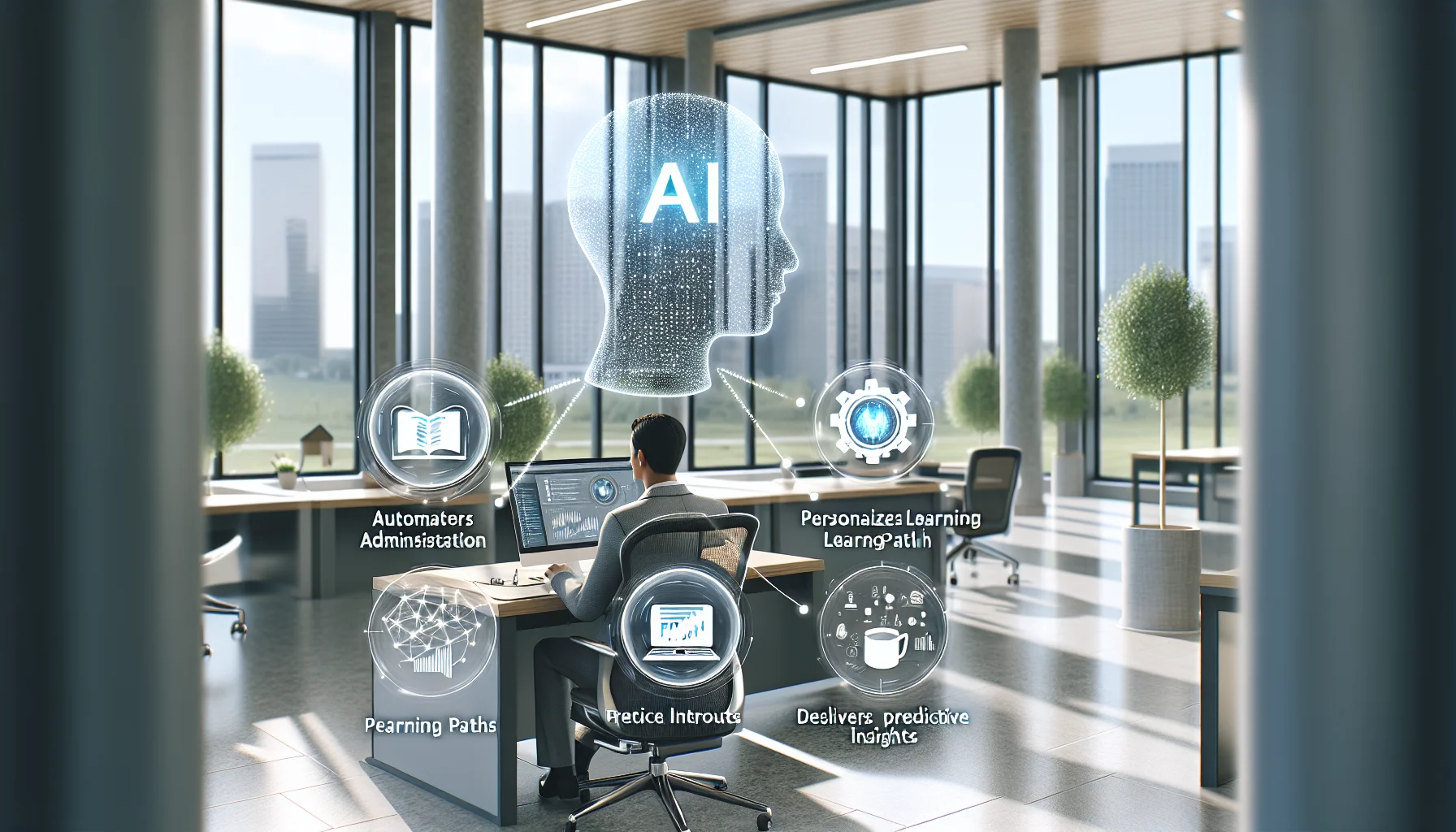
AI in LMS automates administration, personalizes learning paths, and delivers predictive insights to improve completion and skill transfer. This article explains adaptive learning mechanics, concrete AI features, a four-step implementation framework, measurement metrics, and governance practices to pilot safely and demonstrate ROI for learning programs.
 Lms
LmsDecember 23, 2025
This article explains how to create personalized learning paths using a skills baseline, role-based milestones, and multi-modal learning. It gives a step-by-step framework, reusable IDP and journey templates, LMS automation tactics, two sample employee journeys, and a KPI set to run a 90-day pilot and measure time-to-competency.
 Learning System
December 28, 2025
This article defines hyper-personalization employee learning and explains how AI personalized learning techniques—NLP, collaborative filtering, and reinforcement learning—enable unique employee learning paths. It presents a three-part Data–Models–Delivery framework, architecture patterns, case studies with measured uplift, and practical steps for a 90-day pilot to reduce ramp time.