


This article explains how AI tutors and interactive learning assistants transform passive video lessons into adaptive, 24/7 tutoring systems. It outlines core technologies (NLP, RL, knowledge graphs), measurable benefits like 10–25% test-score lifts, and a six-step implementation checklist plus pilot and governance recommendations for institutions.
AI tutors are shifting the center of gravity in digital learning from one-way lectures to continuous, personalized dialogue. In our experience, this transformation is not incremental: it changes how learners engage, how instructors scale, and how institutions measure outcomes. This article explains the shift, the technologies that enable it, the measurable benefits, and a practical roadmap for adoption.
We will contrast static video lessons with interactive learning assistants, break down the core technologies behind modern AI tutors, and provide case studies and a six-step checklist institutions can use to evaluate and deploy solutions. The goal is to give actionable insight for decision-makers, curriculum designers, and edtech leaders.
Static videos have dominated online education because they are easy to produce and scale. Yet videos are inherently passive: they present information but do not adapt to a learner's misconceptions or pace. In contrast, interactive learning assistants — powered by AI tutors — create an ongoing two-way learning loop that responds to questions, adapts difficulty, and provides immediate feedback.
Two short paragraphs summarize the user experience difference. A video is a one-directional content stream. An adaptive tutoring system engages in dialogue, simulates Socratic questioning, and tracks mastery over time.
Active learning principles show that feedback and retrieval practice are core drivers of durable learning. When an AI tutor prompts a student to recall, corrects error patterns, and scaffolds with hints, retention improves. Studies show that adaptive tutoring systems can produce substantial learning gains compared with static content because they individualize practice and pacing.
From a practical perspective, this reduces wasted time on irrelevant material and surface-level engagement, tackling a common pain point: low student engagement with recorded lessons.
Static video platforms rely on content management and analytics. By contrast, AI tutors combine real-time inference engines, interaction models, and curriculum mapping. The result is a persistent learner model that informs content selection and feedback strategies.
This architectural difference is why replacing a video library with an interactive assistant requires changes in data capture, content tagging, and assessment design.
At the heart of modern AI tutors are three technology families: NLP for language understanding and generation, reinforcement learning for optimizing pedagogical strategies, and knowledge graphs for representing curricular relationships. Each plays a distinct role in converting passive content into an active tutor.
NLP turns natural questions into instructional intents, RL selects the next-best pedagogical action, and knowledge graphs enable targeted remediation by mapping dependencies across concepts.
NLP models parse student inputs, infer misconceptions, and generate scaffolded responses. Advanced systems use contextual embeddings and fine-tuned language models to maintain multi-turn dialogues and preserve the learner's state across sessions. This increases relevance and reduces repetition.
Robust NLP pipelines also filter hallucinations and ensure responses align with the curriculum — a critical trust requirement for institutions.
Reinforcement learning enables systems to trade off short-term correctness for long-term retention. By testing different hinting strategies and sequencing techniques, RL discovers policies that maximize durable mastery rather than immediate scores.
In practice, RL is combined with human-in-the-loop experimentation to validate that suggested policies align with pedagogical principles and ethical constraints.
Knowledge graphs encode prerequisite relationships and learning pathways. When a student struggles with a topic, the graph helps the tutor select prerequisite concepts to remediate and provides interpretable reasoning for instructors.
This structured knowledge is particularly valuable when converting large video catalogs into adaptive tutoring systems because it surfaces which modules to update or augment for effective personalization.
Shifting to AI tutors delivers multiple benefits across stakeholders: learners get continuous support, instructors scale their impact, and institutions improve retention and completion metrics. Below are the most significant gains we've observed in real deployments.
These benefits directly address the common pain points of low student engagement, limited instructor bandwidth, and slow content update cycles.
According to industry research and pilot evaluations, adaptive tutoring systems often yield measurable improvements in assessment performance and course completion. In several K-12 pilots and higher-ed studies, interventions with AI tutors reported test-score lifts in the range of 10–25% and completion increases of 8–15% compared to video-only cohorts.
Beyond scores, institutions report reduced instructor intervention time and faster onboarding for new learners — tangible ROI factors when scaling programs.
Successful engagement patterns include short, interactive challenges; immediate corrective feedback; and social prompts (e.g., peer comparison or collaborative problem solving). Student engagement AI that integrates these patterns increases time-on-task without requiring more instructor hours.
Designing for micro-moments and mastery learning produces higher satisfaction and lower churn.
Implementing AI tutors is a programmatic effort that combines technology, pedagogy, and change management. Below is a practical roadmap we’ve used with institutions to move from pilots to production.
Each phase balances risk and learning: start small, iterate with data, and scale proven interventions.
A strong pilot isolates variables: compare a video-only control group with a cohort using an AI tutor. Run pilots across diverse learner segments to surface edge cases and bias. Include qualitative feedback loops so students can report confusion or content mismatch.
We’ve found that 6–12 week pilots provide sufficient data to assess effects on engagement and short-term mastery.
Operationalizing AI tutors requires learning data pipelines, anonymized learner logs, and governance for model updates. Integrations with LMS platforms, single-sign-on, and gradebooks are essential for instructor adoption.
Allocate resources for data engineers and instructional designers during the first 6–12 months to avoid common scale bottlenecks.
Examining real-world implementations clarifies trade-offs and outcomes. Below are three compact case studies that illustrate different deployment models and results with AI tutors.
Each case highlights the problem, the intervention, and the measured impact.
Problem: High rates of stumbling on algebraic prerequisites led to low course pass rates. Intervention: A district deployed an adaptive tutoring system that provided daily micro-lessons and diagnostic checks. Results: Within one semester, students using the system improved formative assessment scores by ~18% versus peers, and the district reduced reteach sessions by 40%.
Operational note: Teachers used the system to triage students rather than replace classroom instruction, preserving human oversight.
Problem: Large introductory courses delivered via recorded lectures had low engagement and overloaded TAs. Intervention: A university integrated an online education AI assistant that answered common conceptual questions and provided targeted resources. Results: Course completion rose by 10% and TA hours for routine queries dropped by 35%, freeing staff to focus on high-value mentoring.
Insight: Students reported higher satisfaction with faster response times and more tailored practice problems.
Problem: Adult learners need flexible, competency-based retraining that acknowledges prior knowledge and time constraints. Intervention: A workforce program used AI tutors to create individualized learning paths and simulate interview coaching. Results: Job placement rates improved by 12 percentage points, and time-to-certification decreased by an average of 20%.
Business benefit: Employers valued verifiable skill attainment aligned with role competencies.
The market for AI tutors includes pure-play startups, LMS vendors adding AI modules, and enterprise incumbents embedding adaptive engines. Vendor selection should be driven by pedagogy fit, data security, and integration capabilities.
We’ve found that platforms with strong analytics and easy content authoring have higher adoption among faculty and learners.
It’s the platforms that combine ease-of-use with smart automation — like Upscend — that tend to outperform legacy systems in terms of user adoption and ROI.
Write clear RFPs that specify learning outcomes and data portability requirements. Include pilot success metrics and require vendors to demonstrate model transparency and human oversight workflows.
Ask for a staged pricing model that aligns vendor incentives with realized student outcomes rather than flat seat-based fees.
Adopting AI tutors introduces risk vectors that require active mitigation. The main challenges are algorithmic bias, scalability constraints, and cost-management during pilot and scale phases.
Below are practical mitigation strategies grounded in our experience working with institutions.
Risk: Training data can encode biases that affect how the tutor interprets non-standard language or diverse problem-solving approaches. Mitigation: Curate diverse training datasets, run fairness audits, and maintain human review for escalations. Document decision logic in accessible formats for instructors.
Policy: Establish a governance committee including educators and ethicists to review outcomes and corrective actions.
Risk: Real-time interaction at scale places demands on infrastructure and increases costs. Mitigation: Use hybrid architectures that cache frequent responses, batch non-urgent processing, and implement adaptive model selection based on load.
Operational tip: Start with limited conversational depth and expand features as usage patterns stabilize.
Risk: Licenses, compute, and content engineering can create budget pressure. Mitigation: Negotiate outcome-based pricing, reuse existing course assets where possible, and prioritize highest-impact modules for initial investment.
Financial planning: Model total cost of ownership over 3 years, including personnel, hosting, and content maintenance.
This checklist is a practical tool institutions can use to keep adoption on track. It focuses on readiness, ethics, pedagogy, and operationalization.
Use this checklist as a living document: revisit it after each pilot and refine based on outcomes and stakeholder feedback.
The transition from static videos to 24/7 interactive learning assistants powered by AI tutors is both achievable and high-impact when executed with pedagogical rigor and operational discipline. Institutions that begin with targeted pilots, prioritize measurable outcomes, and maintain human oversight see improvements in engagement, retention, and scalability.
If your institution faces pain points like low engagement, instructor bandwidth limits, or slow content updates, start by running a tightly scoped pilot focused on a single course or program. Measure engagement metrics, run A/B comparisons against video-only cohorts, and implement governance for fairness and data privacy.
Next step: assemble a cross-functional pilot team (instructional designer, data engineer, faculty lead, and privacy officer), define KPIs, and run a 6–12 week trial that follows the checklist above. That structured process produces the evidence base you need to scale responsibly and achieve meaningful learning gains.
The Upscend Team provides actionable insights on technology and business strategy.
Book a walkthrough and we'll show you how it applies to your own content.
 Ai
AiDecember 28, 2025
Adaptive learning AI offers continuous, data-driven tutoring that personalizes pathways, shortens time-to-proficiency, and frees teacher time for targeted instruction. The article outlines value, cost models, funding sources, pilot case results (up to 18% mastery gains), and a three-phase adoption timeline to help districts build an evidence-driven business case.
 Ai
AiDecember 28, 2025
This article explains the architecture and algorithms behind AI tutoring platforms, covering data ingestion, student modeling (IRT/BKT/hybrids), personalization engines, conversational NLP, and operational concerns like latency and observability. Readers will learn how platforms analyze answers, recommend content, and mitigate integration and explainability challenges.
 Ai
AiDecember 28, 2025
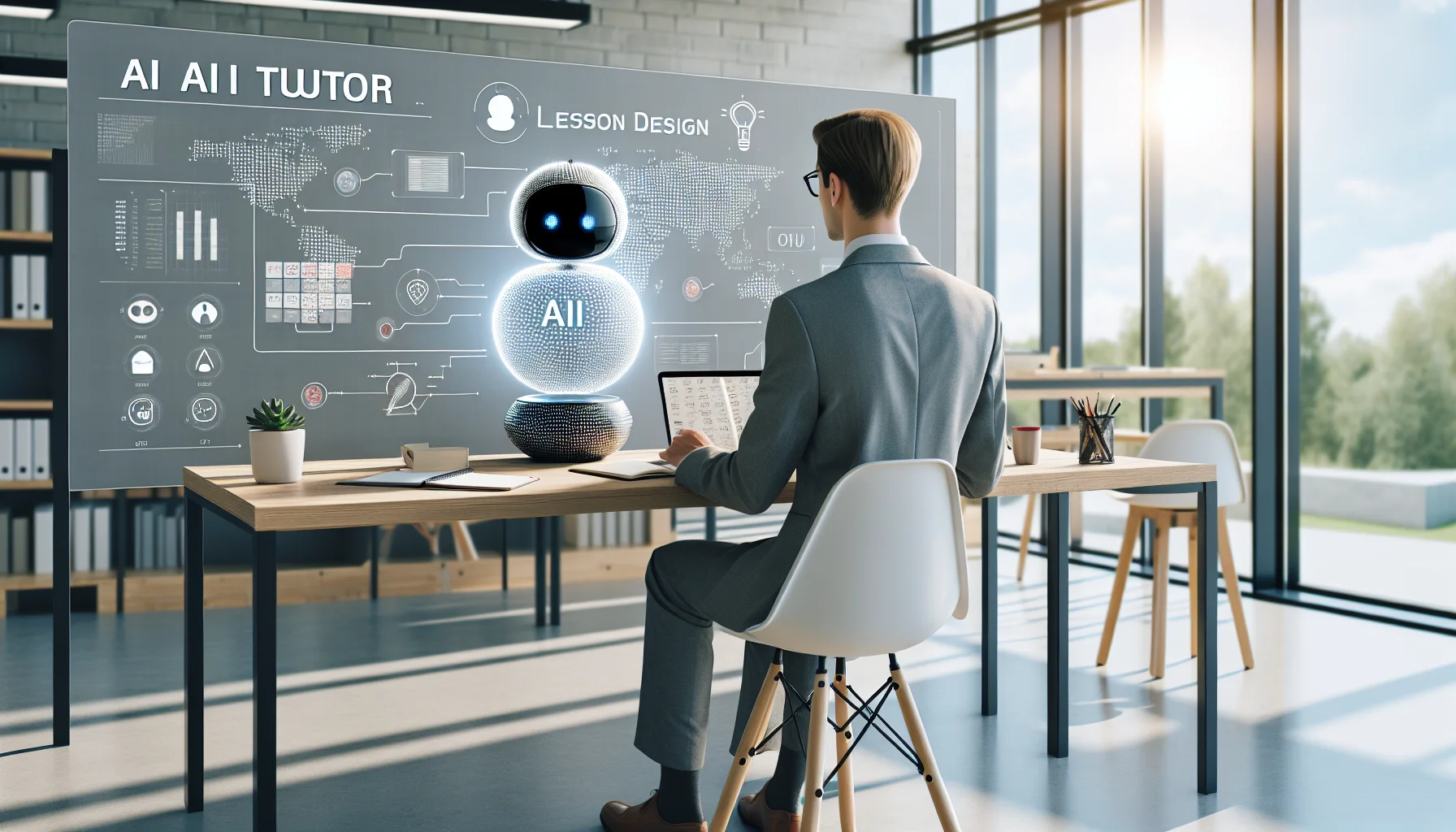
This article shows how teachers can design AI tutor lesson design that maps objectives to AI capabilities across pre-work, in-class, and follow-up phases. It includes sample lesson plans, assessment-integration checklists, scaffolding strategies, and troubleshooting tips to preserve teacher judgment and scale personalized practice.
 Ai-Future-Technology
February 4, 2026
Decision makers should treat AI tutors for upskilling as strategic learning engines. This guide explains market adoption, adaptive tutoring mechanics, measurable benefits (30–50% faster ramp, 10–20% retention gains), an ROI model, vendor selection checklist, integration needs, governance, and a quarterly roadmap to pilot and scale enterprise programs.