


Short, repeatable simulations—tabletop, decision-making drills, and selective live exercises—turn policy into fast, measurable behavior. Focus on clear learning objectives, tight timeboxes, and three core metrics (time-to-decision, stakeholder alignment, action completion rate). Run a 60–90 minute rapid simulation, complete an AAR within 48 hours, and update runbooks within seven days.
Crisis simulation exercises are the fastest way to convert policy into behavior under pressure. In the first encounter teams learn what works — and what doesn’t — within minutes, not months. In our experience, the most effective programs blend tabletop exercises, live simulations, and focused decision-making drills so teams practice both thinking and acting. This article gives a practical, step-by-step approach to how to design crisis simulation exercises that produce measurable, repeatable improvements in time-to-decision and stakeholder alignment.
Read on for a structured framework, facilitation tips, templates, and two short case studies that show runbooks being updated after measurable gains. We also address common pain points like resource intensity, cross-timezone coordination, and maintaining realism while keeping people safe.
Selecting the correct type of exercise is the first step in simulation design. Each modality trains different skills and scales differently across global teams.
Match the modality to the objective: use tabletop exercises to validate policy, decision-making drills to shave minutes off response times, and live simulations to stress test logistics and external coordination.
Decision-making drills and short, repeated live simulations create muscle memory for quick assessments. Rapid simulation exercises for global teams should prioritize clear objectives, fixed timelines, and pre-positioned decision authorities so every participant knows the expected outputs at each timebox.
Designing effective crisis simulation exercises requires a structured process from objectives to debrief. Below is a repeatable framework we’ve refined through field work and program coaching:
Key to rapid learning is limiting scope so each exercise targets specific behaviors. A pattern we’ve noticed: shorter, more frequent sessions yield faster, more durable improvements than single large annual events.
For global teams, design must solve cross-timezone and language barriers. Use asynchronous pre-reads, regional facilitators, and a common playbook template. Rapid simulation exercises for global teams succeed when you combine local injects with centralized evaluation metrics so improvement is comparable across regions.
Measurement turns training into performance improvement. Select a small set of high-value metrics and capture them consistently.
Capture these with timestamped logs, facilitator observations, and a short post-exercise survey. Studies show that teams who track time to decision and action completion rate see measurable response improvements after three to five rehearsals.
Good facilitation determines whether an exercise is a learning event or a theatrical performance. Facilitation should enforce learning objectives, manage tempo, and protect psychological safety while preserving realism.
Best practices:
To maintain realism without risk, simulate external communications and media via controlled channels, and never share real customer data. A common trade-off is that the most realistic live simulations are resource-intensive; use virtual simulations and focused decision-making drills to reduce cost while retaining pressure.
Some of the most efficient L&D teams we work with use platforms like Upscend to automate coordination, timed injects, and post-exercise analytics so simulation design scales without prohibitive overhead.
Two short examples show how focused exercises and updated runbooks produced measurable outcomes.
A mid-sized bank ran quarterly crisis simulation exercises centered on a simulated ransomware attack. Objective: reduce the time between detection and public communication to under 90 minutes while preserving compliance checks.
Design elements:
Runbook & improvements:
A global logistics provider ran a hybrid simulation of a primary distribution hub outage. Objective: validate rerouting playbooks and vendor failover within 6 hours.
Design elements:
Runbook & measurable outcomes:
A robust AAR turns observations into prioritized improvements. Use a simple template that teams can complete within 48 hours to retain accuracy and momentum.
Include a runbook update process: triage (immediate change), revise (documented updates within 7 days), and validate (tested in the next simulation). Keep runbooks concise — a one-page decision tree plus a 3-step operational checklist often outperforms long manuals during stress.
Tip: Prioritize 3 critical actions that must happen in the first hour of any incident and ensure they are clearly assigned in the runbook.
Designing crisis simulation exercises that deliver quick-response learning requires focus on objectives, choice of modality, measurable metrics, and disciplined facilitation. Short, frequent simulations and targeted decision-making drills produce faster behavioral change than large, infrequent events. Address pain points by using virtual tools for coordination, regionally distributed facilitators for timezone coverage, and simplified playbooks to preserve realism without increasing risk.
Start with one 60–90 minute rapid simulation exercise this quarter, track time to decision and stakeholder alignment, and iterate your runbook within 7 days. Conduct follow-up drills every 4–8 weeks to embed improvements.
Call to action: Run a single rapid simulation exercise this month, capture the three core metrics from this article, and schedule an AAR within 48 hours to make the first actionable improvements visible to leadership.
The Upscend Team provides actionable insights on technology and business strategy.
Book a walkthrough and we'll show you how it applies to your own content.
 ESG & Sustainability Training
January 5, 2026
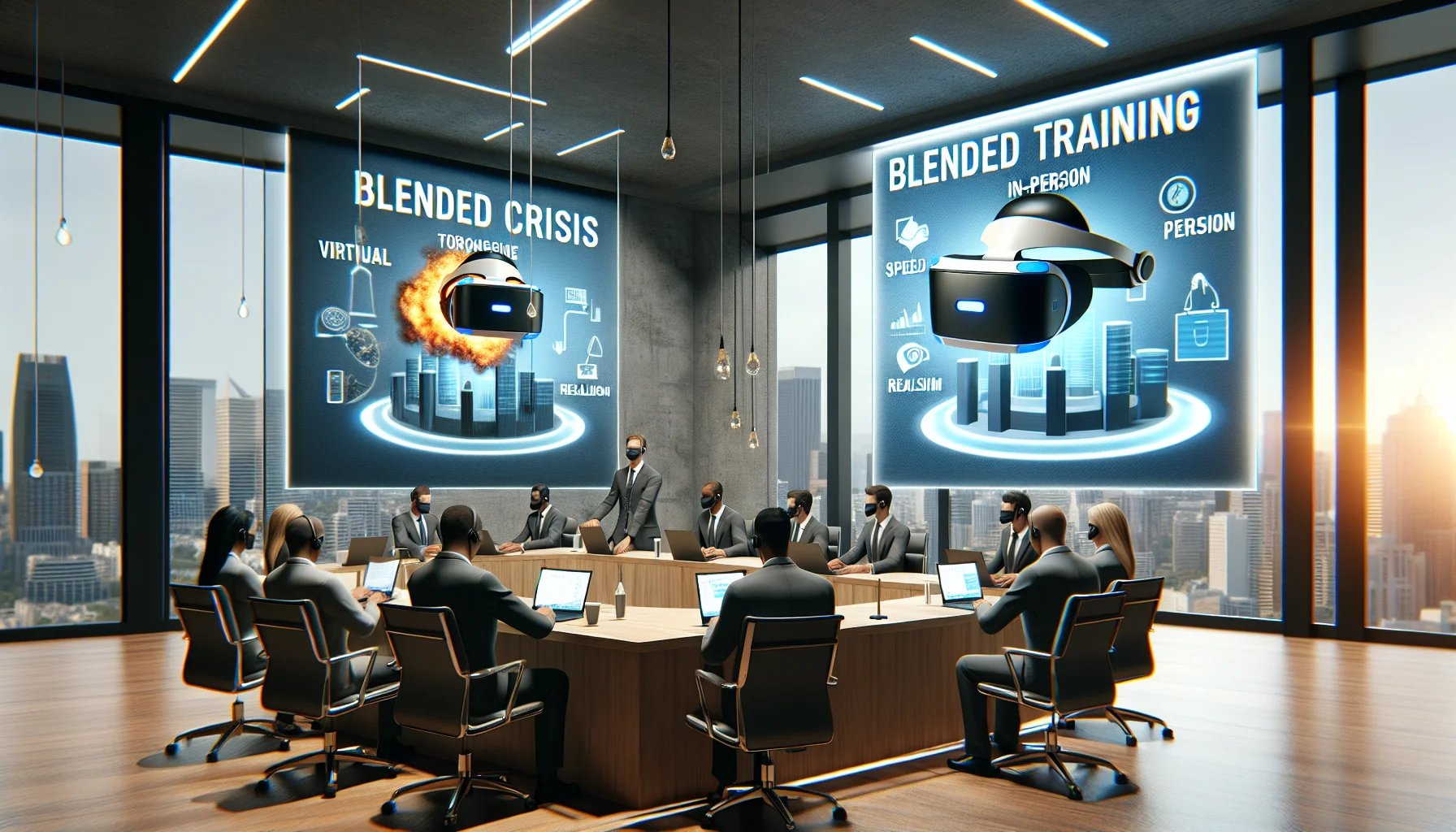
This article compares virtual, in-person and blended crisis training across speed, realism, reach, cost and assessment fidelity, and concludes blended crisis training is the pragmatic default when speed and fidelity matter. It includes a decision matrix, role-based mixes, sample schedules, cost/time trade-offs, and a 6–8 week pilot checklist with metrics.
 Business Strategy&Lms Tech
February 3, 2026
This case study shows how a metropolitan hospital used generative AI to automate emergency response simulations, enabling weekly short drills, automated injects, and real-time scoring. Over six months mean time-to-decision dropped 36% and protocol adherence rose to 84%, while drill frequency increased tenfold. Practical templates and implementation tips are included.
Workplace Culture&Soft SkillsFebruary 4, 2026
Practical roadmap for decision makers to build and measure soft skills for crisis. The guide outlines five core competencies—communication, decision-making, emotional intelligence, adaptability, psychological safety—and a three-tier assessment approach, modular training (microlearning, simulations, coaching), process embeds, KPIs, and a sample 90‑day implementation plan to drive measurable improvement.