

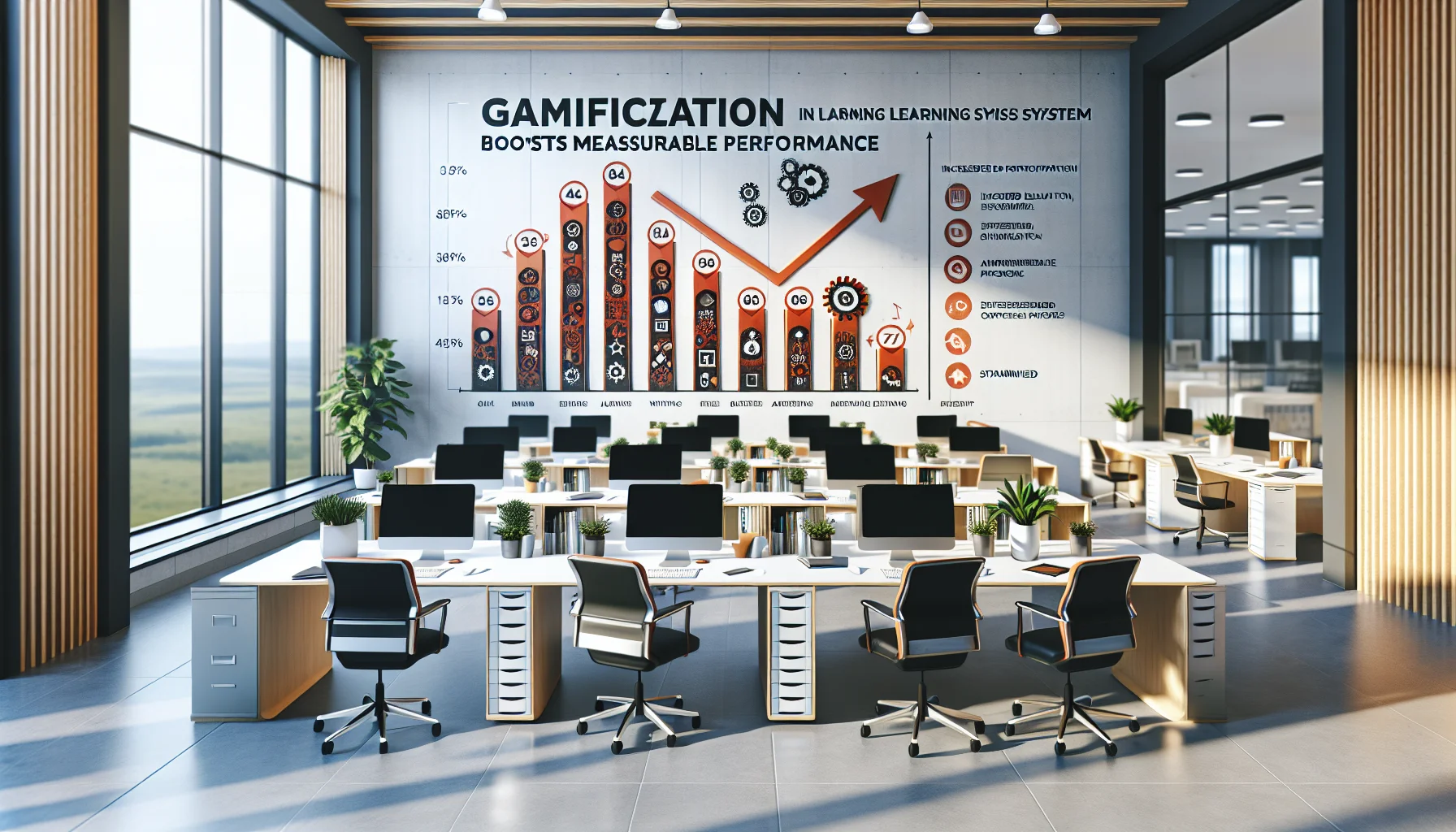
This article explains how the future of gamification LMS combines AR, VR and AI to create immersive, personalized learning that improves retention and speed-to-competency. It outlines pilot design, privacy and infrastructure challenges, three visionary use cases, and a pragmatic three-year adoption roadmap with budget and governance recommendations.
Future of gamification LMS trends are shifting from simple badges and leaderboards to immersive, adaptive learning journeys. The combination of AR gamification LMS modules, VR learning gamification scenarios and AI gamification personalization engines creates a continuous learning loop that sustains engagement and improves outcomes. This article examines near-term innovations, implementation choices, technical and ethical trade-offs, practical use cases, and a clear three-year roadmap institutions can follow to adopt these capabilities responsibly.
Market signals reinforce the shift: analysts expect the broader gamification and immersive learning market to grow as enterprises invest to improve retention and on-the-job performance. Organizations that adopt the future of gamification LMS early—while focusing on measurable outcomes—capture disproportionate gains in skill velocity and engagement.
The future of gamification LMS centers on three converging technologies: augmented reality overlays, immersive VR scenarios, and AI systems that personalize challenge and feedback in real time. Modern platforms embed gameplay mechanics directly into content workflows so progress, feedback and adaptive difficulty are seamless rather than bolted on.
AI gamification personalization enables dynamic sequencing, real-time competency mapping, and micro-rewards tuned to learner state. An AI layer can detect plateaus and adjust challenge, suggest peer collaboration, and generate targeted mini-games for remediation. Studies report retention and proficiency gains often in the 10–30% range when adaptive learning is paired with timely feedback.
Typical AI stacks mix learner modeling (Bayesian or deep knowledge tracing), reinforcement learning for pacing, and transformer-based generators for scenario variation. Models can run centrally or at the edge for low-latency personalization. Privacy-preserving techniques—differential privacy, federated learning, and local inference—are increasingly important as platforms balance personalization with compliance.
AR gamification LMS overlays contextual tasks into physical spaces—technicians can see interactive checklists on equipment—while VR learning gamification creates risk-free simulations for soft skills and hazardous procedures. Combined with game mechanics (progression, scarcity, narrative), they produce emotional resonance traditional modules rarely achieve.
Beyond visuals, haptics, spatial audio, and collaborative virtual spaces deepen immersion. The question of how AI and AR will change gamification in learning platforms centers on blending adaptive narrative with context-aware prompts—so the system not only knows what to practice but when and where to prompt real-world application.
Implementing the future of gamification LMS requires a phased approach balancing pedagogy, technology and operations. Effective rollouts start with clear learning objectives and mapped competencies, then select pilots that maximize ROI while minimizing production complexity.
Choose 1–2 high-impact workflows—onboarding, compliance simulations, or sales role-play. Build a minimum viable product pairing a short VR module or AR overlay with AI-driven adaptive scoring. Track engagement and skill transfer using pre/post assessments and behavioral analytics.
Operationally, integrate with your LMS via xAPI and an LRS to capture granular events, maintain a single source of truth for competency frameworks, and ensure content pipelines support glTF or USDZ 3D assets. Define pilot metrics—time-to-competency, error-rate reduction, learner NPS, and ROI per learner month—to guide scale decisions.
Moving toward the future of gamification LMS raises technical and governance challenges: device management, edge computing for low latency, 3D content pipelines, and scalable AI inference. Detailed behavioral logs that power personalization also create privacy risk.
Design teams must minimize data collection, apply differential privacy where possible, and be transparent about what behavioral signals personalize experiences. Ethical design means avoiding manipulative mechanics—gamification should support autonomy and competence, not exploit biases for metric-driven engagement.
Design for learner agency: personalization should increase choice and support, not nudge users toward behaviors that only serve metrics.
Operationally, keep latency under 20–50 ms where motion sickness is a risk, and plan device lifecycle management—battery care, sanitation for shared headsets, and accessibility features such as captions and alternate inputs. Prepare for algorithmic audits and give learners control panels to opt in/out and review what data influences their path.
To see the future of gamification LMS in action, consider three scenarios that illustrate potential and limits.
Technicians wear AR glasses that overlay stepwise instructions and inject mini-challenges—identify the faulty component within a time window to earn rewards. AI evaluates hand motions and suggests refresher micromodules when patterns indicate weakness. Pilots have shown 30–40% faster onboarding for common routines when AR guidance is combined with targeted remediation.
Managers enter VR role-play to practice difficult conversations. Branching narratives adapt based on decisions; AI-driven NPCs evolve across sessions. Narrative progress and skill badges replace simple trophies, tying to measurable behavior change and downstream improvements in team engagement.
Clinicians rehearse emergency protocols in VR with gamified debriefs revealing micro-skill gaps. AR overlays during rounds prompt checklists and safety challenges that reduce procedural errors. Integrated with electronic health records, these approaches can improve patient safety and reduce risk.
Efficient L&D teams often use platforms that automate analytics, content pipelines and deployment—allowing them to focus on pedagogy rather than orchestration.
| Capability | Primary Benefit | Typical Investment |
|---|---|---|
| AR gamification LMS | Contextual transfer to job | Medium (content, devices) |
| VR learning gamification | Safe deliberate practice | High (simulation fidelity) |
| AI gamification personalization | Scalable adaptive learning | Medium-High (data, models) |
Adopt the future of gamification LMS with a timeline aligned to capability and budget. A pragmatic three-year plan focuses on outcomes, not tech for tech's sake.
Budget guidance: allocate 15–25% of modernization spend to pilots (Year 1), 40–60% for production scaling (Year 2), and 15–25% for model maintenance, asset libraries and governance (Year 3). Shift budget from one-off productions toward reusable asset libraries and model upkeep. Key milestones include pilot success metrics, security certification, device management maturity, and measurable business performance improvements.
To avoid stranded investments, prioritize modular architectures, open 3D asset standards, and AI models that can be retrained with new data. Designing for composability—small adaptive modules that recombine—protects value as platforms evolve.
Don’t equate flashy VR with impact. Avoid monetizing engagement metrics that encourage shallow interactions. Ensure instructional designers lead feature decisions, not only engineers or marketers. Prefer vendors supporting OpenXR for portability, choose ONNX-compatible models for runtime flexibility, and use feature flags and A/B tests to validate game mechanics before broad rollouts. Maintain version control for 3D assets and include accessibility testing in QA.
The future of gamification LMS is multidisciplinary: learning science, immersive tech, and responsible AI must converge. Organizations that start with clear competency outcomes, protect learner privacy, and adopt a staged roadmap achieve the most sustainable gains. Emerging trends gamification in LMS will continue to push boundaries, but winners will balance innovation with measurable outcomes and ethical safeguards.
Begin with a small, measurable pilot pairing AI personalization with a single AR or VR scenario, measure transfer, then scale iteratively. Assemble a cross-functional steering team, define three measurable success metrics, and schedule a six-week prototyping window.
CTA: Start your pilot: define one competency, choose a small cohort, and run a six-week AR/VR + AI experiment to validate impact and cost assumptions. That experiment will answer the critical questions of transfer, scalability and learner acceptance—revealing whether the investments align with your strategic learning outcomes.
The Upscend Team provides actionable insights on technology and business strategy.
Book a walkthrough and we'll show you how it applies to your own content.
 L&D
L&DDecember 21, 2025
This article explains how LMS gamification uses mechanics like badges, progress bars, and optional leaderboards to increase engagement, completion, and job performance. It provides a four-phase pilot roadmap—define objectives, prototype, pilot, scale—plus design patterns, platform tips, pitfalls, and measurement strategies to tie gamified learning to business outcomes.
 L&D
L&DDecember 21, 2025
This article explains why gamification in LMS raises engagement, completion, and retention when aligned with instructional design. It outlines effective game mechanics — badges and leaderboards, progress bars, timed challenges — and provides a 6-8 week pilot checklist, measurement tactics, and common pitfalls to avoid. Use metrics to verify learning transfer.
 General
December 22, 2025
This article explains how LMS gamification and gamified learning transform courses into practice-focused experiences. It outlines core game mechanics (points, badges, leaderboards), design patterns, a phased rollout checklist, measurement tiers, and real corporate examples showing measurable gains such as faster ramp times and improved recall. It recommends piloting with clear success metrics.
 Lms
LmsDecember 24, 2025
This article explains why gamification LMS succeeds across sectors and outlines practical design patterns — progress systems, micro-challenges, leaderboards, and badges — that increase engagement and skill transfer. It recommends a staged rollout: define outcomes, run a 4-week pilot, measure return rate and on-the-job performance, then iterate using cohort analysis and learner feedback.